
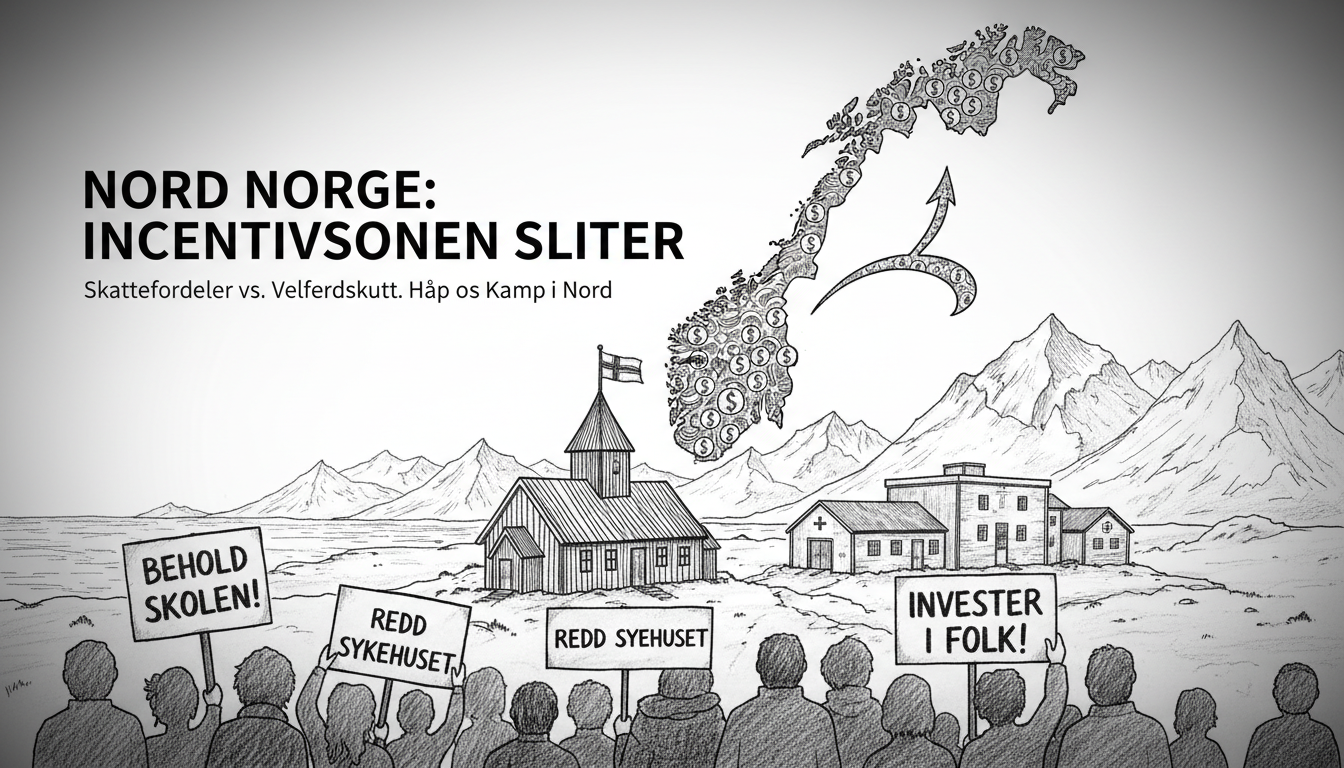
A major government program in Northern Norway aims to reverse population decline with financial incentives. The 'Incentive Zone' offers tax breaks and benefits to attract young families and workers. Yet residents report a frustrating paradox. They receive support while watching essential services disappear. The region's strategic importance is growing, but its communities are shrinking.
The Incentive Zone covers municipalities in Finnmark and North Troms. Anyone living and working there for at least 12 months can access benefits. These include student loan reductions of 60,000 kroner per year, free kindergarten, and increased child benefits. Businesses get a full exemption from employer's national insurance contributions, a significant saving compared to rates of 5.1 to 14.1 percent elsewhere.
Bård Bendik Grøtta Fanghol and his wife Rakel moved to Nordreisa after studying in Bergen. 'The benefits gave us a push. It was attractive in the startup phase after studies,' he said. 'Together we save about 150,000 a year.' They appreciate the trust and community influence found in small places. 'The road from being a newcomer to being able to influence how society and everyday life is shaped is an important and exciting part of living here,' he noted.
Despite the personal financial advantages, the couple highlights a critical flaw. They are constantly fighting cuts to maternity wards, high school education, and transport links. 'We cannot develop our society and build something new because we use all our time fighting closure,' Bård Bendik explained. 'It is a fight to keep what we have, instead of working to develop it.' He points to increasingly poor flight connections and minimal bus services as major concerns. The airport, seen as a lifeline, is being steadily reduced.
Official population projections paint a bleak picture for North Troms. By 2050, while Troms county is projected to grow by 3.5 percent, North Troms faces a 6.1 percent reduction. A recent economic barometer for Northern Norway confirms the challenge. It states that while current measures help maintain the population, they do not increase it. The report also underscores the region's shift from periphery to strategic hub, driven by its role as a supplier of food, energy, and minerals to Europe.
Conservative MP Erlend Svardal Bøe argues for a more comprehensive approach. 'For a long time, the focus has been on the person-oriented measures in the incentive zone; lower tax and other measures that are very good,' he said. 'We must look more at society-oriented measures.' He stresses that with the current security policy situation, having people in the north to safeguard Norwegian interests is more important than ever. He calls for investment in reliable flights, good health services, and lower taxes for both people and businesses, criticizing current efforts as a 'patchwork policy.'
Emil Raaen, State Secretary for the Ministry of Local Government and Regional Development, disagrees. He points to the government's new Northern Region Strategy. This plan includes a major defense boost with over 50 billion kroner in investments and more than 1,700 new jobs in Northern Norway over the next ten years. Measures aimed at individuals will total 2 billion kroner in the coming fiscal year. Raaen stated there will be no changes to the support for Nordreisa municipality.
The situation reveals a clear disconnect. National strategies focus on broad security and investment. Local realities are about keeping schools and maternity wards open. For families like the Fanghols, and the other newcomers at Bård Bendik's office who hail from Oslo, Bergen, and other parts of Norway, the equation is simple. Financial incentives attract people, but only sustained investment in core public services will make them stay and build a future. The success of Northern Norway's repopulation efforts hinges on bridging this gap between high-level strategy and everyday livability.