
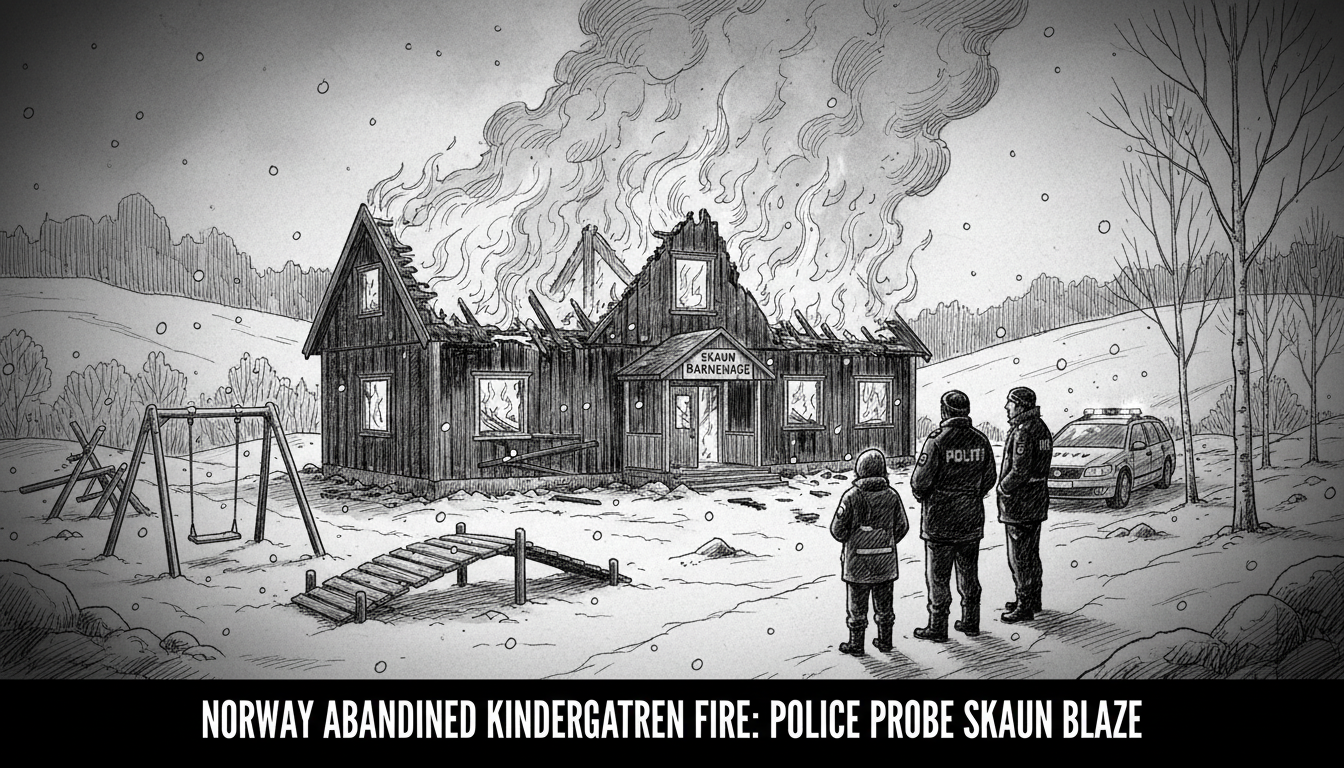
Norway's latest abandoned building fire has destroyed a former kindergarten in Viggja, sparking a police investigation into its cause and reigniting a national debate on derelict property risks. The nighttime blaze in Trøndelag county left the structure totally damaged, with fire crews preventing its spread to nearby homes. Local police are now working through multiple hypotheses for the ignition source at the disused Skaun municipality facility.
Flames Light Up the Night
Emergency services received the call in the early hours of Sunday morning. Residents reported seeing flames engulfing the single-story wooden building on the outskirts of the village. The Trøndelag Fire and Rescue Service responded with multiple units, containing the fire to the kindergarten structure alone. Operations leader Svein Helgetun confirmed the building was a total loss but assured the public there was no immediate threat of the fire spreading further. The building had been vacant for several years following the consolidation of local childcare services.
Police cordoned off the area as damp, charred timber smoldered in the daylight. Investigators in protective gear began their initial assessment of the site. A police spokesperson stated their work would proceed methodically, examining all possibilities from accidental causes to deliberate ignition. The remote location of the building, set back from main residential streets, is a key factor in their inquiry.
The Problem of Empty Structures
This incident highlights a persistent challenge for Norwegian municipalities, particularly in rural areas. Skaun, with a population just over 8,000, manages a portfolio of public buildings. When services are centralized or moved, older structures like the Viggja kindergarten often enter a state of limbo. Maintenance budgets shrink, and security can become an afterthought. Local councils must balance the cost of demolition, which can exceed 500,000 NOK, against potential future use or sale.
Fire safety experts point to abandoned buildings as significant community hazards. "An empty building is an attractive nuisance," explained Lars Holm, a risk assessment consultant based in Trondheim. "Without regular inspections, minor issues like faulty wiring can go unnoticed. More concerning is the risk of unauthorized entry. These structures can become gathering spots, and the chance of an accidental or intentional fire rises dramatically."
Holm emphasizes that simple, cost-effective measures can reduce risk. These include boarding windows, installing motion-sensor lights, and conducting monthly exterior checks. For many small municipalities, however, even these steps strain limited operational budgets.
A National Pattern of Neglect?
While this fire is localized, it fits a pattern seen across Norway. National fire registry data shows several hundred fires occur in non-residential buildings annually, with a portion categorized as "vacant or derelict." These fires often demand disproportionate resources from small volunteer fire brigades, common in regions like Trøndelag. They also pose environmental risks from burning materials and runoff from firefighting foam.
The political responsibility is clear, yet solutions are complex. Municipalities own the buildings, but national building and fire codes set the standards. "There is a gap in accountability for the lifecycle of a public building," said Storting representative Marius Arion of the Liberal Party, who sits on the local government committee. "We fund construction, but the long-term stewardship, especially for structures that have outlived their original purpose, needs a clearer framework. A fire like this in Viggja is a failure of that stewardship."
Arion suggests a review of state guidelines for decommissioning public property, potentially creating a fund to assist smaller communes with secure demolition. Opposition comes from those advocating for property repurposing and from historical preservation groups.
The Local Impact in Viggja
For the residents of Viggja, the fire is more than a policy debate. The building, though empty, was a part of the community's recent history. Several current parents attended the kindergarten themselves as children. Its loss, especially under mysterious circumstances, creates a sense of unease. Community safety meetings are likely in the coming weeks, with residents expected to demand more proactive management of other disused properties in the area.
The Skaun municipal chief administrator has pledged full cooperation with the police investigation. She also announced an immediate audit of all vacant municipal properties to assess their security and condition. This audit will evaluate fencing, lighting, and the integrity of doors and windows. The results could lead to a reallocation of municipal funds in the next budget cycle.
What Comes Next
The police investigation in Viggja will take precedence. Forensic teams will sift through the debris, looking for telltale signs of an ignition point. They will interview residents and check for any recent reports of suspicious activity in the area. The findings will determine if this becomes a criminal matter or is classified as an accident.
Broader implications will resonate in council chambers far beyond Trøndelag. This fire serves as a stark reminder that abandoned buildings are not merely eyesores but tangible liabilities. As Norway continues to modernize and centralize public services, the question of what to do with the leftover architecture grows more pressing. The charred shell of the Viggja kindergarten is a costly monument to a problem that can no longer be ignored. Will this incident finally prompt a coherent national strategy, or will communities continue to gamble with the safety risks lurking in their empty buildings?