
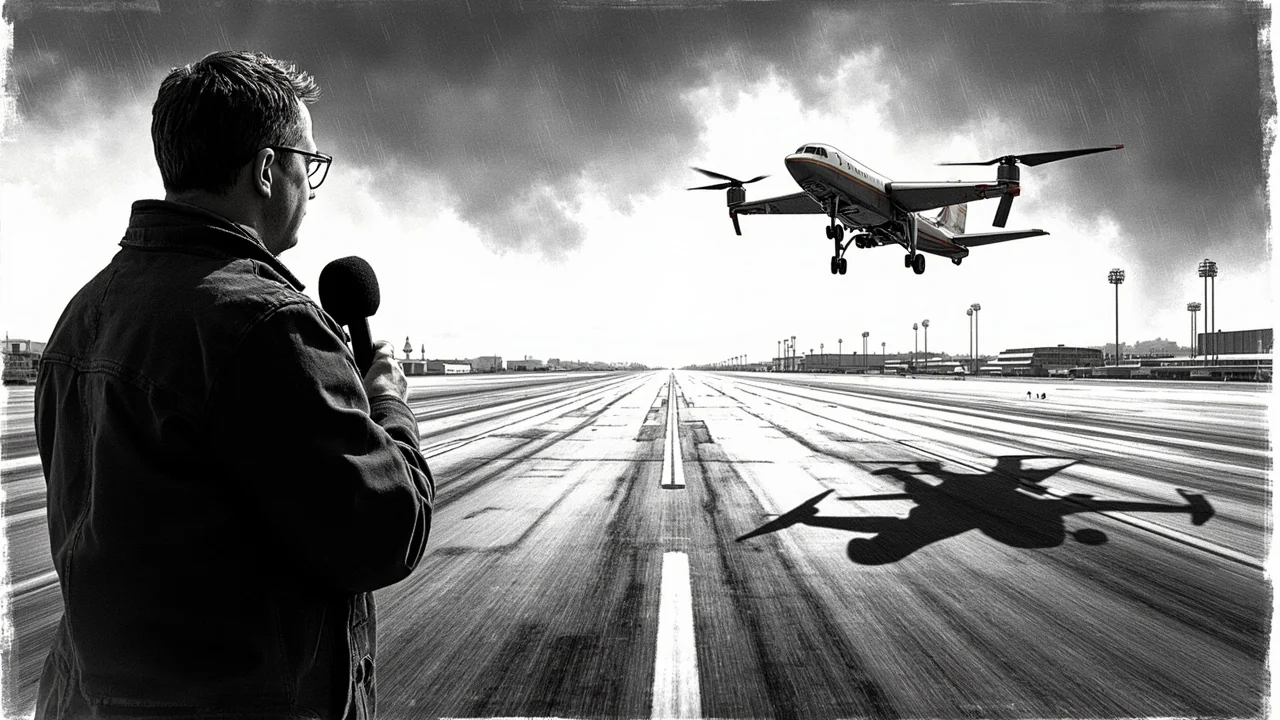
Norway's main international airport, Oslo Gardermoen, closed its eastern runway for over an hour on Tuesday following a confirmed drone sighting within its restricted airspace. The incident, reported by air traffic operator Avinor to police just after midday, triggered immediate security protocols and caused minor delays during a peak traffic period. Police launched a search for the drone operator on the ground, highlighting the persistent vulnerability of critical national infrastructure to unauthorized drone activity.
"We have observed and detected a drone within the prohibited zone at Oslo Airport," said police press officer Karoline Pedersen. The eastern runway was closed as a precautionary safety measure, she confirmed. While traffic was managed on the airport's other runway, the disruption came during a busy operational window. "We have had a period with quite a lot of traffic, so one can expect minor delays because of this," Pedersen added.
The event marks the latest in a series of drone incidents affecting Norwegian airports and sensitive sites, reigniting debates about regulatory enforcement and technological countermeasures. For a nation where aviation is essential for connecting its sprawling geography and Arctic territories, such intrusions represent a direct challenge to transport security and economic stability.
A Persistent Threat to Aviation Security
Drone incursions near airports are treated with extreme seriousness by Norwegian authorities due to the catastrophic risk of a collision with a passenger aircraft. A drone sucked into a jet engine or striking a cockpit windshield could cause a fatal accident. Norway's Civil Aviation Authority maintains strict regulations, prohibiting drone flights within a 5-kilometer radius of airport boundaries without explicit permission.
Despite these rules, violations occur with worrying frequency. Oslo Gardermoen, as the country's busiest hub, is a prime target for both reckless hobbyists and potentially malicious actors. Each incident forces a difficult calculation: balancing the immediate safety risk of a possible drone-aircraft collision against the economic and logistical disruption of shutting down runways. Tuesday's decision to close the eastern runway reflects a standard, safety-first protocol, but each closure costs airlines tens of thousands of euros in extra fuel from holding patterns and cascading schedule disruptions.
"The protocol is automatic and non-negotiable when a drone is confirmed in the zone," said a former Avinor security advisor, speaking on condition of anonymity. "The cost of a delay is nothing compared to the cost of a disaster. The real challenge is not the response, but prevention and rapid apprehension."
The Legal and Technological Battle
Norwegian police have strengthened their focus on drone-related crimes in recent years. The legal penalties for endangering air traffic can be severe, including substantial fines and imprisonment. Following Tuesday's incident, police units were deployed around the airport perimeter in an attempt to locate the pilot. However, finding an operator controlling a small drone from a concealed position, potentially kilometers away, remains notoriously difficult.
Technology offers partial solutions. Avinor and other airport operators have invested in detection systems designed to identify and track unauthorized drones. These can include radar, radio frequency scanners, and acoustic sensors. The statement from authorities that they had "observed and detected" the drone suggests such systems were in use. Yet, effective mitigation—safely disabling or capturing a rogue drone—is a more complex problem. Jamming signals or taking control of the device risks causing it to crash in an unpredictable manner, potentially creating new dangers.
Parliament has debated granting security forces broader authority to use counter-drone technology. Proposals include allowing targeted signal jamming in predefined, high-security zones like airport approaches. Critics argue such measures could interfere with essential communications and require careful legal frameworks. The ongoing incidents add urgency to these discussions in the Storting, Norway's parliament.
Economic and Operational Ripple Effects
The immediate impact of Tuesday's closure was described as minor delays. However, the term "minor" belies the knock-on effects in a highly synchronized global aviation network. A delayed arrival in Oslo can mean missed connections for passengers traveling to regional airports like Bergen, Trondheim, or Tromsø. For cargo operations, which are vital for Norway's offshore oil and gas industry and northern communities, even short delays can disrupt supply chains.
Oslo Airport is a central node for travel across the Nordic region and to the Arctic. Its smooth operation is critical for business, tourism, and the transport of goods to remote areas. Repeated security incidents, even those contained quickly, can gradually erode confidence in its reliability. Airlines factor in such risks when planning schedules and may eventually build in more buffer time, indirectly increasing costs.
Furthermore, these events consume significant security resources. Police manpower diverted to search for a drone pilot is manpower not available for other duties. Airport security teams must initiate incident protocols, distracting from other screening and monitoring tasks. The cumulative burden of multiple responses is a hidden cost of the drone threat.
A Broader Pattern of Airspace Intrusions
This incident is not isolated. In recent years, Norwegian authorities have dealt with drones flying near offshore oil platforms in the North Sea, over major military installations, and near other airports. The motivations vary widely: from simple curiosity and irresponsible recreation, to commercial photography, to potential industrial espionage or state-sponsored reconnaissance.
The Arctic, where Norway maintains a vigilant watch, has seen increased drone activity linked to research and strategic interests. The blurry line between civilian and dual-use technology makes it hard to distinguish a tourist's drone from a more sophisticated surveillance tool. This ambiguity complicates the response. An incident at a civilian airport like Gardermoen is treated as a public safety issue, but the same technology appearing near the Haakonsvern naval base or an offshore gas field raises immediate national security concerns.
This pattern underscores that drone management is not solely an aviation problem but a comprehensive security challenge. It requires coordination between the Civil Aviation Authority, the National Police Directorate, the Norwegian Armed Forces, and the Norwegian Intelligence Service. Information sharing about drone types, flight patterns, and recurring hotspots is essential to build a threat picture and deploy resources effectively.
Looking Ahead: Policy and Prevention
The recurring nature of these disruptions will likely prompt a political response. Members of the Storting's Transport and Communications Committee have previously called for stricter enforcement and public awareness campaigns. There are discussions about making geofencing—technology that uses GPS to automatically prevent drones from entering restricted zones—mandatory for all drones sold in Norway. However, determined operators can often disable these features.
Enhanced public education is another pillar. Many pilots may simply be unaware of the extensive no-fly zones around airports. Clearer signage in parks and residential areas near flight paths, combined with information in drone retail packaging, could reduce accidental violations. For intentional violators, the promise of swift prosecution and severe penalties is the main deterrent. The success of the police search in Oslo will be closely watched as a test of that deterrent effect.
Ultimately, the drone over Oslo Gardermoen is a symptom of a new technological reality. The accessibility of advanced drones puts powerful capabilities into the hands of the public, for better and for worse. Norway, with its vast airspace, critical infrastructure, and strategic location, must continuously adapt its defenses. The closure of a single runway is a temporary measure. The larger task is building a permanent, resilient system that protects the skies without grounding the innovation and utility that drones also bring. As one aviation analyst put it, "The genie is out of the bottle. We can't stuff it back in, so we must learn to live with it safely." The question for Norwegian authorities is whether current laws and technologies are sufficient for that task, or if Tuesday's disruption is a preview of more serious consequences to come.