
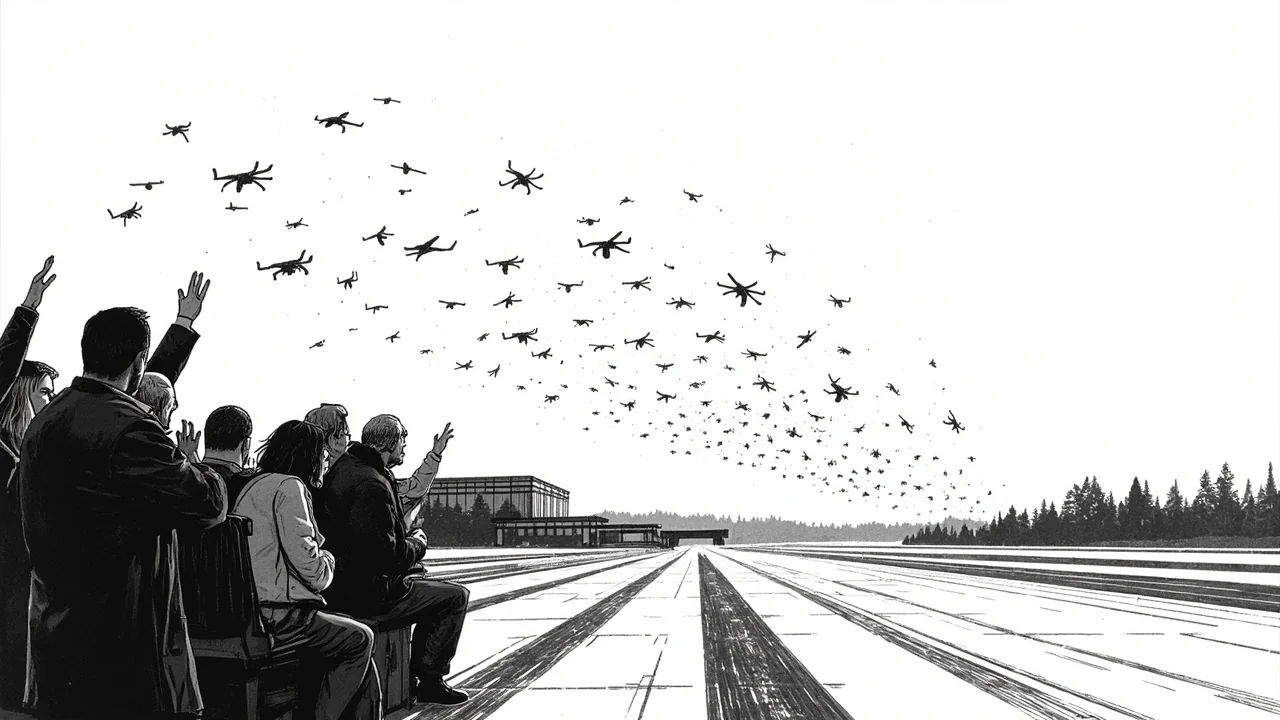
Norway's main international airport faced a critical security shutdown after authorities detected an unauthorized drone within its restricted airspace. The incident at Oslo Airport Gardermoen forced the closure of its eastern runway for over an hour, disrupting air traffic and triggering a police search for the operator. This event marks the latest in a series of drone-related security breaches that challenge Norway's critical infrastructure protection.
Airport operator Avinor confirmed the detection to police at approximately 2:30 PM local time. "We have observed and detected a drone within the prohibited zone at Oslo Airport," said police press officer Karoline Pedersen. Authorities immediately closed the eastern runway as a safety precaution, citing the severe risk drones pose to aircraft during takeoff and landing. The incident occurred during a period of high traffic, leading to minor delays across the airport's operations.
Police units were dispatched to the area surrounding the airport to locate the drone pilot. The search underscores the difficulty of apprehending operators who can control devices from kilometers away. The runway reopened just before 3:00 PM, but the security alert highlighted a persistent vulnerability. "We had a period with quite a lot of traffic, so one can expect minor delays because of this," Pedersen noted, downplaying the operational impact while emphasizing the serious safety implications.
A Recurring Threat to Nordic Aviation
This is not an isolated event for Oslo Airport or the Nordic region. Similar incidents have periodically paralyzed major airports, including a high-profile shutdown at London's Gatwick Airport in 2018 that affected 140,000 passengers. In Norway, drone sightings near Stavanger Airport Sola, a key hub for offshore oil traffic, have also raised alarms. The airspace around airports is a strictly enforced no-fly zone for drones, typically extending a 5-kilometer radius from the runway ends.
The threat is multifaceted. Even a small consumer-grade drone colliding with an aircraft engine can cause catastrophic failure. The potential for drones to carry explosive or hazardous payloads into secure areas adds a layer of national security concern. For a country like Norway, where aviation is essential for connecting its long, mountainous geography and supporting its offshore energy industry, reliable airport security is non-negotiable.
The Legal and Technological Countermeasures
Norwegian law prohibits drone flights near airports, over crowds, or above 120 meters without special permission. Violations can result in heavy fines and imprisonment. The Norwegian Civil Aviation Authority works with Avinor and police to enforce these rules. In response to increasing incidents, authorities have invested in detection systems. Many critical airports now employ radar, radio frequency scanners, and electro-optical sensors to identify unauthorized drones.
The challenge lies in mitigation. While detection technology is improving, stopping a drone in flight remains difficult. Jamming its control signals or using trained eagles or interception drones are methods used in some countries, but deploying them in busy airport corridors is risky. The preferred method is finding and arresting the operator, which often proves elusive. This incident will likely renew debate in the Storting about funding for more advanced counter-drone technology at national infrastructure points.
Implications for Norway's Security Posture
From my perspective covering Norwegian affairs, this event touches on several key policy areas: transport security, critical infrastructure protection, and technological regulation. Norway's expansive geography and sparse population make it heavily reliant on unimpeded air travel. The government in Oslo has prioritized the security of energy installations in the North Sea and Arctic research facilities, with drone incursions being a recognized threat.
The incident at Gardermoen, while resolved quickly, serves as a live-fire test of response protocols. It occurred not far from major government buildings in Oslo and key national assets. The efficiency of the response—closing the runway, initiating a search, and reopening swiftly—will be analyzed. However, the fact that a drone penetrated the zone undeterred until detection points to a preventative gap.
Energy analysts will note the parallel to offshore security. Norway's oil and gas platforms in the North Sea are also protected by extensive no-fly zones. A drone incident at a major airport raises questions about the robustness of these wider protective measures. The Storting's Standing Committee on Transport has previously called for a unified national strategy against malicious drone use, arguing that the threat transcends individual sectors.
The Human and Economic Cost of Disruption
While this shutdown caused only minor delays, the potential for greater economic damage is significant. Oslo Airport Gardermoen handles over 28 million passengers annually and is a vital hub for business travel connecting Norway to Europe and beyond. A prolonged closure would ripple through the economy, affecting tourism, business meetings, and high-value freight, including seafood exports. Norway's international reputation for efficiency and safety is also a commodity put at risk by such breaches.
For passengers, even "minor delays" mean missed connections, anxiety, and logistical headaches. In a nation where domestic flights are a necessity for many, reliability is paramount. The psychological impact of knowing that a single irresponsible actor can disrupt national infrastructure is also non-trivial. It erodes public confidence in the systems that keep daily life running smoothly.
Looking Ahead: Policy and Prevention
This incident will almost certainly prompt reviews within Avinor and the Norwegian Police. Key questions will focus on detection capabilities: Was the drone spotted visually or via technology? How long was it in the zone before detection? Could its flight path be traced to an origin point? The answers will inform future investments.
From a legislative standpoint, there may be calls to revisit penalties or to mandate geofencing technology—which uses GPS to prevent drones from entering restricted zones—on all drones sold in Norway. The balance between regulating a popular recreational activity and ensuring national security is a delicate one for Norwegian lawmakers.
The role of public education is also critical. Many drone pilots may simply be unaware of the extensive restrictions around airports. A renewed public information campaign, perhaps coordinated through electronics retailers and drone registration platforms, could prevent inadvertent violations. For intentional, malicious actors, however, only deterrence and detection will suffice.
Norway's approach to this modern security dilemma will be watched closely by its Nordic neighbors, who face similar challenges. As drone technology becomes more accessible and capable, the task of protecting the skies above our most important hubs only grows more complex. The brief closure of a runway at Gardermoen is a small warning sign—a reminder that in an interconnected nation, a single point of failure can have widespread consequences. The question for authorities in Oslo is not if another incident will occur, but when, and whether the response systems will be robust enough to manage an ever-evolving threat.