
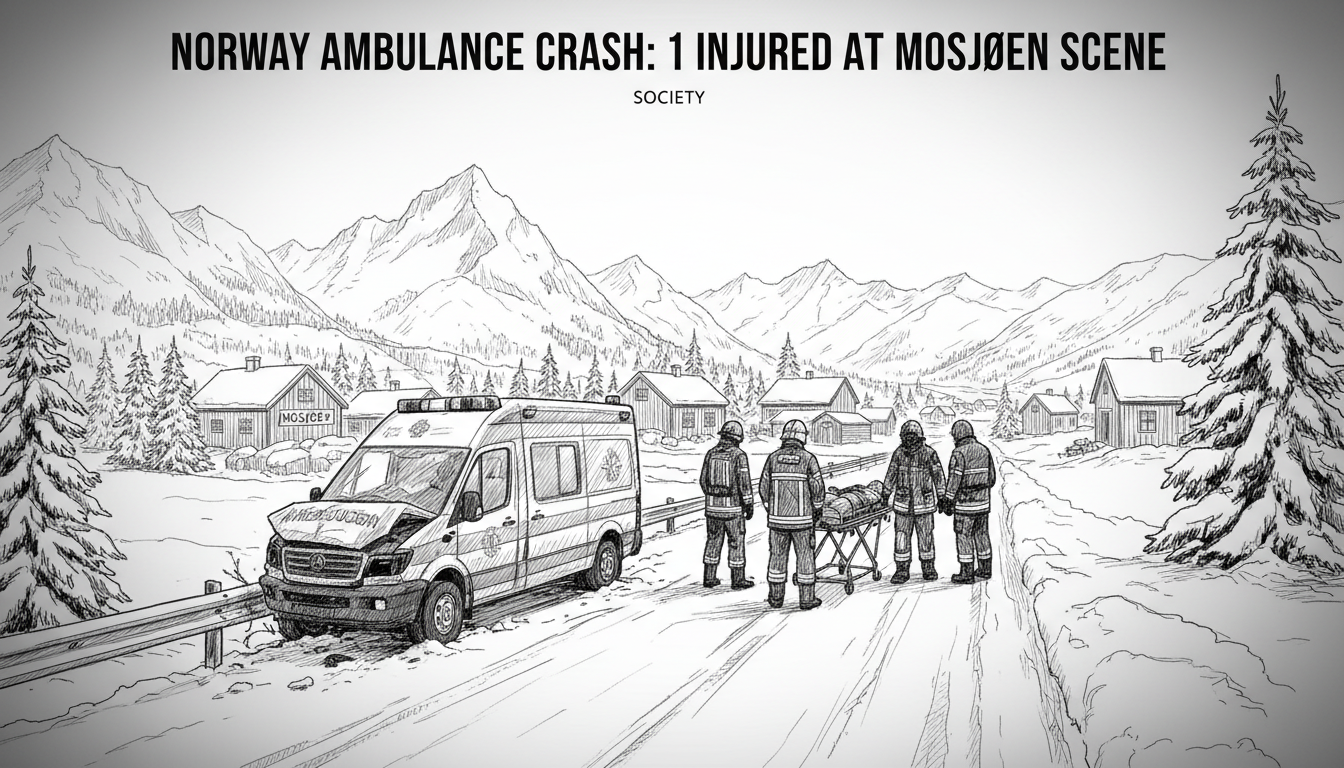
Norway road safety faces scrutiny after an ambulance responding to a crash was itself struck by another vehicle near Mosjøen. The incident occurred at Drevjamoen, 30 kilometers north of the town, while police and ambulance crews were working at the site of an initial traffic accident. One person was injured in the secondary collision and received medical care, according to police operations leader Stig Østbø.
This event highlights the persistent dangers emergency responders face on Norwegian roads. It raises immediate questions about driver awareness and the protection of personnel at accident scenes, even as national statistics show a long-term decline in traffic fatalities.
A Dangerous Scene Compounded
The sequence began with a standard traffic accident report. Police and an ambulance from Nordland emergency services arrived at Drevjamoen to assist. While personnel were engaged in their work, a separate vehicle collided with the stationary ambulance. The exact circumstances of the second crash are under police investigation. Officials have not released details on the speed or actions of the driver who hit the ambulance, nor the severity of the injury sustained by the person involved.
Emergency vehicles in Norway are marked with high-visibility reflective panels and use blue flashing lights to signal their presence. Norwegian traffic law mandates that drivers must slow down and, if possible, change lanes when approaching stationary emergency vehicles with activated warning lights. The law is clear on creating a safety buffer for those working on the roadside.
The High-Stakes Work of First Responders
Ambulance crews in Norway are typically staffed by paramedics or emergency nurses trained in advanced life support. Their role is critical in a country with vast rural distances and challenging weather conditions. Responding to traffic accidents is a core, and inherently risky, part of their duties. They must operate on often narrow roads, with traffic passing close by, while focusing on delivering urgent medical care.
"Every time we stop on a road, we are entering a high-risk zone," said a veteran paramedic from a southern region, who spoke on condition of anonymity as they were not authorized to comment on the specific incident. "Our lights are on, our vests are bright, but our backs are to traffic. We rely completely on the alertness and compliance of passing drivers. An incident like this is our worst fear realized while we're trying to help others."
This crash near Mosjøen is not an isolated event. Similar incidents, where emergency vehicles are struck at accident scenes or while responding with lights and sirens, are reported periodically across the country. Each one triggers internal reviews and discussions within emergency services about procedural safety.
Norway's Road Safety Paradox
The incident presents a paradox within Norway's generally strong road safety record. The country is a global leader in traffic safety initiatives, with ambitious 'Vision Zero' policies aiming to eliminate road deaths and serious injuries. Measures like stringent drunk-driving laws, extensive use of speed cameras, and investment in safer road infrastructure have yielded results.
Preliminary figures from the Norwegian Public Roads Administration (Statens vegvesen) show 117 road traffic fatalities in 2022, with 627 people seriously injured. While each number represents a tragedy, the long-term trend is downward. Compared to decades past, Norwegian roads are significantly safer.
Yet, the safety of those who respond to the remaining accidents is a persistent vulnerability. The statistics on accidents involving emergency vehicles are less frequently highlighted in national data, but they point to an ongoing occupational hazard. Experts argue that protecting responders is the next frontier in road safety.
Expert Calls for Layered Protection
Road safety researchers emphasize a multi-faceted approach to preventing secondary crashes at accident scenes. "Technology, law, and driver education must work together," explains Dr. Lena Larsen, a transportation safety researcher at the Institute of Transport Economics in Oslo. "The law requiring drivers to slow down and move over is essential, but compliance needs to be near universal."
Larsen points to potential technological aids, such as advanced warning systems that can alert approaching drivers of a stopped vehicle further ahead. She also stresses the importance of consistent public awareness campaigns. "Drivers can become de-sensitized to emergency lights or distracted. We need to regularly remind everyone that a flashing blue light means people are working in a vulnerable position just ahead. Their lives depend on your attention."
Some countries have implemented more robust physical barriers for roadside work zones, but for dynamic and unpredictable accident scenes, this is often impractical. The primary defense remains the behavior of the motoring public.
The Human and Systemic Cost
Beyond the immediate physical injury, an accident like this has cascading effects. The damaged ambulance is taken out of service for repair, straining regional emergency medical resources in Nordland county. The crew involved may experience psychological trauma, potentially affecting their readiness to respond to future calls. The investigation diverts police resources.
It also shatters the assumed safety of an emergency scene. For the public, it is a stark reminder that accidents create zones of ongoing danger long after the initial impact. For responders, it reinforces the need for constant vigilance, even when their primary focus is on providing lifesaving care.
The economic cost is also measurable. Repairing specialized emergency vehicles is expensive. Medical treatment, occupational sick leave, and potential long-term disability for injured personnel represent a significant public expense. Investing in prevention is far more cost-effective than managing the aftermath of such collisions.
A Look at Legal Consequences and Accountability
Norwegian road traffic law provides clear grounds for penalizing drivers who fail to exercise proper caution around emergency vehicles. The driver who struck the ambulance at Drevjamoen will likely face investigation for violations of the Road Traffic Act. Potential charges could relate to careless driving, failure to reduce speed appropriately, or not yielding to a stationary emergency vehicle.
The penalty depends on the investigation's findings regarding culpability and the severity of the outcome. It can range from substantial fines and license suspension to imprisonment for serious offenses, especially if grievous bodily harm was caused. The police investigation will seek to determine if speed, distraction, impairment, or road conditions were the primary factor.
This legal framework is designed to enforce accountability and deterrence. However, experts like Dr. Larsen note that the fear of punishment is less effective than ingrained safe driving habits. "The goal is not to punish more drivers," she says. "The goal is to have zero drivers put responders at risk in the first place. That requires a cultural shift where protecting them becomes an automatic driver reflex."
Moving Forward: A Community Responsibility
The crash near Mosjøen serves as a critical, if unfortunate, case study. It will likely be examined in detail by the local police, the emergency service provider, and national safety bodies. Recommendations may follow regarding crew positioning, vehicle lighting patterns, or the use of additional warning signage.
Ultimately, the solution extends beyond protocols and technology. It rests on a shared societal commitment. Every driver in Norway holds a responsibility not just for their own safety, but for the safety of those who respond when things go wrong. The blue flashing lights are not just a signal to clear a path; they are a signal to activate heightened awareness and caution.
As the investigation into the Drevjamoen incident continues, the core question remains: How can a society celebrated for its safe roads better protect the men and women who deal with the consequences when safety fails? Their next emergency stop could be on any road, in any weather, at any time. The nation's vigilance is the primary safeguard they have.