
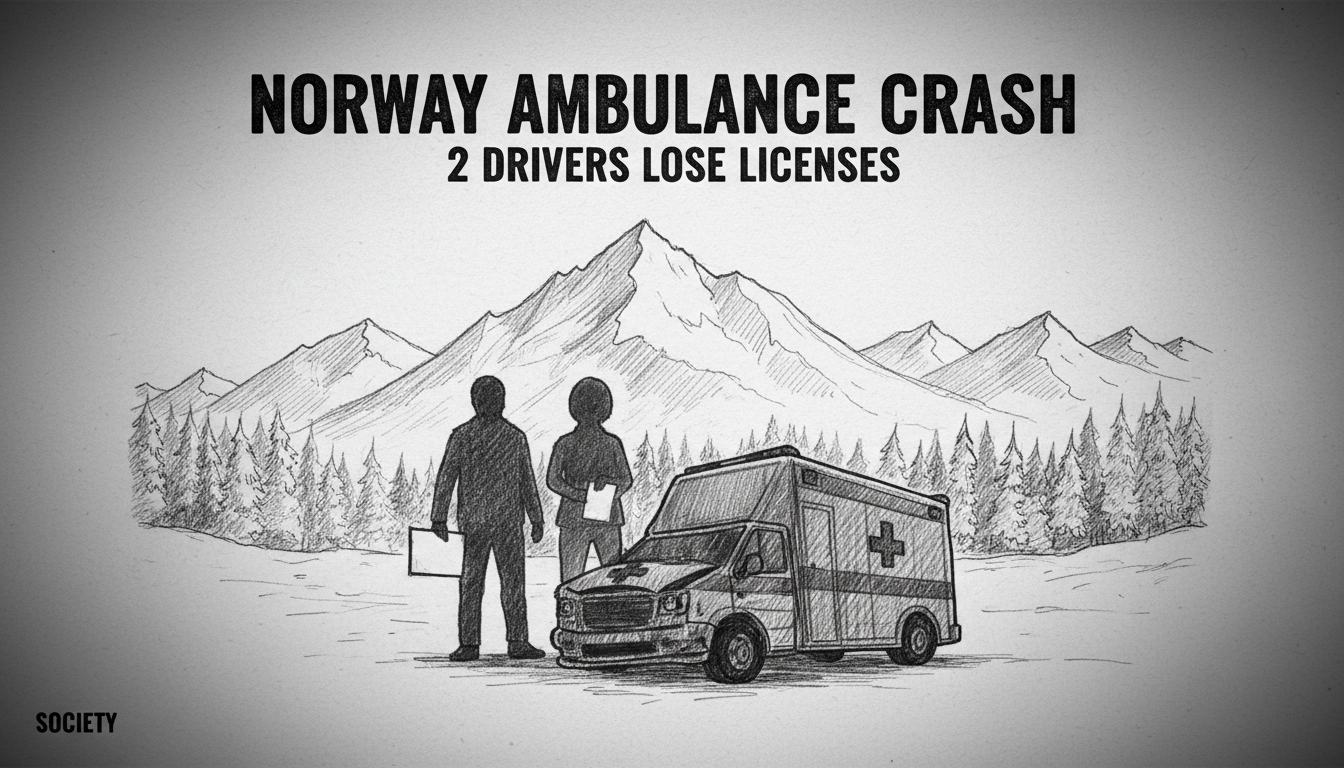
Norway road safety faces scrutiny after a dramatic chain-reaction crash in Nordland left an ambulance damaged and two drivers without their licenses. The incident on National Road 78 near Drevjamoen saw emergency responders become victims themselves when a vehicle transporter skidded into their ambulance at a T-junction.
Operational leader Stig Østbø described a scene of heavy snowfall and treacherous ice. "He couldn't manage the turn and hit the ambulance," Østbø said of the transporter driver. The crash occurred while police and ambulance crews were already attending to a separate accident where a car with a caravan had veered off the same road.
One ambulance worker sustained injuries requiring hospital treatment, though authorities confirmed they were not serious. Both the driver of the original crashed car and the driver of the vehicle transporter had their driving licenses temporarily confiscated by police. Traffic was reduced to a single lane past the accident site, causing significant disruption on this key Nordland route.
A Dangerous Sequence on a Critical Route
The double incident unfolded on Riksvei 78, a major arterial road in northern Norway. First, a car towing a caravan left the roadway, landing in a ditch. This routine winter callout turned dangerous when a second, much larger vehicle lost control. The vehicle transporter, a heavy truck designed to carry multiple cars, failed to navigate the T-junction in what Østbø confirmed were "dense snow showers and a slippery road surface."
This type of secondary collision, where emergency responders or other drivers crash at an existing accident scene, represents a particular danger in winter conditions. The flashing lights of emergency vehicles can create glare in snow, while reduced visibility and sudden traffic slowdowns catch following drivers unprepared. The temporary license confiscations are a standard police procedure in Norway when investigating serious traffic incidents, allowing authorities to immediately remove potentially impaired or reckless drivers from the roads.
Winter's Relentless Toll on Norwegian Roads
This crash near Vefsn municipality exemplifies the heightened risks of the Nordic winter driving season. Norway mandates winter tires from November 15 to March 31, but even proper equipment has limits. The term 'glatt føre' – slippery conditions – covers a range of hazards from black ice to packed snow, precisely the conditions reported at Drevjamoen.
Preliminary data from the Norwegian Public Roads Administration (Statens vegvesen) recorded 115 road fatalities in 2022. While this continues a long-term downward trend, single-vehicle departures and multi-vehicle collisions in poor weather remain stubborn challenges. Northern counties like Nordland, with longer winters and more remote, winding roads, often see a disproportionate share of such incidents.
"The mandatory winter tire period is a baseline, not a guarantee," explains traffic safety researcher, Dr. Ingrid Larsen, whose work focuses on Arctic road networks. "The critical factor is speed adaptation. A road's posted limit is for ideal conditions. During heavy snow, the safe speed might be half that. This is especially crucial for heavy vehicles like transporters, which have longer stopping distances and different handling dynamics."
The Human Factor in Emergency Response Risks
The injury to the ambulance worker underscores an occupational hazard often overlooked by the public. Paramedics and other first responders operate at the roadside, a high-risk environment even when stationary. Their vehicles, while equipped with reflective markings and warning lights, become large, fixed objects in unpredictable traffic flows.
Norwegian emergency services have protocols for securing accident scenes, including positioning vehicles to create a safety buffer. However, on narrow roads like sections of Riksvei 78, options are limited. The investigation will likely examine whether all available safety measures were deployed and if road conditions deteriorated faster than expected.
"Our crews train for these scenarios, but reality is often more complex," says a statement from the local health trust responsible for ambulance services. "When responding to one emergency, the last thing you expect is to become part of another. We are thankful the injury was not more serious and will review this incident to see if any procedural lessons can be learned."
Infrastructure and Behavior in the Arctic Climate
Beyond driver error, accidents like this prompt questions about road design and maintenance in harsh climates. T-junctions on major routes in snowfall areas can be accident hotspots if gradients or sightlines are problematic. The Norwegian Public Roads Administration constantly evaluates high-risk sections for improvements like better drainage to prevent ice, enhanced signage, or even realignment.
For drivers, the incident is a stark reminder of fundamental rules. The two-meter rule – maintaining a distance of at least two seconds to the vehicle in front, doubled in winter – is crucial. So is the practice of reducing speed significantly when seeing emergency vehicle lights, as there may be stopped traffic, people on the road, or, as in this case, a large ambulance partially blocking the lane.
Vehicle condition is also paramount. For commercial transporters, brake and tire checks are frequent and logged. The police investigation will verify the transporter's mechanical fitness and whether its tires met the Nordic winter tire standard, marked with a mountain/snowflake symbol.
A Broader Look at Nordic Winter Mobility
Norway's approach to winter road safety is among the world's most comprehensive, yet absolute safety remains elusive. Compared to its Nordic neighbors, Norway's more mountainous terrain and longer network of rural roads present unique challenges. Sweden and Finland have similar tire regulations and extensive use of studded tires, but Norway's geography often means dealing with more frequent and severe weather transitions along fjords and through mountain passes.
The economic cost of winter accidents is immense, factoring in emergency service deployment, medical care, infrastructure repair, and lost productivity. The social cost is measured in trauma and tragedy. Every such incident renews public debate about whether regulations are strict enough, if infrastructure investment is sufficient, and if driver education truly prepares people for the realities of a Norwegian winter.
As the investigation into the Drevjamoen crashes continues, the damaged ambulance serves as a metallic symbol of a system under strain. It represents the bravery of responders who work in dangerous conditions, the vulnerability of all road users when weather turns, and the constant balance Norway must strike between maintaining mobility and ensuring safety in one of the world's most demanding driving environments. Will this chain-reaction crash lead to changes on that stretch of Riksvei 78, or will it simply be recorded as another statistic in the long, cold battle between Norwegian drivers and winter?