
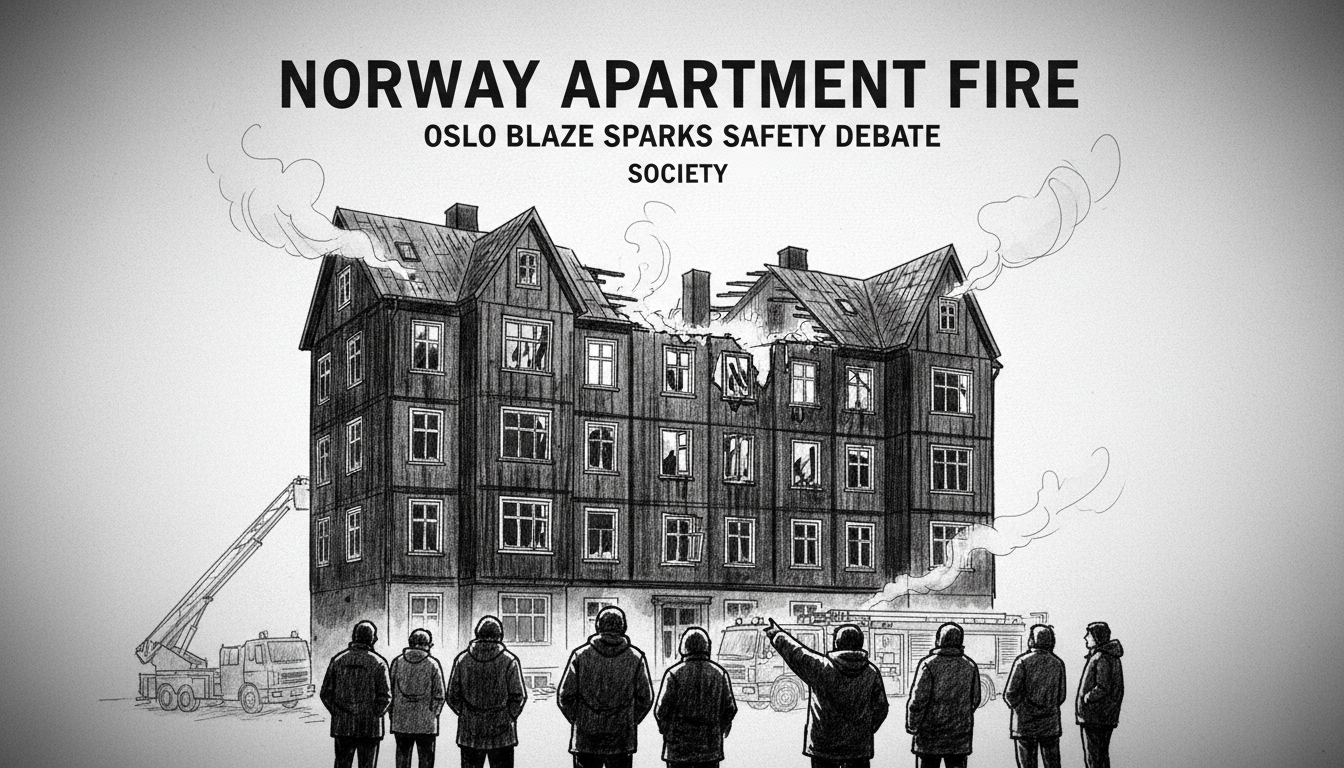
Norway's capital Oslo faced a stark reminder of urban vulnerability as emergency services rushed to a major apartment fire in the Skullerud neighborhood. The blaze, reported as a "full fire" in a single unit, drew a significant response from the Oslo Fire and Rescue Service and police. The incident at Skullerudskogen, a residential area bordering the Østmarka forest, highlights the persistent risks in densely populated urban housing despite Norway's stringent safety standards.
A Swift Emergency Response
Operational commander Bjarne Pedersen confirmed the severity of the situation shortly after the alarm was raised. "Patrols report a full fire in an apartment," Pedersen said in a statement. The call triggered a standard multi-agency response protocol. Fire crews from the Oslo Fire and Rescue Service arrived quickly to contain the flames and prevent horizontal spread to adjacent units. Police secured the perimeter, managed traffic, and assisted with any necessary evacuation. Initial reports indicated the fire was confined to one dwelling, a critical factor in limiting potential casualties and damage in the multi-story building.
The location in Skullerud presents specific challenges and advantages for responders. Situated in the borough of Østensjø, east of the city center, Skullerud is a mixed residential zone of apartment blocks and detached houses. Its proximity to the forest edge can influence wind patterns and access for large emergency vehicles. However, the well-developed infrastructure of the area allows for efficient deployment of resources. The response underscores the city's integrated emergency system, where police and fire services coordinate closely from the initial alert.
The Anatomy of an Urban Fire Risk
Apartment fires remain a primary concern for Norwegian safety authorities. The concentration of people and property in vertical structures creates a unique risk profile. Fire can spread through ventilation shafts, electrical conduits, and exterior cladding if not immediately contained. Modern Norwegian building codes, particularly those updated after significant fires in the past, mandate compartmentalization. This design philosophy uses fire-resistant walls and doors to create sealed units, theoretically containing a blaze for a critical period. The effectiveness of these measures depends on correct construction, maintenance, and resident behavior.
Older buildings, which constitute a substantial portion of Oslo's housing stock, may not fully comply with the latest regulations. Retrofitting these structures with modern sprinkler systems, smoke seals, and non-combustible materials is an ongoing and costly process. "Every fire is a test of the building's original design and subsequent upkeep," explains a fire safety engineer who consults for several Oslo housing cooperatives. "The goal is to provide residents with at least 30 minutes of protected egress time. In a 'full fire' scenario, that clock starts ticking the moment the first flame appears."
Resident Safety: The First Line of Defense
While structural measures are vital, expert consensus holds that resident awareness and preparedness are equally important. Norwegian law requires working smoke detectors in all homes, a simple device credited with saving countless lives. Fire safety campaigns consistently emphasize the importance of having a home fire extinguisher and knowing how to use it. More importantly, households are encouraged to have and practice an escape plan, identifying two exits from every room. In an apartment building, this means knowing the location of stairwells and understanding that elevators become death traps during a fire.
"The minutes before the fire service arrives are the most dangerous," says a senior instructor with the Oslo Fire and Rescue Service's prevention division. "What residents do—or don't do—determines the outcome. Closing doors behind you as you leave cuts off oxygen to the fire. Alerting neighbors is crucial. Staying low under smoke saves lives. These actions are not instinctive; they must be learned." Community drills in larger apartment complexes, though not universally mandated, are increasingly seen as a best practice. The Skullerud fire will likely renew calls for such local initiatives.
A Broader Look at Norway's Fire Safety Landscape
Norway generally enjoys an excellent fire safety record compared to international standards, a result of high-quality construction, widespread public education, and a professional emergency services sector. National statistics show a steady decline in fire-related fatalities over decades. However, each incident exposes potential weaknesses. Recent national debates have focused on the flammability of certain exterior cladding materials, electrical safety in aging homes, and the fire load created by modern furnishings, which often contain synthetic materials that burn hotter and faster than traditional wood and fabric.
Insurance data reveals that cooking-related incidents remain the leading cause of residential fires in Norway, followed by electrical faults and improper use of candles or fireplaces. The Skullerud incident's cause will be investigated by the Fire Investigation Service (Brannskadetjenesten), which will determine the origin and contributing factors. Their findings feed into national statistics and can inform future revisions to building codes and safety recommendations.
The Aftermath and the Path Forward
For the residents of the affected building in Skullerud, the immediate aftermath involves displacement, damage assessment, and dealing with insurance claims. The housing cooperative or building owner will be responsible for repairs, which must meet current fire codes. The emotional impact on residents, particularly those who lost their homes and possessions, can be profound. Community support networks, often strong in Norwegian neighborhoods, typically mobilize in such situations.
For city officials and safety advocates, the fire serves as a catalyst for review. It prompts questions: Were all safety systems in the building functional? Did residents receive adequate information? Is the frequency of mandatory inspections for common building systems sufficient? The Oslo Fire and Rescue Service routinely uses such incidents to evaluate its own response times and tactics, seeking continuous improvement.
Norway's commitment to safety is deeply ingrained, but it is not infallible. The Skullerud fire, while hopefully resulting in no serious injuries, acts as a cold, smoky reminder. It underscores that safety is a shared responsibility—a contract between builders, regulators, landlords, and residents. In a country famed for its security and order, the crackle of flames in an Oslo apartment is a sound that commands attention and demands vigilance. As the city expands and its buildings age, maintaining that vigilance is the ongoing challenge. The true measure of success is not just a fire extinguished, but a disaster averted, a lesson learned, and a community made more resilient.