
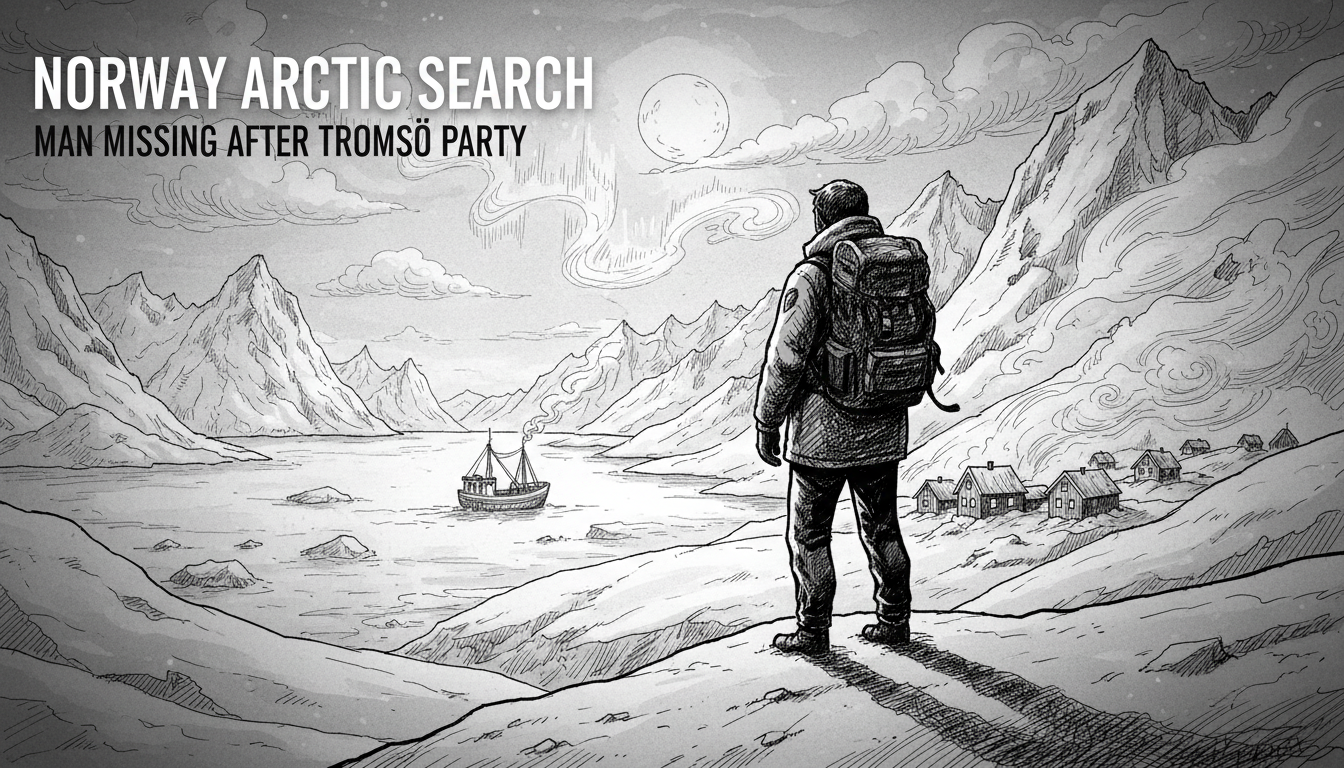
Norway police have launched a major search operation for a young man missing in Tromsø after he was last seen leaving a New Year's Eve party. The man was last seen on the island of Tromsøya around 11 PM on December 31, according to police operations leader Eirik Kileng. A coordinated search involving maritime, aerial, and ground teams is now underway in the Arctic city.
A Race Against the Polar Night
Tromsø, located 350 kilometers north of the Arctic Circle, experiences near-constant darkness in early January. The sun does not rise above the horizon from late November to mid-January, a period known as the polar night. Temperatures currently hover around -5°C (23°F), but wind chill from the Norwegian Sea can make conditions feel significantly colder. This environment creates unique and severe risks for anyone exposed without proper clothing or shelter. "The cold is an immediate and critical danger," said Lars Fjelldal, a former commander with the Norwegian Rescue Dogs association. "Hypothermia can set in rapidly, especially if a person is wet or disoriented. The darkness complicates everything, making visual searches extremely difficult."
The search operation reflects Norway's integrated emergency response model. Police are leading the effort with a fire department boat patrolling the harbors and coastline around Tromsøya. A police drone equipped with thermal imaging scans areas inaccessible to ground crews. Police dogs work along trails and urban edges, trying to pick up a scent. This core public service response has now been significantly expanded with volunteer organizations, a standard escalation in Norwegian search and rescue (SAR).
The Volunteer Network Mobilizes
Norway has a deeply rooted tradition of volunteer emergency response. The expansion of this search highlights that system in action. Personnel from Norsk Folkehjelp (Norwegian People's Aid) and the Norwegian Red Cross are now involved. These groups provide trained manpower for systematic ground searches, often covering large forested or coastal areas. The Norwegian Rescue Dogs association (Norske Redningshunder) deploys additional specialized dog teams. Perhaps most critically for a coastal city, the Norwegian Sea Rescue Society (Redningsskøyta) has joined the operation. Their vessels and crews are experts in searching fjords and shorelines, a vital asset given Tromsø's island setting.
This model of professional and volunteer integration is formalized through the Joint Rescue Coordination Centres (JRCC). "It's a force multiplier," explained Anja Olsen, a researcher at the University of Tromsø who studies Arctic safety protocols. "The police have the coordination authority and certain technical assets. The volunteer organizations bring massive manpower, local geographical knowledge, and specialized skills. In a vast, sparsely populated county like Troms, you cannot maintain effective 24/7 rescue coverage without this volunteer backbone." The volunteers are typically on-call and train regularly for scenarios ranging from mountain hiker rescues to maritime incidents.
The Challenges of an Arctic Search
Searching for a missing person in an Arctic winter urban environment presents a distinct set of challenges. Tromsøya is not a remote wilderness; it is a populated island with a city center, residential areas, university buildings, and patches of forest. It is connected to the mainland by the Tromsø Bridge and the Tromsøysund Tunnel. This complexity means search teams must cover a mosaic of environments: built-up streets where a person could seek shelter, dark alleyways, frozen shoreline, and wooded patches where footing is treacherous. The proximity to cold water adds a constant maritime hazard.
Thermal imaging technology from drones is less effective in urban areas due to heat signatures from buildings and vehicles. Police have not released details on the man's direction of travel or state of mind when he left the party, factors that would help narrow the search corridor. Without a clear last known point, teams must methodically grid the area. The clock is a critical factor. Survival time in wet clothing in near-freezing water is measured in minutes, not hours. On land, the progression of hypothermia accelerates as the body's core temperature drops.
Community and Context in the High North
Tromsø, with a population of about 77,000, is the largest urban area in Northern Norway. It is a vibrant hub for Arctic research, tourism, and fisheries. The community is accustomed to the harsh climate, but a missing person incident resonates deeply, especially during the holiday season. Social media in the region has been flooded with shares of the police announcement and messages of concern. Local news outlets are providing updates, though police have urged the public not to conduct their own searches, as this could disturb scent trails for the dogs or create safety risks for untrained individuals.
The incident underscores a broader reality of life in the Arctic. While Norwegians are generally well-prepared for the climate, the combination of social gatherings, alcohol, and extreme winter conditions can lead to acute danger. Most public buildings and homes are built to high insulation standards, but the outside environment remains unforgiving. City planning in Tromsø accounts for the darkness, with extensive street lighting, but shadows and unlit areas are inevitable.
A Look at Norway's Search and Rescue Philosophy
Norway's approach to search and rescue is considered one of the most effective in the world. It is built on the principle of total defense, where civilian and military resources are aligned, and on a strong societal value of collective responsibility. The state funds and coordinates the major assets like rescue helicopters and the JRCC, while supporting volunteer organizations through grants and equipment. Citizens receive basic first aid and outdoor safety education from a young age. This creates a resilient chain of response, from the individual who can provide initial aid to the professional helicopter crew performing a technical evacuation.
For the family and friends of the missing man, this operational philosophy is now a tangible reality. They wait while a small army of trained professionals and dedicated volunteers scour the island in the dark. Each team brings a piece of the puzzle: the drone's aerial view, the dog's nose, the rescue boat's sonar, the volunteers' thorough foot search. The goal is to cover every possible meter before time runs out.
As the search continues into the new year, it is a stark reminder of nature's dominance, even at the doorstep of a modern city. The Arctic does not compromise. The response it demands is one of precision, coordination, and unwavering persistence, qualities embodied in the teams now working through the polar night in Tromsø.