
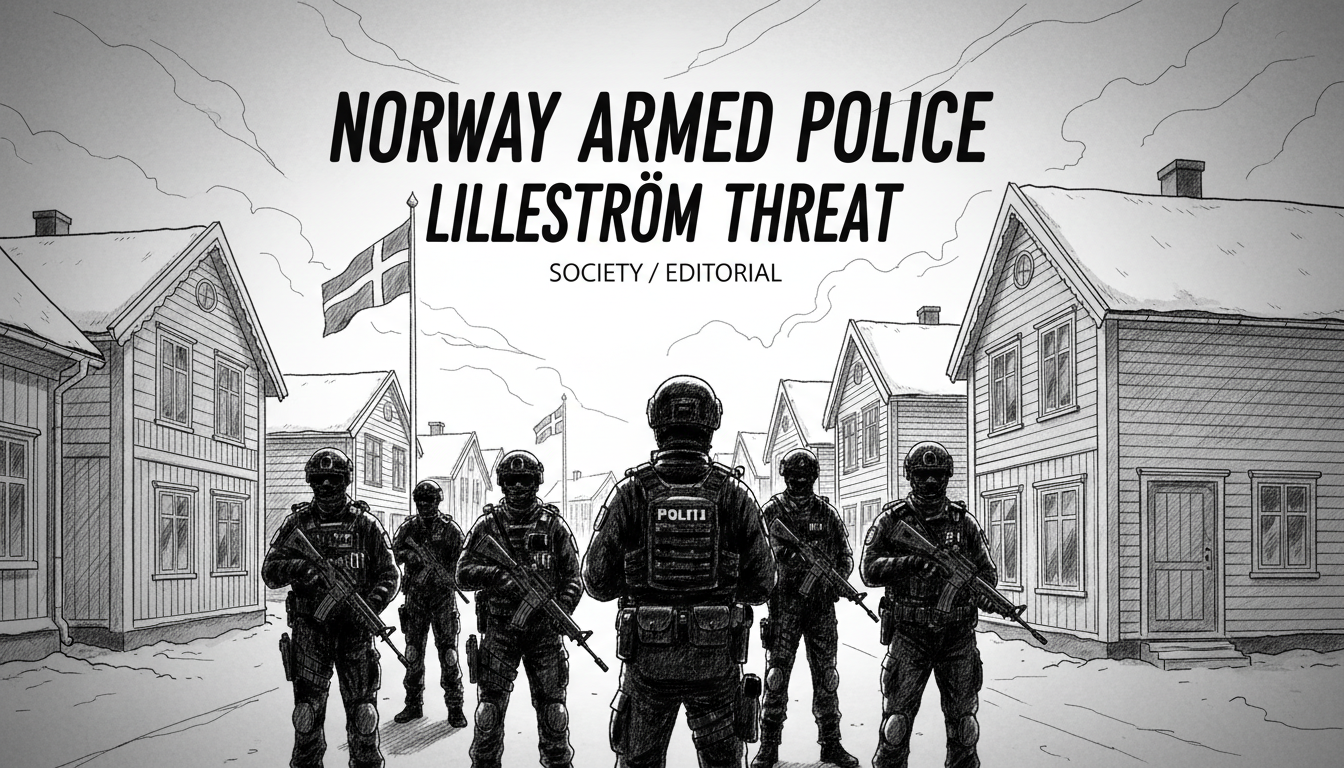
Norwegian police armed themselves and cordoned off a Lillestrøm address Tuesday evening, responding to what they called a serious threat situation. Officers, typically unarmed, were authorized to carry firearms as a precautionary measure, deploying what they described as large resources to the scene. Authorities urged residents to avoid the area immediately, highlighting the rarity of such visible police armament in Norway. This incident underscores the protocols activated when Norwegian law enforcement perceives a credible danger.
Armed Response in a Peaceful Town
Lillestrøm, a town of approximately 86,000 people in Akershus county, found itself at the center of an unusual security operation. Police vehicles blocked streets near the unspecified address, with armed officers establishing a perimeter. The response disrupted normal evening activities in this commercial and transport hub just northeast of Oslo. Witnesses reported a noticeable police presence, a sight that stands out in a country where officers routinely patrol without visible weapons. The operation continued for several hours as police assessed the threat.
Norwegian police do not carry firearms as standard equipment. Their weapons are stored securely in patrol vehicles. Authorization to arm officers requires a specific threat assessment from commanding superiors. The decision to deploy armed police in Lillestrøm signals that intelligence or reports pointed to a potential for violence. A police statement emphasized the action was preventive, aimed at ensuring public safety while they managed the situation. No arrests or injuries were immediately reported, but the investigation remained active.
Understanding Norwegian Police Protocol
The Norwegian Police Service operates on a principle of minimum force. Officers complete extensive de-escalation training. Drawing firearms is a last-resort measure, governed by strict guidelines. In 2021, Norwegian police used firearms in just 0.02% of all reported incidents, according to official statistics. This context makes the Lillestrøm deployment particularly significant. It reflects a shift from normal procedure to a heightened state of alert.
Such operations are coordinated through the East Police District, which oversees the Oslo region. Commanders must balance the need for a decisive response with the societal impact of seeing armed police. "The goal is always to resolve situations without violence," a senior officer explained in a past briefing on threat management. "Arming officers is a tool for protecting life, not an escalation." In Lillestrøm, the visible armament served as both a practical precaution and a clear signal of the perceived risk level.
Lillestrøm's Role and Community Impact
Lillestrøm is more than a quiet suburb; it is a key node in Norway's infrastructure. The town is a major railway junction connecting Oslo to other eastern regions. Its central station sees thousands of commuters daily. The municipality, formed in 2020 from the merger of Skedsmo, Fet, and Sørum, has grown into a significant commercial center. This threat situation temporarily put the rhythms of this hub on pause. Local businesses near the police cordon experienced disruptions, and public transport routes were altered.
Residents expressed a mix of concern and confidence in online forums. Many noted the unusual sight of armed police but praised the transparent communication from authorities. Norwegian police often use social media and official channels to provide updates during incidents, a practice aimed at preventing misinformation. The Lillestrøm event tested this system, with police advising people to follow official accounts for real-time information. This approach helps maintain public trust during volatile situations.
Expert Analysis on Threat Assessments
Security experts highlight that Norway's general threat level has been elevated in recent years. The Police Security Service (PST) regularly assesses risks from extremist groups and isolated actors. While Norway remains one of Europe's safest countries, police must prepare for rare but high-impact events. The Lillestrøm response fits within this framework. "When police visibly arm themselves in Norway, it indicates a specific, credible threat has been identified," said a university researcher specializing in Nordic security, who requested anonymity due to the ongoing case. "It is not done lightly. The assessment likely involved potential weapons or immediate danger."
The expert pointed to Norway's integrated response system. Police, emergency services, and local authorities coordinate closely. This incident likely triggered pre-established protocols for threat containment. The focus is on isolating the risk while minimizing public panic. The researcher added that such events, while alarming, demonstrate the system's capacity to adapt from a peacetime posture to a crisis response. The efficiency of this shift is critical for national security.
Public Safety and Strategic Communication
Communication is a cornerstone of Norwegian police strategy during incidents. By quickly advising people to avoid the Lillestrøm area, police aimed to create a safety buffer. This directive protects civilians and gives officers operational space. The armed presence also acts as a deterrent. Historically, most threat situations in Norway are resolved without shots fired. The 2011 terrorist attacks in Oslo and Utøya led to reforms in police armament and rapid response capabilities. Training and equipment have been enhanced since.
However, the psychological impact of armed police in communities is carefully considered. Norwegian society values proximity and accessibility in policing. Visible weapons can create distance. Police commanders are aware of this balance. In Lillestrøm, the decision prioritized immediate physical safety over normative appearances. As the situation developed, updates were issued to reassure the public that the threat was being contained. This transparency is intended to curb speculation and fear.
The Aftermath and Broader Implications
As the Lillestrøm operation concluded, police began investigating the source of the threat. Details remain scarce, but such incidents often involve reports of individuals making violent threats or possessing weapons. The judicial process will determine any charges. For the community, the event serves as a reminder that even peaceful regions are not immune to security risks. It also showcases the adaptability of Norwegian law enforcement.
Norway's model of generally unarmed policing faces constant evaluation. Events like this test its effectiveness. The system relies on accurate intelligence, rapid authorization, and disciplined officer training. The Lillestrøm response appears to have followed this model without major incident. Yet, it prompts questions about future preparedness. How will suburban centers like Lillestrøm integrate security planning with urban growth? Can Norway maintain its low-crime reputation while adapting to evolving threats?
The answers depend on continued investment in police resources and community engagement. For now, residents of Lillestrøm return to their daily routines, assured by a system that responded decisively. The sight of armed officers will fade, but the lessons from Tuesday evening will inform Norway's ongoing dialogue about safety, liberty, and the role of police in a changing world.