
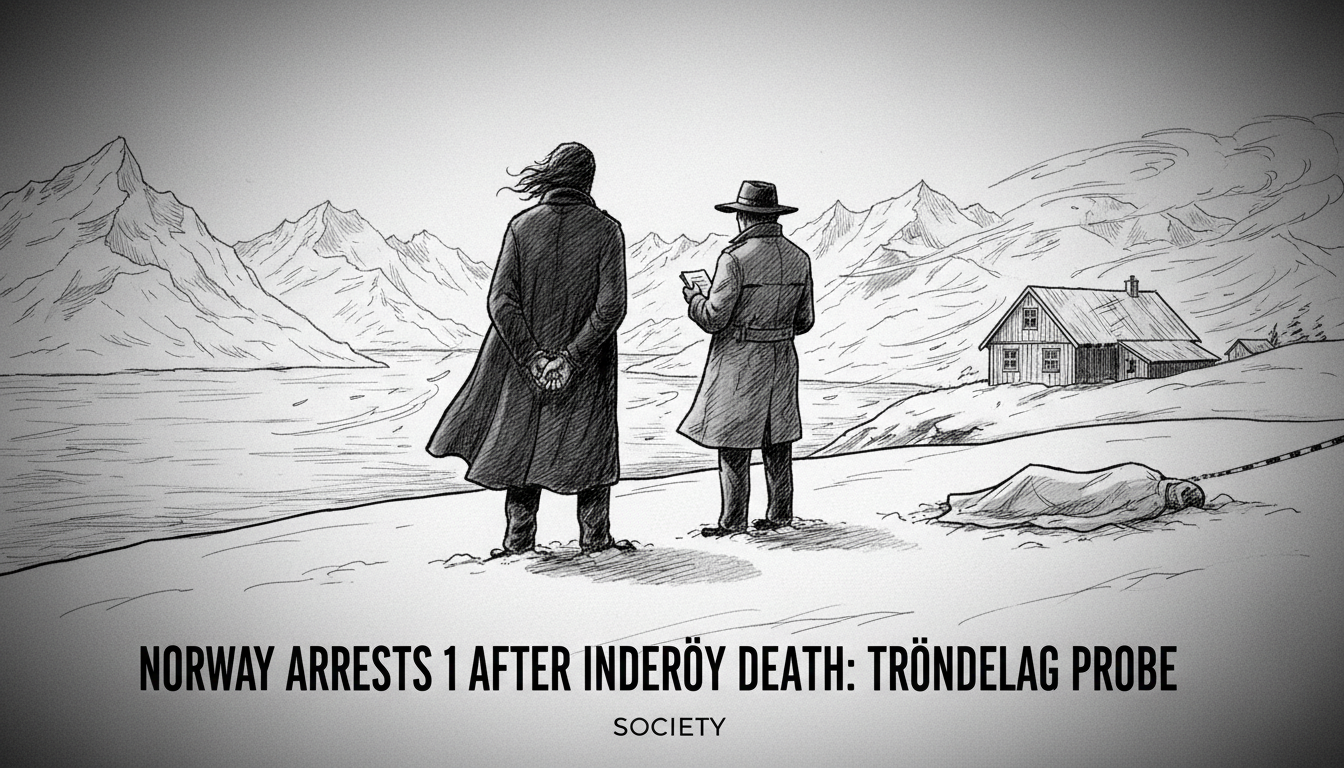
Norway's Trøndelag police have arrested one person after a body was discovered in the rural municipality of Inderøy on Sunday evening. The incident, reported to authorities at 17:20, has sent shockwaves through the quiet agricultural community and prompted a major investigation.
Police prosecutor Christian Spets confirmed the arrest in a statement. "The person who has been charged was apprehended at the scene," Spets said. He stressed the investigation remains in its early stages, with forensic teams and detectives working to establish the precise circumstances surrounding the death.
A Community in Shock
Inderøy, with its rolling farmland and picturesque views of the Trondheimsfjord, is not a place accustomed to violent crime. The municipality, part of the wider Trøndelag county, is home to a small, close-knit population. News of a death leading to an arrest spread quickly, unsettling residents who pride themselves on their region's safety and tranquility.
"Such events have a profound impact on small communities," said Dr. Lena Holm, a sociologist at the Norwegian University of Science and Technology (NTNU) in Trondheim. "Everyone is connected in some way. The sense of security, which is often taken for granted in rural Norway, is suddenly fractured. The police investigation will be scrutinized not just for facts, but for restoring that sense of order."
Norway consistently records one of the world's lowest homicide rates, typically around 0.5 incidents per 100,000 inhabitants annually. For context, Trøndelag county's population is approximately 480,000. A single violent death, therefore, represents a significant statistical anomaly and commands substantial police resources.
The Mechanics of a Norwegian Investigation
The police response in Inderøy follows a standardized yet meticulous Norwegian protocol for suspicious deaths. The scene would have been immediately secured by the first responders. The National Criminal Investigation Service (Kripos) may be called in to assist local police with specialized forensic analysis, depending on the initial findings.
A key focus will be determining the cause of death and the relationship between the deceased and the arrested individual. Norwegian law requires a formal autopsy in such cases, performed by a forensic pathologist. The police will also be conducting interviews with neighbors, family members, and potential witnesses to build a timeline of events.
"The emphasis is always on thoroughness over speed," explains former police prosecutor Erik Møller. "The initial arrest is based on a reasonable suspicion, but the work to compile evidence for the prosecution is exhaustive. The police will be examining phone records, digital footprints, and any prior interactions known to authorities. In a rural setting, the movements of people and vehicles are often more noticeable, which can aid the investigation."
The Broader Context of Crime in Rural Norway
While urban centers like Oslo see more frequent crime reports, incidents in rural areas present unique challenges and consequences. Policing vast geographical areas with limited personnel means initial response times can be longer, though Norway's integrated emergency system is highly efficient. The social fallout, however, can be more deeply felt.
Agricultural communities operate on familiarity and trust. A violent incident disrupts these social bonds, creating anxiety and suspicion that can linger long after the police tape is removed. Community support services, including local mental health teams and church groups, often mobilize quietly in the background following such tragedies.
From a policy perspective, this case will likely renew discussions about resource allocation for police districts covering large rural territories. It also touches on ongoing national debates about mental health services and social support networks outside major cities, which experts argue are crucial for preventative safety.
What Happens Next in the Legal Process
The individual arrested is being held on suspicion of a crime connected to the death. Under Norwegian law, they can be held in custody for an initial period before a court must review the detention. The police will continue their investigation to determine whether to press formal charges, which could range from manslaughter to murder, depending on the evidence of intent and circumstance.
The police prosecutor's office will lead the decision on charges, requiring a high standard of evidence. If charged, the case would eventually be tried in the Trøndelag District Court. The entire process, from investigation to potential trial, is characterized by a high degree of transparency and public access, though with strict protections for the privacy of those involved.
For now, the community of Inderøy is left waiting. The beautiful, stark landscape of Trøndelag in early spring contrasts sharply with the grim activity centered on a single property. The fields are being prepared for planting, a cycle of life continuing as authorities work to unravel a story of death.
This incident serves as a sobering reminder that no society, regardless of its peaceful statistics, is immune to sudden violence. The strength of the Norwegian system is now being tested not in Oslo's courthouses, but in the quiet fields of Inderøy, where the meticulous pursuit of justice must also begin the slow process of healing a community's trust.