
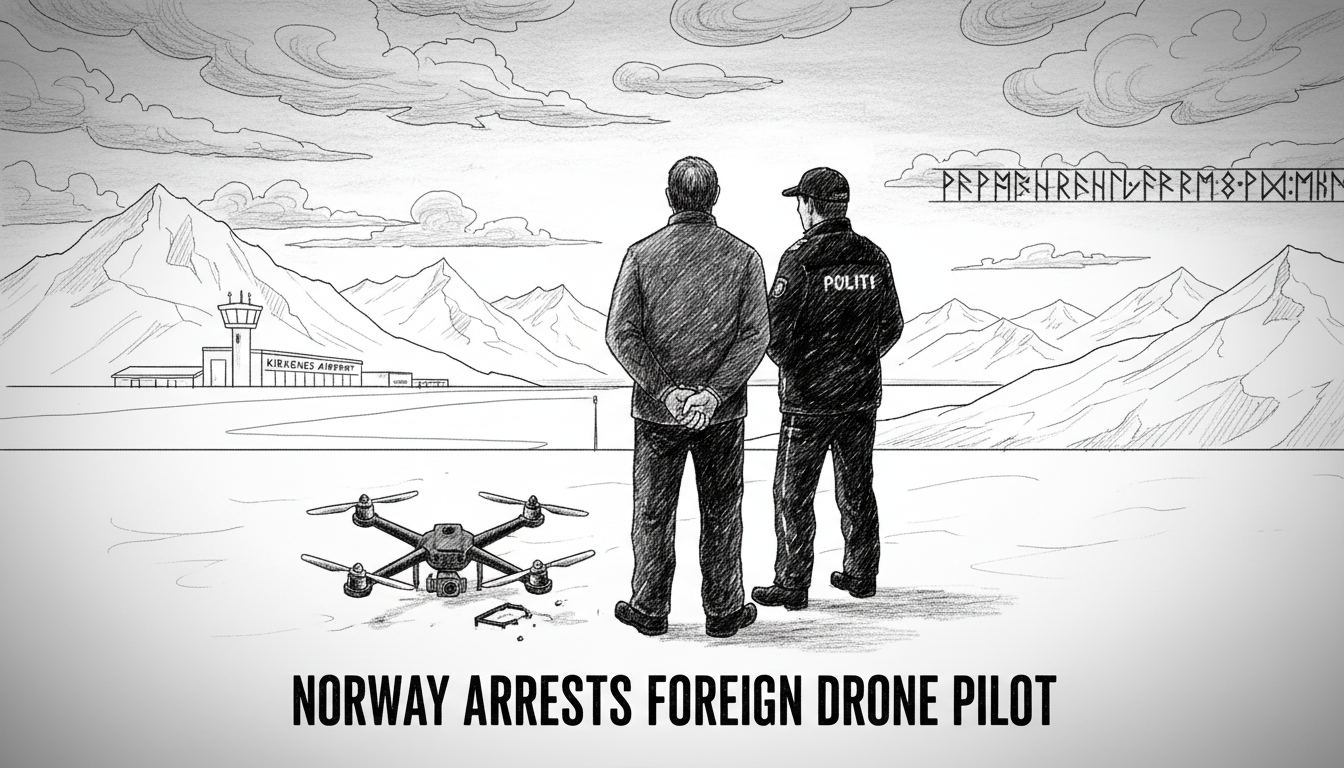
Norway's heightened security alert was triggered again Monday evening when police arrested a foreign national for flying a drone within the restricted zone of Kirkenes Airport. The 50-year-old man, whose nationality was not disclosed, was apprehended after operating the drone near buildings within the 5-kilometer no-fly radius. Police have seized the drone and opened a criminal case, with the pilot facing formal charges for violating Norway's strict aviation security regulations.
Operational leader Martine Schlanbusch Orheim of the Finnmark Police District confirmed the incident in a statement. "The patrol responded and found the drone pilot," Orheim said. "Police are opening a case and the drone pilot is being reported for having flown a drone in the prohibited zone." The individual was interrogated Monday night, though authorities have not confirmed if he will be remanded in custody. This event occurs against a backdrop of significantly tightened security across Norway, particularly in northern regions bordering Russia.
A Pattern of Provocation in the High North
Kirkenes is no ordinary town. Located in Norway's northeasternmost corner, it sits just 15 kilometers from the Russian border. The local airport, Høybuktmoen, serves as a critical transport hub for the region and is considered sensitive infrastructure. Since Russia's full-scale invasion of Ukraine in February 2022, Norwegian authorities have treated the entire Finnmark county with increased vigilance. The arrest of a non-Norwegian citizen flying a drone here follows a pattern of similar incidents that security services view as potential probes or intelligence gathering.
"Every unauthorized drone flight near critical infrastructure in the High North is treated as a potential security threat," says Lars Rowe, a senior researcher at the Fridtjof Nansen Institute specializing in Arctic security. "The rules are clear, widely published, and strictly enforced. For a foreign national to violate them so blatantly suggests either profound ignorance or deliberate testing of Norway's response protocols." Norway has arrested multiple individuals for drone violations since 2022, with several cases involving Russian nationals. The consequences can be severe, ranging from heavy fines and equipment confiscation to imprisonment for serious breaches.
The Legal Framework: Zero Tolerance Near Airports
Norwegian law establishes a strict no-fly zone with a minimum 5-kilometer radius around all airports. This prohibition is absolute for unauthorized drones and is part of the broader Norwegian Aviation Act. The purpose is to prevent collisions with manned aircraft and protect ground infrastructure. In practice, this means drone operators must obtain explicit permission from both the airport operator and the Norwegian Civil Aviation Authority before any flight in these zones. The rules apply equally to tourists, hobbyists, and commercial operators.
Violations are prosecuted under the Penal Code, with penalties escalating based on intent and potential damage. A simple mistake by a tourist might result in a fine of several thousand kroner and the loss of the drone. However, if the flight is deemed a deliberate act of espionage or sabotage, the perpetrator faces the possibility of years in prison. The police's decision to immediately seize the drone in Kirkenes is standard procedure, allowing for forensic examination of its flight logs, camera data, and technical specifications.
Geopolitical Tensions Elevate Everyday Incidents
What might have been a minor regulatory breach five years ago is now a major security event. The transformation of the Arctic from a zone of cooperation to one of confrontation has reshaped Norway's threat assessment. Kirkenes, once a symbol of cross-border commerce with Russia, now hosts a significant Norwegian military presence and is a focal point for NATO's northern flank. The town's strategic importance cannot be overstated; it is a gateway to the Barents Sea and a monitoring post for Russian activity on the Kola Peninsula, home to Russia's Northern Fleet.
"Incidents like this drone flight are not viewed in isolation," explains Kari Aas, a former intelligence officer now with the Norwegian Institute of International Affairs. "They are assessed within a context of hybrid threats. Drones can be tools for mapping infrastructure, testing response times, or simply creating nuisance and uncertainty. The fact that the pilot was flying near buildings is particularly concerning, as it suggests an interest in specific structures rather than general aerial photography." This context explains the police's swift and decisive response, treating the incident as a potential criminal investigation from the outset.
The Human and Technological Challenge of Enforcement
Enforcing drone bans presents a significant challenge for authorities. Modern consumer drones are small, quiet, and can be operated from a distance. Detecting them requires specialized radar or radio frequency monitoring equipment, which is deployed around high-priority sites like major airports and government buildings. Kirkenes Airport, while critical, is a regional facility, and it is unclear what level of permanent detection technology is installed there. The police response likely depended on a visual sighting by airport staff, a member of the public, or a patrol.
Once a drone is detected, identifying and locating the pilot is another hurdle. Operators can control drones from inside vehicles or buildings, making them difficult to spot. The successful apprehension of the pilot in this case suggests either efficient police work or a lack of sophistication on the part of the operator. The confiscation of the drone is a crucial step, as its internal data can reveal the flight path, duration, and whether it recorded video or photographs.
A Message to Residents and Visitors Alike
The Finnmark Police District's public statement serves a dual purpose: it informs the public of a security incident and acts as a deterrent. The message is clear—drone regulations will be enforced without exception, especially in the north. For local residents, this is part of a new reality where previously mundane activities are now scrutinized. For foreign visitors, it is a stark warning that Norwegian laws, particularly those related to security, carry serious consequences.
Norway has invested heavily in public information campaigns about drone rules, translating materials into multiple languages and working with tourism agencies. Despite these efforts, violations continue. Some are honest mistakes by unaware tourists, while others raise deeper suspicions. The nationality of the arrested man in Kirkenes will be a key detail. If he is a Russian citizen, the incident will be interpreted through the lens of state-sponsored probing. If he is a citizen of a NATO ally, it may be framed as reckless behavior, though still punishable.
Looking Ahead: Security as the New Normal
This incident in Kirkenes is a microcosm of Norway's broader security posture. The country is balancing its open society with the need for robust defense in a more dangerous world. The drone flight, while a single event, reinforces the government's argument for increased military spending, enhanced border monitoring, and closer intelligence cooperation with NATO partners. It also validates the decision to significantly upgrade the police's capacity to handle such threats, including the establishment of specialized units for investigating complex digital and technological crimes.
The coming days will reveal more about the pilot's motives. The police investigation will determine if this was an isolated act of negligence or something more coordinated. Regardless of the outcome, the immediate effect is the reinforcement of a security perimeter around Norway's northern frontier. In the clear, cold air of the Arctic, where distances are vast and borders feel abstract, a small drone has once again proven capable of triggering a large response. The question for Norway is not if another incident will occur, but when—and how the nation's defenses will hold.