
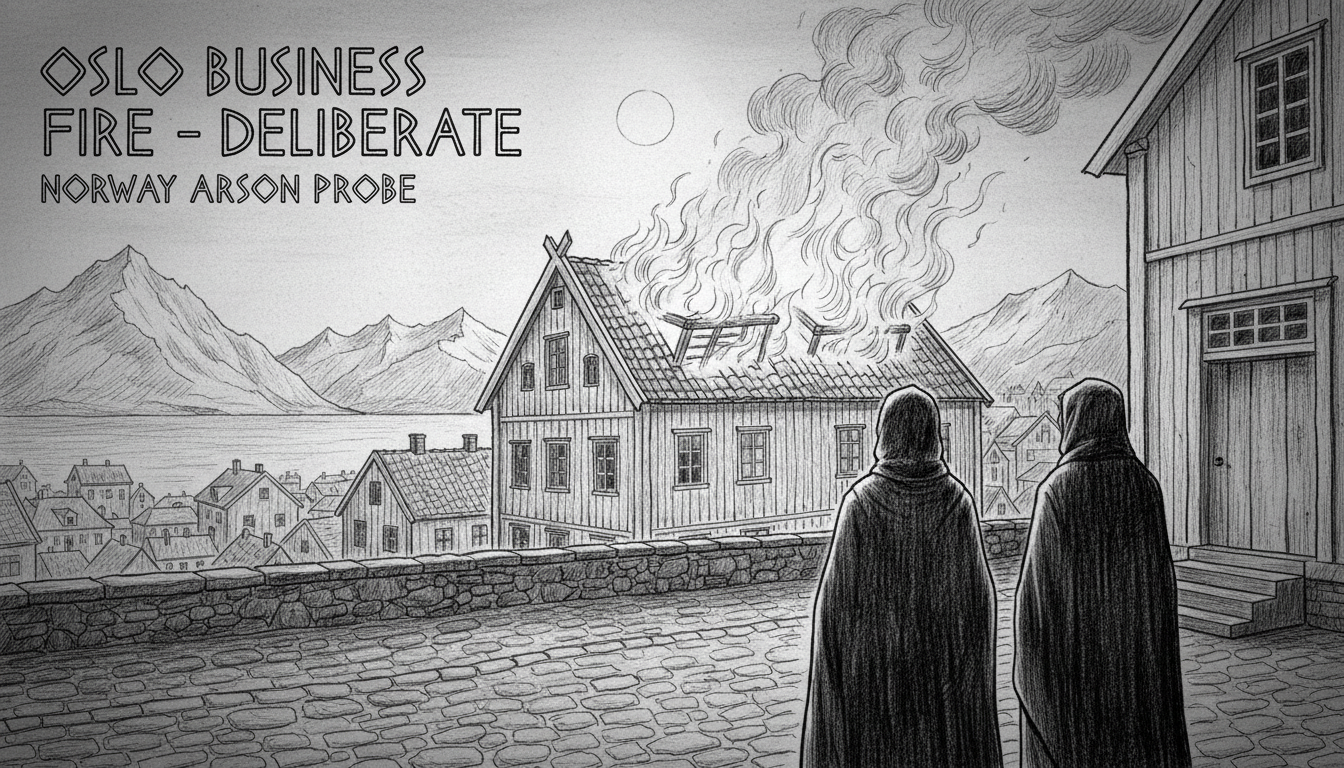
Norway police are investigating a suspected arson attack at a commercial building in Oslo's Bryn district. The fire, reported just after midnight on Thursday, tore through a property housing multiple businesses. Authorities confirmed they are treating the blaze as potentially deliberate, with witnesses reporting suspicious vehicles in the area at the time.
Oslo Police District received the initial alarm shortly after midnight. Fire crews from the Oslo Fire and Rescue Service responded rapidly to the industrial area east of the city center. By 00:48, they reported the fire was under control and crews were conducting a systematic search of the structure. No injuries have been reported.
"There is a possibility the fire was set intentionally," a police spokesperson said in a statement. The declaration shifts the investigation from a routine fire response to a potential criminal inquiry. Witness accounts of one or two cars seen in the vicinity are now a central focus for detectives.
A Deliberate Act in an Industrial Hub
The targeted building sits in Bryn, a key mixed-use zone known for logistics, workshops, and office spaces. Such areas are typically quiet and empty during night hours, making them vulnerable. The timing of the fire, in the early hours of Thursday, suggests an intent to avoid witnesses and maximize damage before discovery.
Arson against commercial property in Norway is statistically rare but carries severe economic consequences. Motives can range from insurance fraud and business disputes to more complex criminal intimidation or, in isolated historical cases, extremist actions. The immediate priority for investigators is securing the scene to preserve evidence.
"The first 48 hours are critical in an arson investigation," said Lars Holen, a former chief fire investigator for the Norwegian Directorate for Civil Protection (DSB). "Fire investigators will be looking for the point of origin and signs of accelerants. Meanwhile, police will be canvassing for CCTV footage from neighboring properties and conducting formal interviews with witnesses who reported the vehicles."
The Methodical Search for Motive
Determining a motive is the complex next step. Forensic accountants may be brought in to examine the financial health of the businesses operating from the building. Police will also look into any recent conflicts, threats, or insurance policies linked to the property or its tenants.
Norway's legal framework treats arson as a serious crime under the Penal Code §148. If the fire endangered human life, charges could escalate significantly. The absence of injuries in this case is a point of relief but does not diminish the potential severity of the charges if an individual is identified and linked to the blaze.
Industrial areas like Bryn often have varying levels of private security and surveillance. The effectiveness of this network will be tested as police attempt to trace the movements of the suspicious cars. License plate recognition data from main arteries like the E6 highway, which runs nearby, could become relevant.
Economic and Community Ripple Effects
Beyond the criminal investigation, the fire disrupts the commercial ecosystem of Bryn. Multiple businesses are now displaced, facing operational halts, data loss, and supply chain interruptions. For small and medium-sized enterprises, such an event can be existential without adequate business interruption insurance.
"This isn't just a property crime; it's an attack on workplace stability and local employment," noted Anna Berger, a risk analyst at the Confederation of Norwegian Enterprise (NHO). "The tenants will be dealing with the practical fallout for months, regardless of how quickly the police investigation progresses."
The incident also prompts broader security questions for other business parks in the Oslo region. While Norway maintains a low crime rate, a deliberate major fire can trigger reviews of security protocols, lighting, and patrols in similar industrial zones.
The Investigative Path Forward
The scene will now be a joint operation between the Oslo Police District and specialist fire investigators. They will sift through the debris in a grid pattern, searching for tell-tale signs like multiple points of origin or the presence of fuel containers that shouldn't be present. Samples will be sent to labs for chemical analysis.
Parallel to the forensic work, detectives will be building timelines for the businesses and individuals connected to the property. This includes reviewing recent communications, financial transactions, and any police reports involving the address. The witness testimony about the vehicles provides a tangible, if vague, lead.
"In cases like this, the motive often points back to a very specific relationship or problem," explained Holen. "It could be a disgruntled former employee, a dispute between landlords and tenants, or a desperate attempt to solve a financial crisis through insurance payout. The challenge is uncovering which thread to pull."
A Test for Urban Security
This suspected arson case serves as a stark reminder that even in one of the world's safest capitals, deliberate destructive acts can occur. The response demonstrates the standard Norwegian protocol: swift emergency containment followed by a meticulous, multi-agency investigative approach.
The coming days will reveal whether the surveillance infrastructure in Oslo's commercial districts can deliver actionable evidence. Success in this investigation hinges on converting the vague description of vehicles into identifiable leads and marrying that with a clear motive.
For now, the charred building on Bryn stands as a silent crime scene. The businesses that operated there face an uncertain future, and a community is left questioning the vulnerability of its commercial spaces. The Oslo police have a complex puzzle to solve, one where the first piece is the simple, ominous conclusion that this fire was no accident.
What appears as an isolated nighttime blaze is now a concentrated probe into human intent and its capacity for damage. The answer to why someone would target this building will define the true cost of the flames that lit up the Oslo night.