
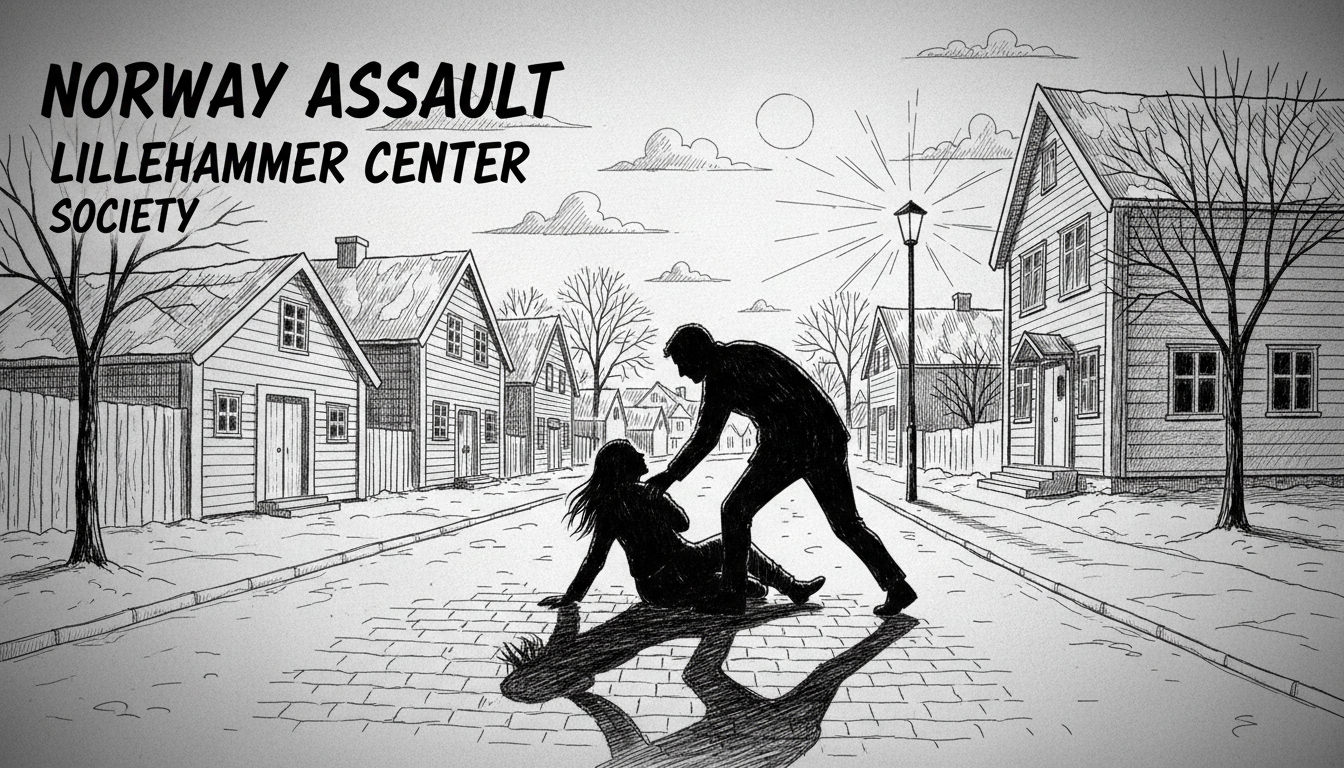
Norway's low crime rate faces a stark test after a violent assault in a quiet Olympic city. A woman in her 20s was attacked in the center of Lillehammer early Sunday morning, sustaining multiple blows to the head. The Innlandet Police District confirmed the incident occurred at 3:46 AM, with the victim transported to a medical clinic for treatment. No arrests have been made, leaving a community known for winter sports glory grappling with a sudden act of violence.
An Attack in the Shadow of Olympic Rings
Lillehammer, nestled in the Gudbrandsdalen valley, is globally synonymous with the peaceful 1994 Winter Olympics. Its picturesque main street, Storgata, is usually a hub of tourists and locals enjoying the mountain ambiance. The assault, occurring in the city center, shatters that tranquil image. Police have not released the exact location but confirm it was within the central urban area. "The woman has been taken to the emergency clinic," said Operations Leader Tommy Økland of the Innlandet Police District in a brief statement. The police investigation is now active, focusing on witness statements, potential CCTV footage, and forensic evidence from the scene.
This incident forces a confrontation between Norway's statistical reality and individual trauma. The country consistently ranks among the safest in the world. According to data from Statistics Norway (SSB), rates of violent crime are low in a global context. Yet, for the victim and the community of Lillehammer, a population of just over 28,000, a single violent act carries disproportionate weight. It disrupts the fundamental expectation of safety in public spaces, particularly for women.
The Broader Context of Violence in Norway
While Norway's homicide rate is among the lowest globally, police-recorded assaults present a more complex picture. SSB data shows fluctuations in assault reports year-to-year, influenced by reporting rates, police prioritization, and actual incidence. Incidents in smaller cities like Lillehammer often generate significant local attention precisely because they are less common than in larger urban centers like Oslo or Bergen. The Innlandet county, where Lillehammer is located, generally experiences lower crime rates than eastern or western metropolitan regions.
Criminologists note that early and effective intervention is critical in assault cases. "The immediate priority is, of course, the victim's health and safety," says a Norwegian criminologist specializing in victim support, who spoke on background. "But the investigative window is also crucial. Evidence must be gathered swiftly, and witnesses interviewed while memories are fresh." The lack of an immediate arrest indicates the perpetrator fled the scene, a common challenge in late-night assaults where witness availability is limited.
Community policing models, which Norway employs, aim to build trust and gather local intelligence that can prevent and solve crimes. In a close-knit community, such an attack can strain that trust. Residents may question the visibility and responsiveness of police patrols, especially during nighttime hours. The police investigation will now test the efficacy of both their reactive investigative capabilities and their proactive community networks.
The Human Impact Beyond the Statistics
The clinical details—time, location, injuries—outline the event but not its human cost. An assault, particularly one involving blows to the head, carries severe potential consequences. Beyond physical injury, victims often suffer psychological trauma, including post-traumatic stress, anxiety, and a lasting fear of public spaces. Support services, such as those offered by the Norwegian Support Organization for Victims of Crime (BOFF), become essential in the aftermath.
The victim's age also aligns with demographic data. Young adults, both men and women, represent a significant portion of assault victims in Norway, often in contexts involving nightlife. This underscores the importance of safety measures in city centers after dark, from adequate lighting to security patrols. The attack occurred in the early hours of Sunday, a time when nightlife activity is typically winding down, raising questions about the victim's and perpetrator's circumstances.
For Lillehammer, the incident is a jarring anomaly. The city's identity is built on international sportsmanship, tourism, and a high quality of life. A violent assault in its core threatens that self-perception. Local business owners and residents often speak of the city's safety as a point of pride. This event forces a recalibration, a recognition that no community is entirely immune to random violence.
The Investigative Path Forward
The Innlandet Police District faces the task of piecing together the events of early Sunday morning. Their work will involve several key steps. First, a forensic examination of the scene for physical evidence. Second, a canvass for closed-circuit television cameras from nearby businesses, apartments, and municipal systems that may have captured the attack or the perpetrator's flight. Third, a public appeal for witnesses who were in the Lillehammer center between 3:00 and 4:00 AM.
"Investigations like this hinge on details," the criminologist explained. "A distinctive piece of clothing, a vehicle seen speeding away, a sound heard by a resident—these fragments can build a timeline and identify a suspect." The police have not disclosed a possible motive, leaving open whether the attack was targeted or random, a critical factor for public reassurance. A random attack typically generates greater community anxiety, while a targeted one suggests a contained risk.
The absence of an arrest will likely increase public pressure on the police department. In small communities, rumors can spread quickly. The police must balance transparency with protecting the integrity of the investigation and the privacy of the victim. Their next public update will be closely watched for any indication of progress or a shift in the case's classification.
Safety, Perception, and the Norwegian Ideal
This assault touches a nerve in Norwegian society, which invests heavily in social welfare and cohesion to prevent crime. The model includes wealth redistribution, accessible healthcare, and low social inequality—all factors correlated with lower violent crime. When violence occurs, it prompts introspection: is this a tragic but isolated failure, or a sign of underlying pressures?
For now, the evidence suggests the former. Norway's crime rates remain enviably low. However, each incident is a reminder that safety is not a passive condition but an active achievement requiring continuous investment in policing, social services, and community trust. The attack in Lillehammer does not rewrite Norway's crime statistics, but it irrevocably alters the life of one young woman and the sense of security in her city.
As the investigation continues, the community awaits answers. Can the police, with their methodical approach, identify a suspect in a case with no immediate arrests? Will this event lead to increased patrols or safety initiatives in Lillehammer's city center? And for the nation, does this highlight a blind spot in the Norwegian sense of security, or simply reaffirm that even the safest places are not without risk? The quiet streets of Lillehammer now hold these uneasy questions.