
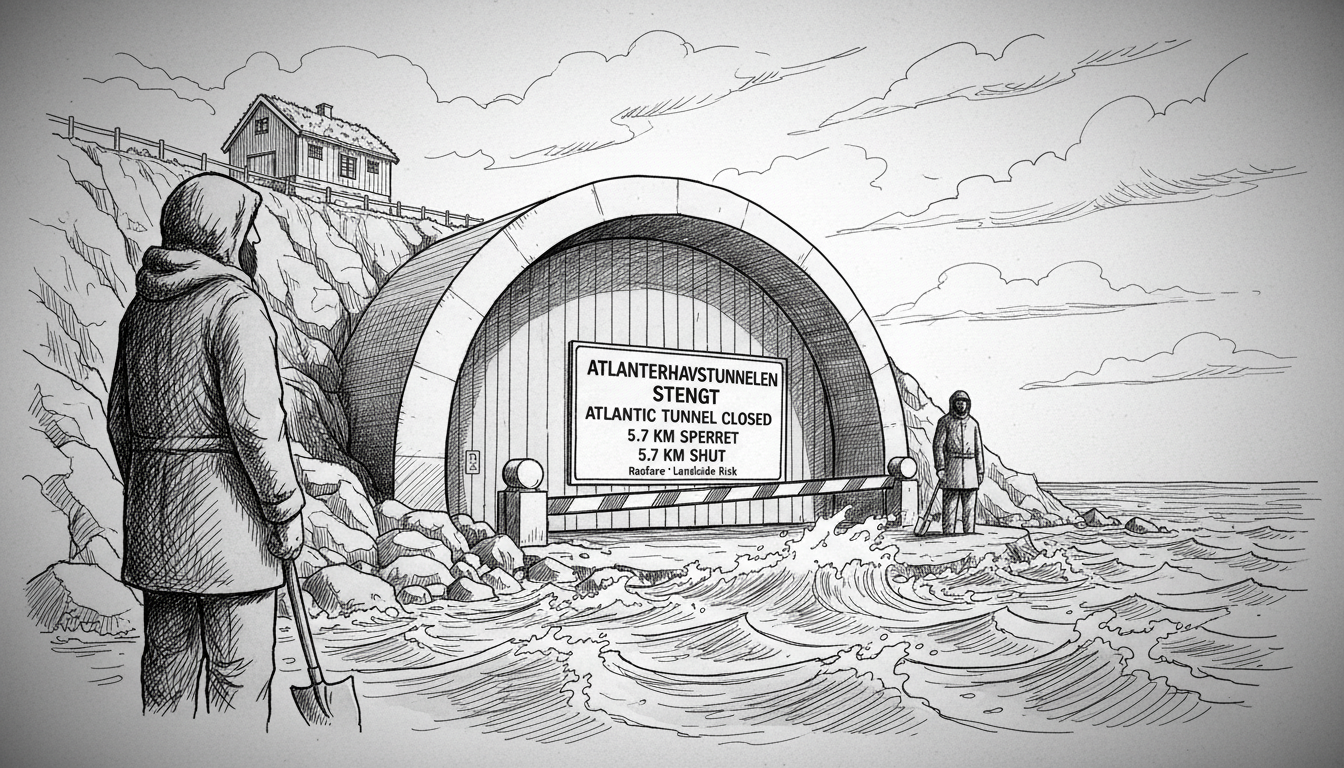
Norway's Atlanterhavstunnelen is closed in both directions after a vehicle breakdown inside the subsea passage. The incident on County Road 64 between Averøy and Kristiansund occurred during the morning commute, trapping the vehicle approximately halfway through the 5.7-kilometer structure. Emergency services from Møre og Romsdal county are on scene, with initial reports indicating no injuries but significant traffic backups forming on both sides. Norwegian road authorities confirmed the closure is indefinite, prioritizing safety assessments and recovery operations in the deep-sea tunnel.
Immediate Response and Commuter Chaos
Police and the Norwegian Public Roads Administration (Statens vegvesen) cordoned off access points within minutes of the breakdown. Traffic cameras showed queues stretching back towards Kristiansund and the island of Averøy, with drivers advised to avoid the area entirely. "All traffic must find alternative routes immediately," a county traffic manager said in a statement. "We understand the disruption, but safety in a subsea tunnel is non-negotiable." The only practical detour adds over 90 minutes of travel time, requiring a ferry crossing from Averøy to Molde followed by a long drive back to Kristiansund. Local bus services are suspended, stranding residents and tourists alike.
Engineering Marvel Meets Operational Vulnerability
The Atlanterhavstunnelen represents a triumph of Norwegian engineering, opened in December 2009 to replace a slower ferry connection. It plunges to a depth of 250 meters below the Atlantic Ocean, with a steep 10% gradient that challenges heavy vehicles. This tunnel is a critical link in County Road 64, a major artery connecting the regional hubs of Kristiansund and Molde. An average of 3,500 vehicles use it daily, including freight trucks supplying goods to coastal communities. Its closure exposes a fundamental weakness in Norway's coastal infrastructure: the lack of redundant routes for deep subsea passages. When one fails, entire regional transport networks seize.
Stringent Safety Protocols in a Pressurized Environment
Subsea tunnel closures in Norway follow strict national safety directives. Any vehicle stoppage triggers an automatic closure to prevent carbon monoxide buildup, fire risk, or collisions in the confined space. Ventilation systems are designed for moving traffic, not stationary vehicles. Recovery is complex and slow, often requiring specialized teams to assess the vehicle, deploy tow trucks suited for the gradients, and ensure structural integrity. "A breakdown at 250 meters below sea level is a technical rescue operation, not a simple tow," explained a senior engineer with the Norwegian Tunnelling Society. "Pressure differentials, limited access, and communication hurdles all factor in." These protocols have proven effective, with no major accidents in Norwegian subsea tunnels since their inception, but they come at the cost of prolonged disruptions.
Economic Ripples Across the Northwest Coast
The closure's impact extends beyond stranded commuters. Kristiansund, a city of 24,000, relies on the tunnel for daily freight, including fresh seafood exports from its fishing industry. Logistics companies report delays in shipments to Oslo and Trondheim, with perishable goods at risk. Averøy island, with a population of 5,800, is effectively cut off from mainland services like specialized healthcare and secondary education. Local business owners in Kristiansund's harbor district express frustration. "Our lunch deliveries from mainland suppliers are canceled," said one restaurant manager. "We might have to close early if staff cannot get to work." The Norwegian Coastal Administration notes that increased ferry traffic from the detour could cause bottlenecks at the Molde-Averøy ferry port, compounding delays.
Historical Context and Comparative Infrastructure Challenges
Norway operates over 40 subsea road tunnels, the most of any nation, as a solution to its fractured coastline. The Atlanterhavstunnelen is among the deepest and longest. Previous incidents, like a 2017 closure of the similar Eiksund Tunnel, led to reviews of emergency preparedness. However, each closure reveals systemic vulnerabilities. Compared to Sweden or Finland, Norway's dependence on single-point subsea links is unique due to its extreme topography. Investment in alternative bridges or tunnels is often deemed prohibitively expensive for low-density regions. This incident will likely reignite debate in the Storting about infrastructure resilience, particularly as climate change increases the frequency of extreme weather events that can affect tunnel systems.
Expert Analysis: A Stress Test for National Policy
Transport analysts point to this closure as a real-time stress test for Norway's famed infrastructure model. "The Atlanterhavstunnelen closure shows the trade-off between engineering ambition and practical redundancy," said Professor Lena Hansen, a transport geography specialist at the University of Bergen. "We build these magnificent tunnels to connect communities, but one incident can isolate them. The policy question is whether to invest in backup systems, like emergency bypass corridors or accelerated maintenance drones." She noted that the government's National Transport Plan 2025-2036 allocates billions for new tunnels, but less for resilience upgrades to existing ones. This event may shift those priorities, especially for critical links in Møre og Romsdal county.
The Human Element: Stories from the Standstill
Behind the traffic statistics are personal disruptions. A nurse from Averøy scheduled for a hospital shift in Kristiansund faced cancellation, impacting patient coverage. A family traveling to Molde Airport for a holiday flight missed their departure, recounting hours spent in detour traffic. Social media platforms are filled with accounts from stranded drivers sharing information and frustrations. These stories highlight the human dependency on this concrete tube under the Atlantic. They also underscore the community cohesion in crisis, with locals offering rides via ferry and sharing real-time updates on alternative routes.
Technical Breakdown and Recovery Timeline
Authorities have not released specific details about the stricken vehicle, but sources indicate it is a medium-duty truck experiencing mechanical failure. Recovery involves cooling the vehicle if overheated, securing it for towing up the steep gradient, and conducting a full tunnel inspection before reopening. The Norwegian Public Roads Administration estimates a minimum closure of 6-8 hours, but similar past incidents have lasted over 12 hours. Continuous updates are being provided via the national traffic app, Vegvesen Trafikk. The agency emphasizes that reopening will only occur after comprehensive safety checks of the tunnel's lighting, ventilation, and road surface.
Looking Ahead: Resilience in the Norwegian Arctic
This incident serves as a stark reminder for Norway as it continues to develop its Arctic infrastructure. New subsea tunnels are planned for the Nordland and Troms regions, aiming to improve connectivity for remote communities. The Atlanterhavstunnelen closure offers lessons in operational response and design considerations. Should future tunnels include wider shoulders for breakdowns, more frequent emergency bays, or integrated sensor systems for faster detection? Parliament member Marit Østbye, who sits on the transport committee, stated, "We must review today's event to ensure our future tunnels are even safer and less disruptive when failures occur. Our geography demands innovation, but also practicality." As Norway balances its ambitious coastal road projects with reliability, this closure in the dark depths of the Atlantic Ocean will inform policy debates for years to come.