
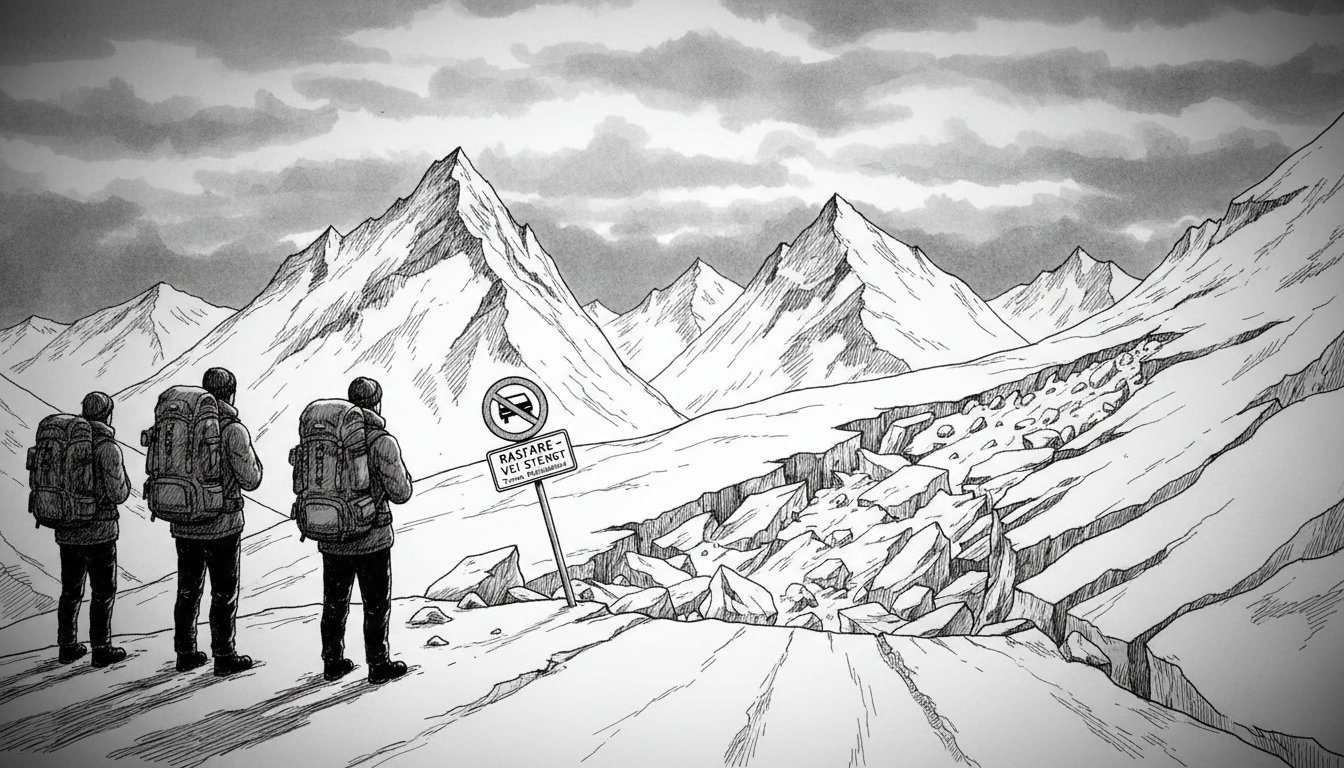
Norway's avalanche risk has forced the closure of three key roads in Troms county this Saturday morning. County Road 7900 in Holmbuktura and County Roads 7940 and 7942, both in Skjervøy municipality, are shut to all traffic. The Norwegian Public Roads Administration (Statens vegvesen) has set a provisional reopening window between 10:00 and 12:00 local time. This preventative action follows an actual snowslide earlier Saturday on County Road 866 in neighboring Nordreisa, underscoring the volatile and immediate danger present in the region's mountainous terrain.
For residents of Northern Norway, such closures are a disruptive but familiar winter reality. They represent the frontline of a constant battle between maintaining vital transport links and ensuring public safety in one of Europe's most avalanche-prone landscapes. The decision to close a road is never taken lightly, given the economic and social ripple effects, but it is a core component of Norway's sophisticated approach to managing natural hazards.
A Calculated Response to a Volatile Threat
The closures are not reactions to observed instability alone but are based on a proactive forecasting system. Meteorologists and avalanche experts at the Norwegian Water Resources and Energy Directorate (NVE) and the Public Roads Administration analyze a complex matrix of data. This includes recent snowfall amounts, wind speed and direction, which dramatically redistributes snow, temperature fluctuations, and the existing snowpack structure. The steep fjord landscapes of Skjervøy and Nordreisa, where these roads are located, are classic avalanche terrain.
"When we issue a warning and roads are closed, it is because the probability of a natural or triggered avalanche reaching the road is unacceptably high," explains a senior avalanche forecaster with the NVE, who spoke on background about standard procedure. "The snowpack is like a layered cake. We need to understand the strength of each layer and the bonds between them. A weak layer buried by new snow and wind-drift is a recipe for a large slab avalanche."
The High Cost of Safety in Isolated Communities
While the closures are a testament to a successful safety protocol, they impose a tangible burden. In a region characterized by fjords, islands, and sparse population, each road is a critical lifeline. County Road 7940 and 7942 in Skjervøy, for instance, connect remote communities and are essential for daily commutes, school buses, and freight. A closure can mean lengthy detours via ferry routes, which themselves are vulnerable to weather, or complete isolation for some households.
Local business owners feel the impact directly. "A closed road means delayed deliveries, cancelled appointments, and fewer customers," says Kari Nilsen, who runs a hardware store in Skjervøy. "We understand the danger completely, and no one wants to risk lives. But it's a sharp reminder of how dependent we are on these mountain passes, and how fragile that connection can be." The estimated midday reopening aims to balance safety with minimizing disruption, but such forecasts are always subject to change based on ongoing weather assessments.
Norway's Evolving Defense Against Snow
Norway's strategy extends far beyond road signs and closures. The country invests heavily in permanent mitigation infrastructure. In high-risk corridors, engineers have constructed massive steel snow sheds—tunnels designed to allow avalanches to pass harmlessly over the road. Elsewhere, deflection dams and berms are built to divert snow slides away from infrastructure. Perhaps most impressively, the Public Roads Administration employs controlled avalanche triggering using remote-controlled howitzer cannons or explosive charges dropped by helicopter.
This proactive release of unstable snow masses is conducted when conditions are safe for experts and when the road can be kept clear, preventing a larger, unpredictable avalanche during peak traffic times. The system is a blend of deep historical knowledge—Norway has recorded deadly avalanches for centuries—and cutting-edge technology, including detailed digital terrain models and real-time weather stations feeding data into forecast models.
Climate Change: A New Variable in the Equation
Experts are now grappling with how a warming climate alters the avalanche risk profile. While intuition might suggest fewer avalanches in a warmer world, the reality is more complex. "Climate change doesn't necessarily mean less snow in these northern regions, at least in the short term," the NVE forecaster notes. "It can mean more variable precipitation, with cycles of heavy snow followed by rain or warm periods. This creates more weak layers within the snowpack and can lead to different, sometimes more unpredictable, avalanche types."
Warmer winters may increase the frequency of wet-slab avalanches, which are heavier and travel differently than dry powder slides. This evolving threat requires constant adaptation of forecasting models and mitigation strategies. The long-term integrity of avalanche defense structures also comes into question as permafrost thaws and precipitation patterns shift.
A Culture of Caution and Preparedness
Ultimately, the effectiveness of Norway's system relies on public trust and compliance. Norwegians, particularly in the north, are generally well-educated about natural hazards. The daily avalanche danger forecast (Faregrad) on the Varsom.no website is a routine check for many, akin to checking the weather. This cultural awareness ensures that road closure announcements are met with understanding, even frustration, rather than defiance.
The closures in Troms this Saturday are a small, routine event in Norway's annual winter narrative. Yet, they perfectly illustrate a comprehensive, science-driven philosophy towards risk management. It is a model that prioritizes human life above all else, accepts the economic costs of prevention as preferable to the tragic costs of disaster, and continuously adapts to new environmental challenges. As the snow continues to fall on the peaks above Skjervøy, the watchful eyes of forecasters and the closed gates on the roads below remain the quiet guardians of the valleys.
Will the increasing volatility of Arctic weather push this world-class system to its limits in the decades to come?