
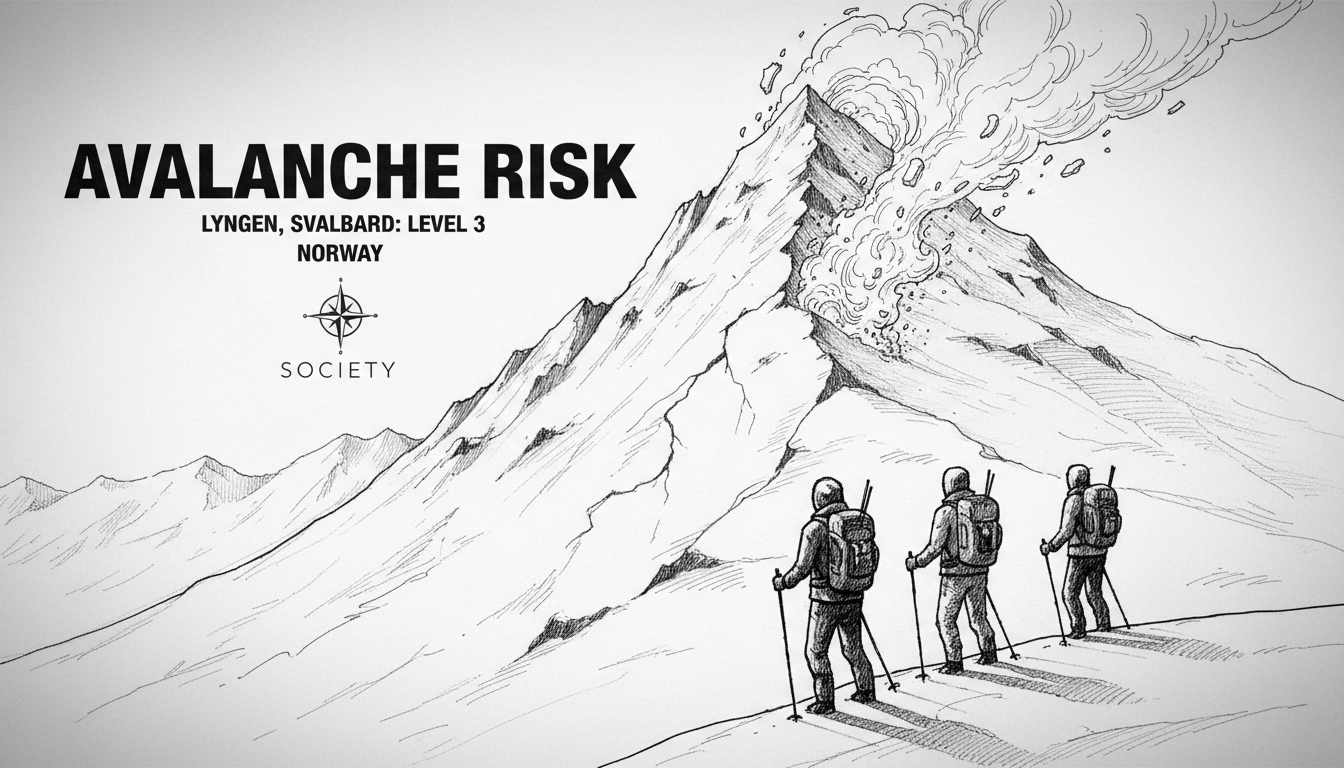
Norway's avalanche warning service has issued a considerable danger level for the Lyngen Alps and Svalbard, signaling hazardous conditions for backcountry travelers. The Level 3 warning, the midpoint on Norway's five-tier scale, indicates dangerous avalanche conditions where human-triggered slides are likely. Strong winds are transporting snow and building unstable wind slabs on northwest-facing slopes, creating a widespread hazard.
A Persistent Threat in Iconic Terrain
The Lyngen Alps, a dramatic mountain range stretching into the Arctic in Troms county, are renowned for their steep fjords and peaks. This very topography makes them a high-risk zone for avalanches, especially with the heavy snowfall typical of the region. The current warning highlights the formation of wind slabs—layers of snow deposited by wind that can bond poorly to the layer beneath. These slabs can fracture easily under the weight of a skier or snowboarder. "Strong wind will continue to move snow onto lee slopes facing northwest and build up wind slab layers. These can be very easy to trigger," the warning service stated. This specific hazard requires careful route selection and constant assessment of the snowpack.
The Arctic Mirror: Svalbard's Parallel Peril
Nearly 800 kilometers to the north, the archipelago of Svalbard faces an identical threat. Nordenskiöld Land, the region encompassing the main settlement of Longyearbyen, is also under a Level 3 (Considerable) avalanche danger. The persistence of this warning across such distant locations underscores a widespread meteorological pattern affecting northern Norway. Svalbard's avalanche risk is compounded by its extreme Arctic climate, where polar night conditions until mid-February limit visibility and complicate risk assessment. The fact that the same danger level is forecast to remain into Monday for both regions suggests stable, hazardous weather conditions are locked in place.
Understanding the 'Considerable' Danger Level
Norway's avalanche danger scale, managed by the Norwegian Water Resources and Energy Directorate (NVE) through Varsom.no, is a critical public safety tool. Level 3 is not to be taken lightly. It sits squarely in the middle of the scale, but avalanche experts often call it the most treacherous. At lower levels (1-Low and 2-Moderate), the danger is more localized or requires a significant trigger. At higher levels (4-High and 5-Very High), the threat is so obvious and widespread that most people avoid the terrain. Level 3, however, presents a deceptive mix of hazardous and stable slopes. It requires precise knowledge to navigate safely, a factor that contributes to its high incidence of accidents. Most avalanche fatalities in Norway involve people triggering slab avalanches themselves, frequently in Level 3 conditions.
The Human Factor in Avalanche Safety
Statistics from NVE show avalanche fatalities in Norway average four to five per year, though this number fluctuates with snowpack stability and winter recreation trends. Each incident is a profound tragedy, often involving experienced outdoor enthusiasts. The common thread in many accidents is a human factor—a misjudgment of terrain, a dismissal of the forecast, or group dynamics that override cautious decision-making. This is why experts relentlessly stress a multi-layered safety approach. Checking Varsom.no is only the first step. It must be followed by carrying and knowing how to use a transceiver, shovel, and probe. Crucially, it requires the skill to interpret the forecast on the ground, identifying which slopes are lee slopes loaded by the wind and which are safer options.
A Nation Built on Winter Preparedness
Norway's relationship with its mountainous winter landscape is deep-rooted. Avalanche awareness is woven into the fabric of outdoor culture, from school trips to professional guides. The Varsom.no service is a cornerstone of this preparedness, providing detailed, region-specific forecasts that are trusted by everyone from local commuters to international ski tourers. Municipalities in high-risk areas like Lyngen also employ mitigation strategies, including controlled detonations to trigger avalanches before they threaten infrastructure. However, for the individual in the backcountry, the responsibility ultimately lies with personal judgment. The current warnings for Lyngen and Svalbard serve as a stark reminder that the mountains demand respect, regardless of one's experience level.
Looking Ahead: A Week of Heightened Awareness
With the forecast indicating the danger will persist, the coming days require heightened vigilance across northern Norway. Mountain guides and tour operators in Lyngen will be adjusting plans, favoring more conservative routes and aspects. In Longyearbyen, residents are accustomed to such warnings, but they dictate daily movement around the town, which is itself surrounded by avalanche-prone slopes. The situation will be monitored closely by NVE's avalanche forecasters, who analyze snowpack data, weather models, and field observations from a network of professionals. For the public, the message remains clear: the mountains are in a volatile state. The beauty of the fresh snow comes with a significant cost—a layer of instability that demands knowledge, equipment, and humility to navigate. As one seasoned forecaster put it, 'The avalanche doesn't know you're an expert.' This week, the snow in Lyngen and on Svalbard is waiting to prove that point.