
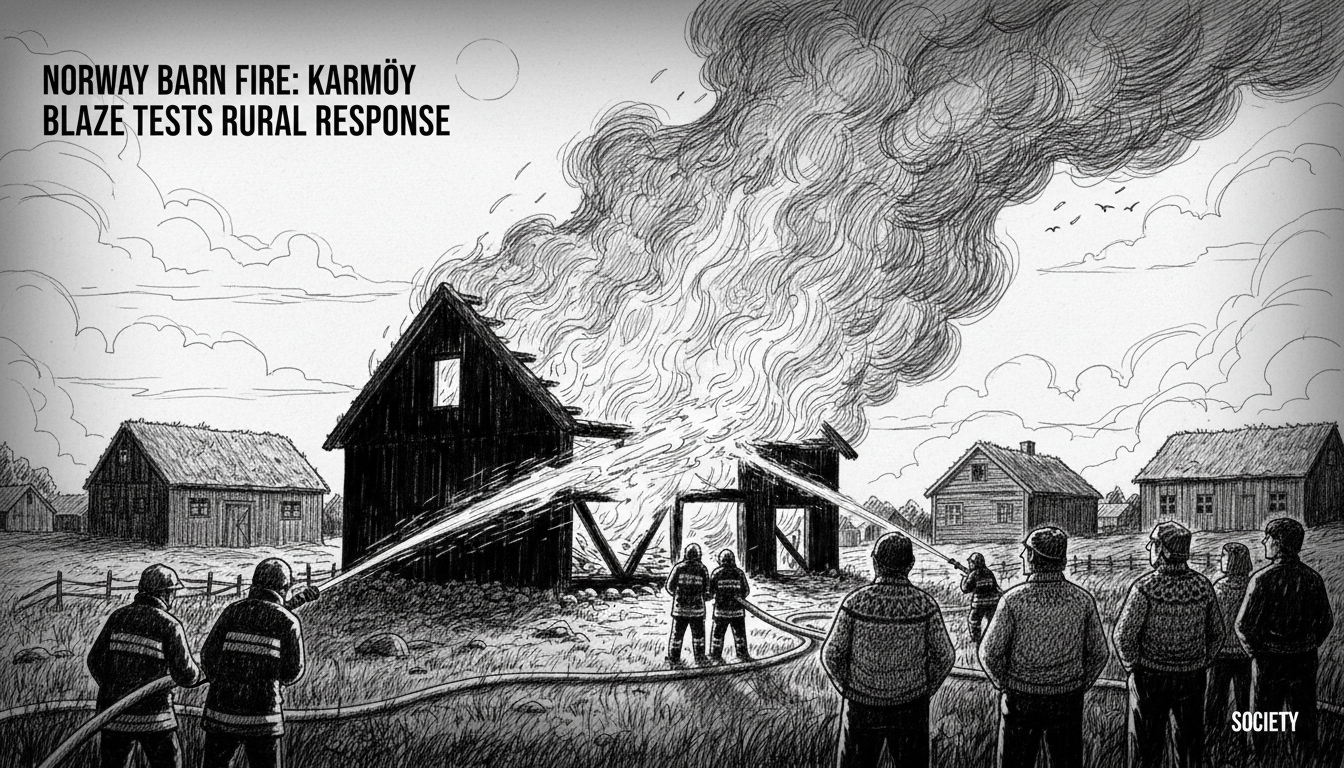
Norway emergency services are battling a major barn fire on the island of Karmøy in Rogaland county. The blaze, described by police as 'full fyr' or fully ablaze, broke out in a structure not used for housing animals. Fire crews from the Åkra and Raglamyr stations are on the scene conducting exterior firefighting operations.
Operations leader Victor Fenne-Jensen confirmed the response. "The fire service has started firefighting work," he said. "There is heavy smoke development, but we are informed the smoke is moving away from residential areas." The statement offers some relief to nearby residents but underscores the scale of the incident.
Vaktleder Stein Arild Egeland from the fire service provided an update just after 12:00. He stated that interior attack was not yet possible, focusing efforts on containing the fire from the outside. "It is too early to say anything about how extensive the firefighting work will be," Egeland said. The uncertainty points to the challenges faced by crews upon arrival at a well-developed rural fire.
A Rural Challenge in a Coastal Community
Karmøy, an island municipality connected to the mainland by bridge, is characterized by a mix of industry, agriculture, and coastal settlements. Fires in such locations present distinct logistical hurdles. Access to sufficient water can be a critical issue, often requiring tanker trucks or drafting from nearby sources like ponds or the sea.
Older wooden barns, common in Norwegian rural landscapes, are particularly vulnerable. They often contain dry timber and can house stored materials like hay, machinery, or fertilizers, which accelerate burning. The police note that this barn had "other uses than for animals," which immediately raises questions for investigators about storage contents and potential fire risks.
"The speed at which a fire takes hold in a traditional wooden låve is dramatic," explains Lars Holen, a former fire safety instructor with experience in rural Rogaland. "The construction allows for excellent airflow, acting like a chimney. The priority is always to protect exposures—nearby homes, other barns, and forested land—especially if the primary structure is already fully involved."
The Anatomy of a Rural Fire Response
The dispatch of crews from two stations, Åkra and Raglamyr, is a standard but crucial escalation. It ensures enough personnel and equipment are available for what could be a long and resource-intensive operation. Initial actions involve establishing a water supply, assessing the direction of fire spread, and evacuating any threatened properties.
The mention of heavy smoke moving away from buildings is a key tactical point. Smoke inhalation is a major risk to firefighters and residents. Controlling smoke direction, when possible, protects air quality and visibility. However, the toxic contents of smoke from a burning barn—which could include plastics, treated wood, or chemicals—remain a significant hazard on-site.
Fighting such a fire from the exterior, as crews are doing, is often a defensive strategy. It indicates the interior may be unsafe for firefighters due to the intensity of the flames or risk of structural collapse. The goal shifts from saving the building to preventing the fire's spread and achieving a controlled burn-down.
Broader Implications for Norwegian Fire Safety
While this is an active incident, it highlights ongoing national conversations about fire protection in rural and semi-rural areas. Norway has strict building codes for new structures, but many older agricultural buildings predate modern regulations. Their conversion to storage or workshop use may not trigger updated safety requirements like sprinkler systems or enhanced electrical standards.
Distance from major fire stations also affects response times. In some remote Norwegian municipalities, volunteers form the backbone of the initial attack. The professional response from Åkra and Raglamyr suggests this fire is within a reasonable radius, but the incident still tests the capacity of local resources.
"Every fire like this is a live exercise," says Holen. "It tests communication between police, fire, and medical services. It tests equipment and training. And, unfortunately, it often reveals the vulnerabilities of older building stock. The post-incident investigation will be critical for learning and for potentially updating local risk assessments."
Looking Ahead: Containment and Investigation
The immediate focus for authorities on Karmøy is achieving full containment and ensuring no injuries to residents or responders. The coming hours will determine if the defensive strategy successfully isolates the blaze. Firefighters will likely remain on scene for an extended period to extinguish hot spots within the rubble.
Once the site is cool, the investigative phase begins. Police and fire inspectors will work to determine the cause. They will examine the barn's electrical system, consider any recent activities in the building, and interview the owner. The fact that it was not an active animal barn may simplify some aspects but also opens a wider range of potential ignition sources related to storage.
Local farmers and residents often feel a deep personal loss when such structures burn, even beyond the financial cost. Barns can represent generations of family history and agricultural livelihood. The community impact, while not the focus of emergency bulletins, is a real consequence of such events.
Norway's emergency services are well-trained and equipped, but rural fires demand a specific set of skills and luck with weather conditions. A shift in wind could have changed the narrative of today's fire on Karmøy. For now, the priority is control, the strategy is defense, and the hope is for a resolution that leaves only property, and not lives, lost to the flames.