
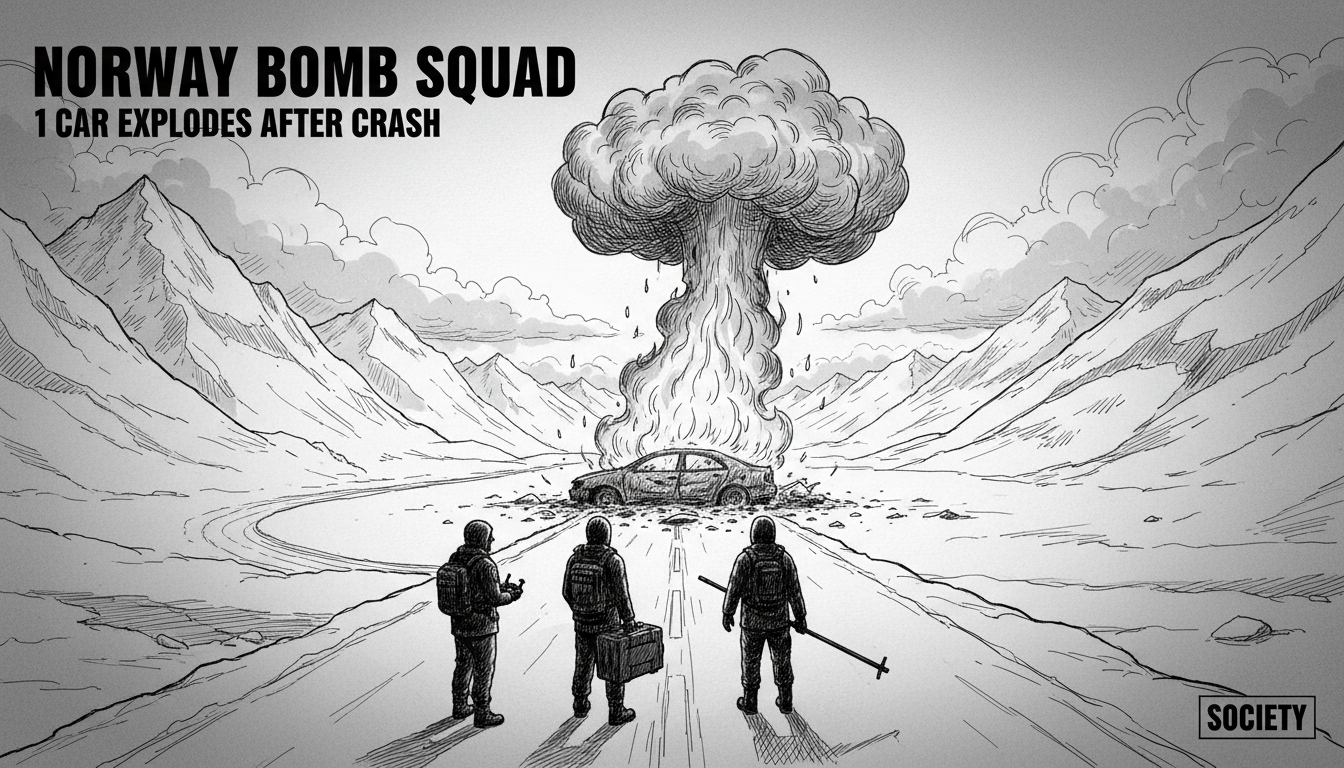
Norway's national bomb squad was deployed to a remote valley after a single-vehicle crash triggered a powerful explosion. The incident occurred in Åmot municipality in Østerdalen, a sparsely populated forested region in eastern Norway. Police reported the explosion and subsequent fire broke out around 7:10 PM, prompting an urgent response from multiple emergency agencies.
Operational leader Bård Einar Hoft confirmed the bomb squad's involvement. "We do not know what caused the fire or explosion," Hoft said in a statement. "To secure emergency personnel, we have received assistance from the bomb squad from the national emergency resources. These were flown in by police helicopter." The deployment of the specialist unit underscores the unusual and potentially hazardous nature of the incident.
A Cautious Response in Rural Terrain
The decision to call in the bomb squad, known as Bombegruppa, reflects a protocol of extreme caution. This unit is part of Norway's national emergency response apparatus, typically reserved for incidents involving explosives or suspected improvised devices. Their primary role at the scene was to clear and secure the vehicle wreckage, ensuring it was safe for other investigators to approach.
Åmot municipality lies in the heart of Østerdalen, a long, forested valley characterized by small communities and vast tracts of wilderness. The terrain and remote location added complexity to the response. Police helicopters were essential for rapidly transporting the specialist team to the site, bypassing long rural road networks.
"The involvement of the bomb squad immediately elevates the operational profile," said a former police security official who spoke on condition of anonymity. "In a standard traffic accident, even a fatal one, you would not see this unit. Their presence indicates the authorities are openly considering possibilities beyond a simple mechanical failure."
The Investigation Phase Begins
Following the bomb squad's clearance of the vehicle, a detailed forensic investigation commenced. Technical teams from the National Criminal Investigation Service (Kripos) and the Norwegian Public Roads Administration's accident investigation group moved in. Their task is dual-faceted: to determine the cause of the initial crash and to uncover the origin of the catastrophic explosion.
Vehicle explosions from accidents are statistically rare in Norway. Investigators will meticulously examine the wreckage for clues. They will analyze the vehicle's fuel system, electrical components, and any cargo it may have been carrying. The possibility of a technical defect causing a rapid fuel-air explosion is one line of inquiry. Another is whether any materials within the vehicle contributed to the blast.
Police have not released details about the vehicle's make, model, or the number of occupants. The condition of the occupants and whether there were fatalities or injuries remains undisclosed as the investigation is in its early stages. The priority has been on securing the scene and mitigating any immediate danger.
Understanding Norway's Emergency Protocols
The incident provides a real-time case study of Norway's integrated emergency response system. The bomb squad is a high-readiness asset that can be deployed anywhere in the country at short notice. Their collaboration with local police, air support units, and fire and rescue services demonstrates a tiered response strategy.
For local residents in Østerdalen, the sight of police helicopters ferrying in a national bomb team is highly unusual. The region is more associated with forestry, agriculture, and outdoor tourism than with major security incidents. This event will likely disrupt the quiet community, raising questions until authorities provide more answers.
"The system worked as designed," commented an analyst from the Norwegian Police University College. "A local district identifies a potential hazard beyond its capacity. It requests, and receives, specialized national resources within hours. The chain of command allows for rapid escalation based on observed risk, not just confirmed facts."
The Rarity of Roadside Explosions
Data from the Norwegian Public Roads Administration shows that accidents resulting in fire are uncommon, and those causing explosions are exceptionally rare. Most vehicle fires are slow-developing events that allow occupants time to escape. An explosion suggests an instantaneous and violent release of energy.
Experts point to several potential causes in a single-vehicle scenario. A severe impact could rupture the fuel tank, creating a vapor cloud that ignites. Alternatively, a compressed gas cylinder in the vehicle's cargo—such as those used for welding or camping—could breach and explode. Electrical faults in high-voltage systems, particularly in electric or hybrid vehicles, also present a complex investigation area, though these typically result in intense fires rather than detonations.
"The investigators' first job is to rule out the obvious before considering the extraordinary," said a veteran traffic accident investigator. "They will look at the physical evidence on the road, the vehicle's trajectory, and the blast pattern. The bomb squad's initial work ensures they can do that safely."
Community Impact and Ongoing Scrutiny
The road where the accident occurred was closed for an extended period, a necessary step that nonetheless affects local travel and commerce. Residents of Åmot and neighboring municipalities are awaiting information, with the unusual police activity fueling local concern and speculation.
Norwegian police are typically measured in their public communications during ongoing investigations. They balance the public's right to know with the need to preserve the integrity of their work and respect the privacy of those involved. A press conference or detailed statement is expected once the preliminary on-site investigation concludes.
The involvement of the national accident investigation group from the Public Roads Administration indicates the findings could have broader implications. Their reports often lead to recommendations for vehicle safety standards, road design changes, or driver education programs if a systemic issue is identified.
A Search for Answers in the Ashes
As night fell over Østerdalen, the scene remained active under portable lighting. Investigators in protective suits documented every piece of debris. The burned-out shell of the vehicle, now cleared by the bomb squad, is the central piece of a puzzle that authorities are determined to solve.
The questions are straightforward but critical. Was this a tragic convergence of a crash and a catastrophic vehicle failure? Or does the evidence point toward something that required the specialized skills of a bomb disposal unit? The answers lie in metallurgical analysis, chemical tests, and painstaking reconstruction.
For now, the quiet valley holds a sobering reminder of how quickly routine travel can turn into a national news story. The deployment of Norway's bomb squad to a rural roadside is an image that resonates, signaling that until proven otherwise, authorities are treating this crash as anything but ordinary. The coming days will determine if this was an unprecedented accident or an incident with far darker connotations.