
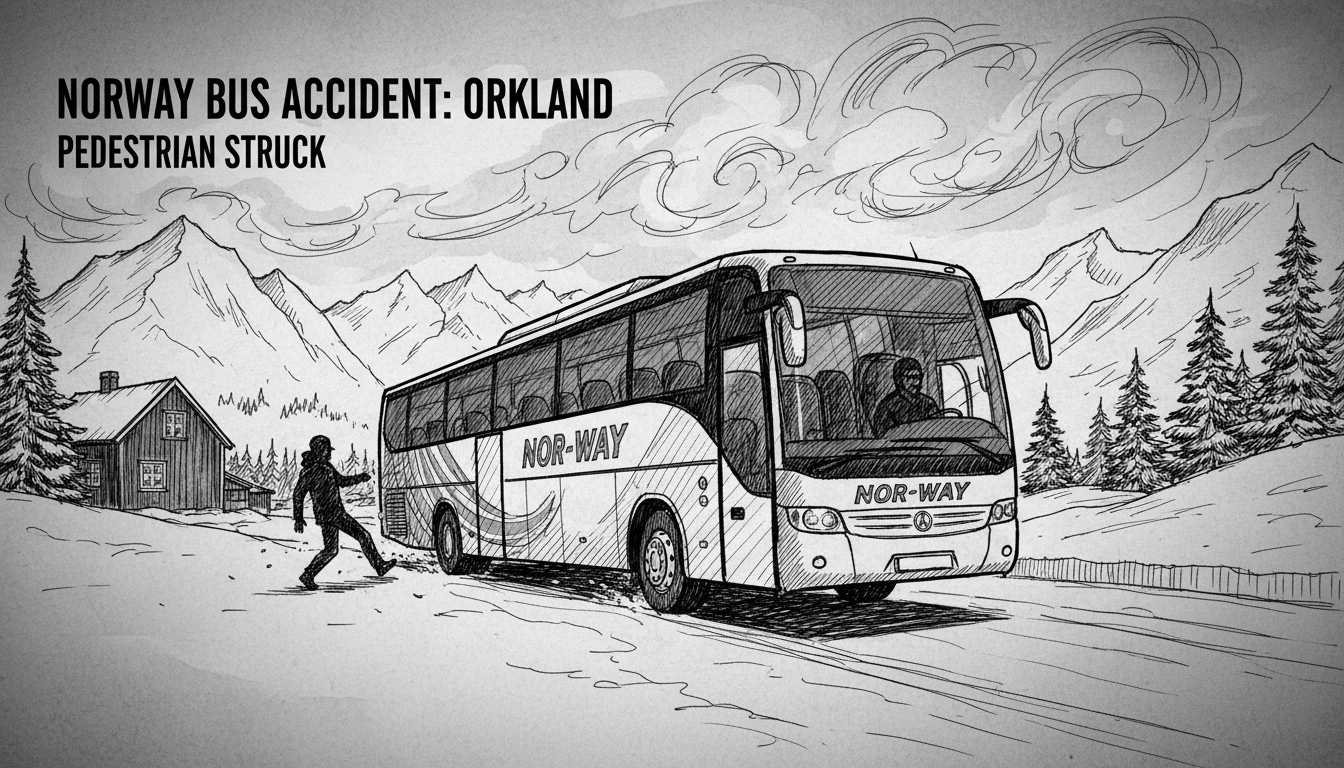
Norway emergency services responded to a traffic accident in Orkland municipality on Thursday, where a pedestrian was struck by a bus. Police confirmed the individual sustained injuries described as non-serious. The incident occurred during daylight hours and draws renewed attention to national road safety targets.
The operation commander confirmed units from police, fire, and ambulance services were dispatched to the scene. No other vehicles were involved. "Our initial priority is the well-being of the individual involved and securing the scene for investigation," the operations lead said in a statement to media. The bus driver is reportedly assisting police with their inquiries.
Location and Local Context
Orkland is a municipality in Trøndelag county, formed on January 1, 2020, through the administrative merger of the former municipalities of Agdenes, Orkdal, Meldal, and parts of Snillfjord. The area features a mix of rural roads and more concentrated town centers. This specific accident location has not been disclosed by authorities pending their investigation. Local road networks in such merged municipalities often see varied traffic flows, from local commuters to heavier transport, creating complex safety environments.
Traffic safety experts note that while Norway has some of the world's safest roads, incidents involving pedestrians and large vehicles remain a critical focus. "Every collision between a vulnerable road user and mass transport is a serious event that demands thorough analysis," said Dr. Lena Strand, a traffic safety researcher at the Institute of Transport Economics. "Factors like visibility, speed, road design, and behavior of all parties must be examined."
Norway's Road Safety Record and Goals
Official statistics from the Norwegian Public Roads Administration (Statens vegvesen) show there were 117 fatalities on Norwegian roads in 2023. This figure represents a slight increase from 2022 but follows a general long-term downward trend. The national strategy, rooted in the Vision Zero philosophy adopted in 2000, has an explicit target: to reduce annual road deaths to below 50 by 2030. This ambitious goal drives continuous policy adjustments in infrastructure, vehicle regulation, and public awareness campaigns.
The strategy encompasses the Safe System approach, which acknowledges human error but designs a transportation system to minimize consequences. Key pillars include safer roads, safer speeds, safer vehicles, and safer road user behavior. Investment in pedestrian crossings, speed reduction measures in urban areas, and technology like autonomous emergency braking on buses are part of this multi-pronged effort.
Analysis of Pedestrian-Bus Incidents
Accidents involving buses and pedestrians, while often less severe than those with heavier freight vehicles, present unique challenges. Buses have significant blind spots, particularly directly in front of the vehicle and along the sides. Pedestrians may assume a bus driver can see them, leading to risky crossings. "In urban and semi-urban areas, bus routes coincide with high pedestrian activity," explained transport analyst Erik Moe. "This requires exceptional vigilance from drivers and clear infrastructure signaling where interactions occur."
Weather and light conditions are perennial factors in Norway. Although this incident occurred during the day, the country's long, dark winters from October to March significantly increase risk for pedestrians. Reflective clothing, well-lit crossings, and street lighting are consistently emphasized in national safety messaging. Investigations into Thursday's accident will assess these environmental conditions, though initial reports did not indicate poor weather.
The National Response and Local Implications
Following any serious traffic incident, Norwegian police conduct a detailed investigation to determine cause and potential liability. The Norwegian Public Roads Administration also reviews such events for systemic learning, especially if they occur on state-managed roads. For a municipality like Orkland, managing road safety involves balancing national guidelines with local geography and traffic patterns.
The merger creating modern Orkland brought together diverse road networks with different historical standards. Municipalities are responsible for local roads, and integration can lead to accelerated upgrade projects. "Post-merger, there's often an opportunity to harmonize and improve infrastructure to the highest common standard," a municipal planning expert noted. "Safety audits become even more important."
Looking Ahead: Technology and Behavior
The path toward fewer than 50 annual road deaths by 2030 relies on technological adoption and sustained behavioral change. Norway is a leader in electric vehicle uptake, and new EVs often come equipped with advanced driver-assistance systems (ADAS). The bus fleet is also gradually modernizing. However, technology alone is insufficient.
Public education campaigns run by the Norwegian Council for Road Safety (Trygg Trafikk) persistently target both drivers and pedestrians. Messages focus on distraction, notably mobile phone use, impairment, speed compliance, and the importance of visibility. "The most advanced system is the human brain, but it must be fully engaged," said a council spokesperson. "Every trip requires focus, whether you are walking or driving a ten-ton bus."
Thursday's accident in Orkland, with its fortunate outcome of non-serious injuries, serves as a stark reminder of the constant interaction on shared roadways. It underscores the fragility of the safety margin and the continuous effort required to protect vulnerable users. As Norway pushes toward its 2030 target, each incident provides data, but the real objective is preventing the next one. The question for planners and policymakers is whether current measures are sufficient or if more aggressive intervention is needed in mixing zones between pedestrians and large vehicles.