
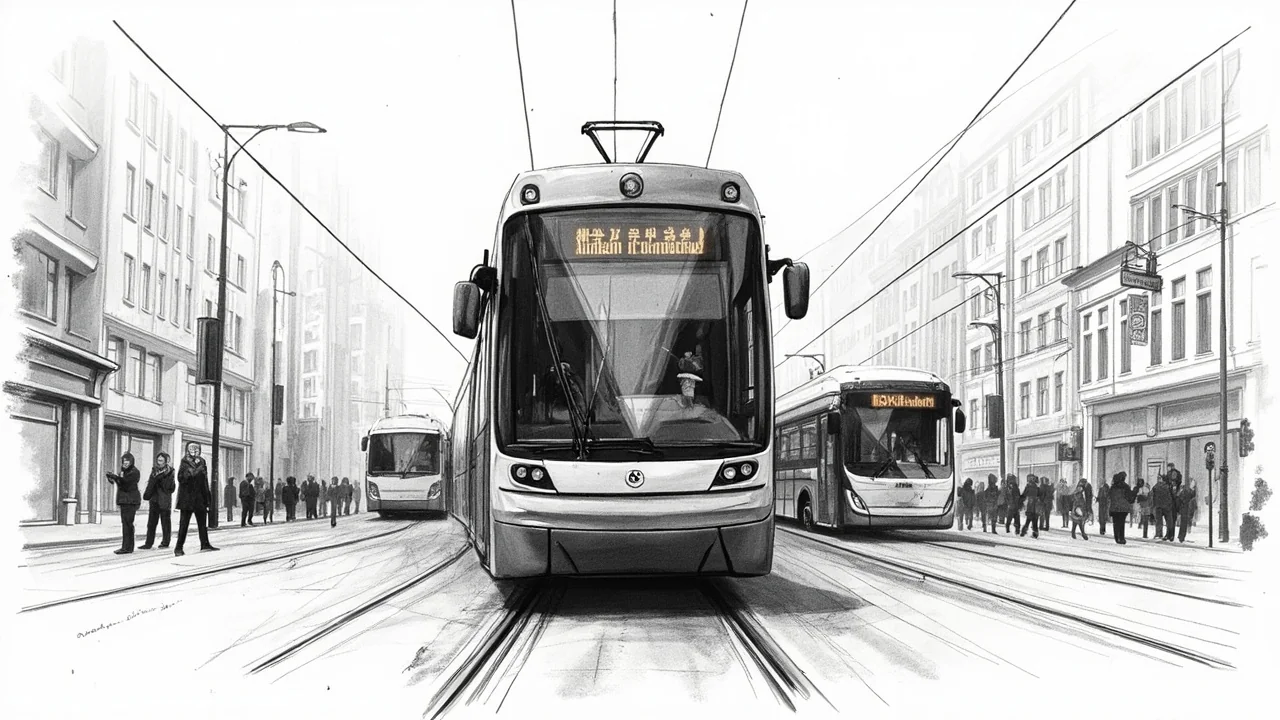
Norway's third-largest city, Trondheim, experienced a public transport paradox today when a bus broke down on tram tracks. The incident occurred in the Ila district, where a city bus with technical failures came to a halt directly on the rails used by the Gråkallbanen tram line. This blockage immediately severed the connection between the city center and the residential area of Byåsen, disrupting hundreds of morning commuters. Grethe Opsal, a representative from the public transport company AtB, confirmed the situation. "A bus has technical problems and is blocking the tram in Ila," Opsal said. AtB has ordered a recovery vehicle to remove the stranded bus, with Opsal adding, "We hope it resolves itself quite quickly." Yet, for passengers stranded on platforms, the resolution could not come soon enough.
A Clash of Modes in Ila
The specific location of the breakdown, at Ila, is a critical junction in Trondheim's transport network. Ila serves as a transfer point between bus routes and the historic tram line that winds its way to Byåsen. When one mode fails, the entire system feels the ripple effects. The Gråkallbanen tram, Norway's only remaining classic tramway, is a single-track line for much of its route. A blockage at any point means no trams can pass in either direction. This incident highlights the vulnerability of mixed-traffic corridors where trams and buses share tight urban spaces. Trondheim's compact city center, with its narrow streets along the Nidelva river, leaves little room for error. A single vehicle failure can cascade into significant delays across the network.
AtB's Response and Commuter Frustration
AtB's crisis protocol swung into action, but the physical constraints of the site complicated recovery efforts. The bus needed to be towed from the tracks without damaging the tram infrastructure, a delicate operation requiring specialized equipment. During the hours of disruption, AtB advised passengers to seek alternative bus routes, though many faced longer travel times and crowded vehicles. For daily users, this incident is not an isolated one. Minor collisions and obstructions on shared routes have occurred before, pointing to a systemic tension. "It's frustrating when the bus meant to take you to work becomes the reason you're late," said one commuter waiting at Ila station, who declined to give his name. This sentiment echoes a broader challenge for Norwegian cities: integrating diverse transport forms in historic urban layouts not designed for modern volumes.
Trondheim's Tram Legacy Under Strain
The Gråkallbanen tram is more than a transit line; it is a cultural icon, operating since 1924. Its preservation is a point of civic pride, but its coexistence with modern bus traffic tests Trondheim's urban planning. The city has invested in upgrading the tram system, including new vehicles and track improvements, yet incidents like today's reveal persistent friction points. The tram's route through residential areas like Byåsen and Marienborg is essential for reducing car dependency, a key goal of Norway's national transport policy. However, when reliability falters, public trust erodes. This breakdown comes at a time when Trondheim is debating further expansion of its light rail network, known as the Tram Loop project, which aims to better connect suburbs with the city center. Skeptics may point to today's event as evidence of shared infrastructure's fragility.
Expert Insights: Shared Infrastructure Risks
Transport analysts note that the Trondheim incident is a microcosm of challenges facing many European cities. "When buses and trams operate in the same corridor without dedicated lanes, the risk of conflict increases," explained Lars Jensen, a urban mobility researcher at the Norwegian University of Science and Technology (NTNU) in Trondheim. "Norway's cities are grappling with how to prioritize space in crowded centers. This isn't just about a broken bus; it's about the design of our streets." Jensen emphasizes that while Norway leads in electric vehicle adoption and green transport goals, physical infrastructure must keep pace. The country's Climate Action Plan calls for a 50% reduction in transport emissions by 2030, heavily reliant on boosting public transit use. Setbacks like today's disruption can hinder progress by making alternatives to private cars seem less dependable.
The Road Ahead for Norwegian Cities
For AtB and Trondheim municipality, the immediate priority is clearing the tracks and restoring service. Long-term, however, this event will likely fuel discussions on separating tram and bus traffic where feasible. Solutions could include more dedicated tram lanes, better traffic management systems, or redesigning key intersections. Other Norwegian cities like Oslo and Bergen have faced similar issues with their light rail systems, often opting for grade-separated routes in new expansions. Trondheim's topography, nestled around hills and fjords, makes such projects expensive and complex. Yet, the cost of inaction is measured in daily commuter hours lost and environmental targets missed. As Magnus Olsen, observing from Oslo, this incident underscores a national dilemma: balancing heritage infrastructure with future mobility needs.
The stranded bus in Ila is a small event with large implications. It reminds us that even in Norway, a country renowned for efficient governance and high-quality infrastructure, urban transport remains a delicate ecosystem. One vehicle's failure can expose the tight coupling of systems that citizens rely on. As Trondheim moves forward with its tram expansion plans, ensuring resilience against such disruptions will be crucial. Will Norwegian cities invest in the hard infrastructure needed to prevent tomorrow's blockage, or will they continue to react when today's bus stops on the tracks? The answer will shape the daily commutes of thousands and the nation's green transition.