
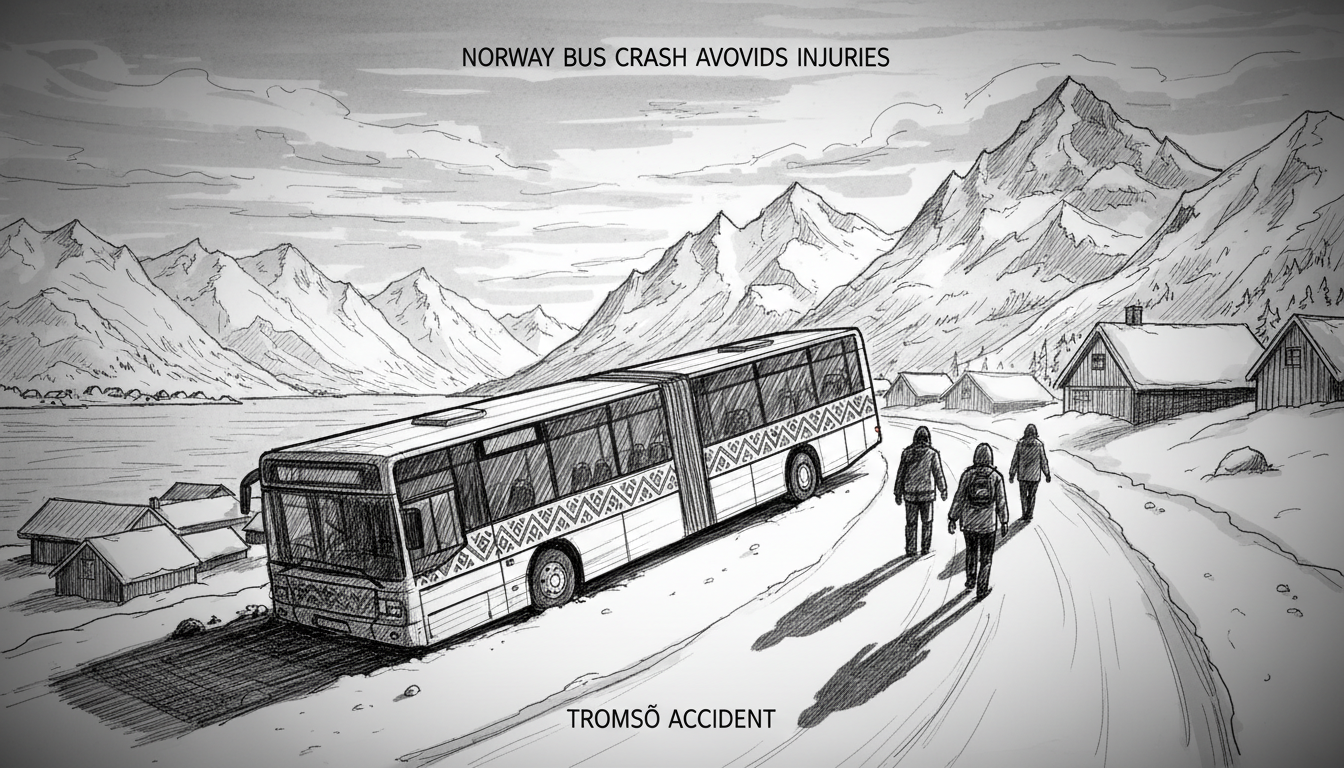
Tromsø public transport avoided tragedy Monday when a bus ended up in a roadside ditch on Tromsøya island. All passengers evacuated without injury, Troms police district confirmed, citing no reports of harm despite the vehicle's precarious position. The incident, initially reported as a rollover, involved a bus standing tilted against the ditch, according to official statements. This event underscores the perennial challenges of operating mass transit in Norway's demanding northern climate.
An Incident Amidst Arctic Normality
The bus came to rest in the ditch during normal operations on Tromsøya, the urban heart of Troms municipality. Home to over 77,000 residents, Tromsø is Northern Norway's largest city and a critical hub for commerce, education, and Arctic research. Its public transport network is a lifeline for commuters and students navigating the island's terrain. While bus accidents remain statistically infrequent across Norway, each incident triggers immediate scrutiny due to the potential for mass casualty events. The successful evacuation with zero injuries represents a best-case outcome for emergency responders.
Authorities have not released specific details regarding the number of passengers, the bus route, or the exact location beyond Tromsøya. The police statement clarified the vehicle's position, correcting earlier reports that it had fully overturned. This accurate communication prevented unnecessary public alarm. The bus operator, likely part of the Troms fylkestrafikk network, will now face an internal review. Standard procedure mandates a technical inspection of the vehicle and an interview with the driver to establish a preliminary cause.
Probing the Causes in a Harsh Environment
Transportation safety experts point to multiple factors requiring investigation after such an event in the Arctic north. Road conditions are a primary concern, especially during seasonal transitions. While not mentioned in the initial report, weather phenomena like black ice, sudden snowfall, or strong crosswinds are common hazards in the Troms region. Driver experience and training for extreme conditions are equally critical. Norway maintains strict professional driver certification, but the unique challenges of polar routes demand continuous adaptation.
Vehicle maintenance records will form another key part of the inquiry. Norway's public transport fleets are generally modern and well-maintained, with stringent annual control (EU kontroll) requirements. However, mechanical failure remains a possible contributor. The investigation will also assess road design and signage at the accident site. The term "grøfta" (the ditch) indicates a roadside drainage channel, which can pose a significant hazard if a vehicle leaves the paved surface, even at low speed.
The Ripple Effects on Northern Commuters
Beyond the immediate safety response, such incidents disrupt the daily rhythm of city life. Tromsø's public transport system is the backbone of local mobility, reducing reliance on private cars in a compact urban area. A single bus taken out of service can strain schedules and increase wait times on connected routes. The municipality must ensure alternative transportation options are available if a route is suspended for investigation. For passengers, the event serves as a psychological reminder of travel vulnerabilities, even on routine journeys.
Local politicians and transport committee members in the Troms County Council will likely request a briefing on the incident's findings. Their focus will be on preventative measures. "Every accident is one too many, and our goal is always zero," a council representative for transport typically states in such situations. Data from this event will be logged with the Norwegian Public Roads Administration (Statens vegvesen), contributing to national statistics that inform safety campaigns and infrastructure investment priorities.
A National Context of Transport Safety
This Tromsø accident occurs against a backdrop of Norway's strong road safety record. The country has some of Europe's lowest rates of traffic fatalities, a result of decades of targeted policy. Investments in safer road infrastructure, rigorous vehicle standards, and a Vision Zero philosophy have yielded results. For buses specifically, safety features like electronic stability control, advanced braking systems, and reinforced passenger compartments are standard. These technologies likely played a role in preventing injuries and a full rollover in this case.
Public confidence in bus travel remains high in Norway, supported by transparent reporting when incidents occur. The police's swift and factual communication regarding the Tromsøya event follows this pattern. It prevents misinformation and demonstrates a controlled response. The lack of injuries will be celebrated but not used to minimize the seriousness of the investigation. For the transport authority, the priority shifts from emergency response to systematic learning. The final report will recommend specific actions, which could range from driver refresher courses to minor road adjustments at the site.
Looking North: Arctic Infrastructure Under Pressure
The incident subtly highlights the broader conversation about maintaining and modernizing infrastructure in Norway's high north. The Arctic climate is punishing, with freeze-thaw cycles, heavy precipitation, and limited daylight in winter months placing extraordinary stress on roads and vehicles. As Tromsø continues to grow, its transport network must keep pace. Investments are not just about convenience but about foundational safety for all citizens, regardless of season.
This bus-in-a-ditch scenario, while ending fortunately, is a tangible example of the daily risks managed by northern communities. It tests emergency services, operational protocols, and community resilience. The successful outcome showcases effective training and passenger composure. Yet, it also asks an implicit question about how Norway will future-proof its northern public transport as climate change alters weather patterns and increases the frequency of extreme events. Will today's safety standards be sufficient for tomorrow's Arctic?