
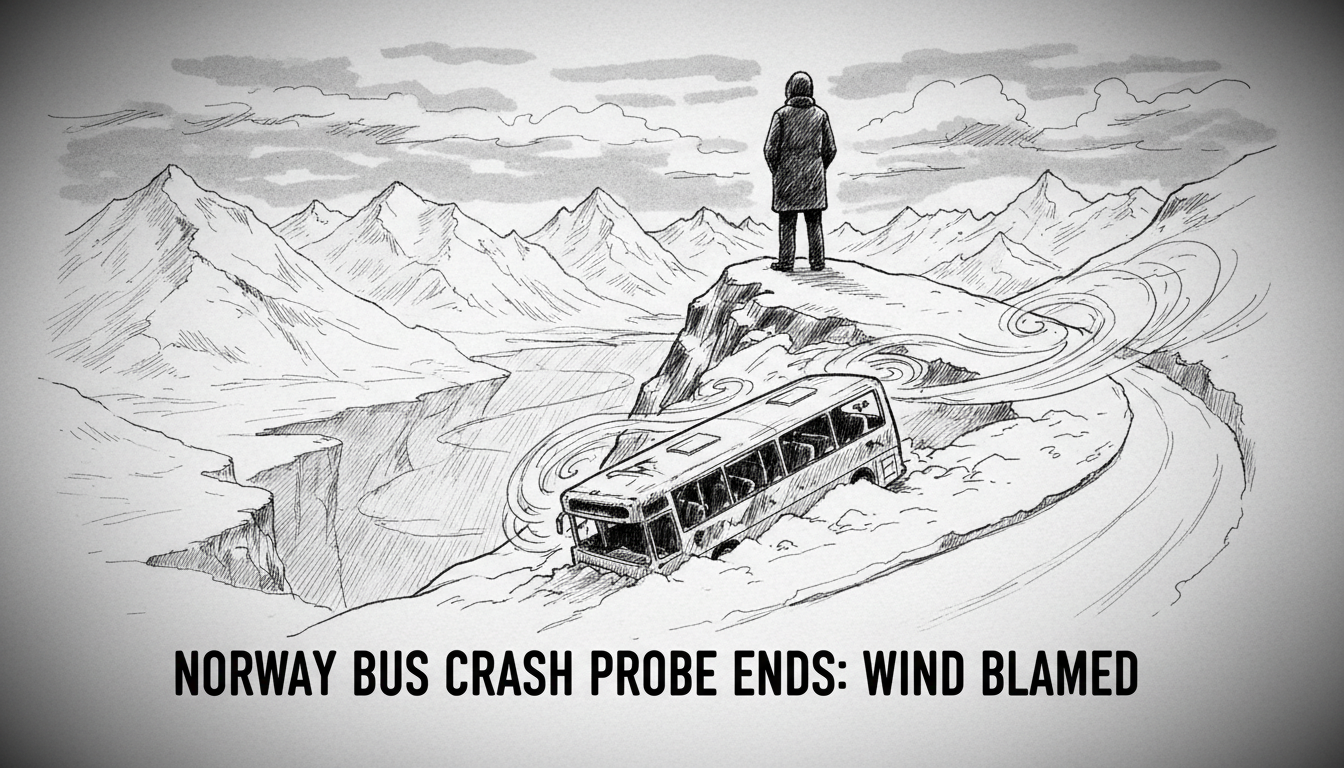
Norway's police have closed their investigation into a fatal bus crash in Hadsel that killed three people on Boxing Day 2024. The Nordland Police District announced the case closure, citing extraordinary wind conditions as the sole cause of the accident. The bus driver, who was initially suspected and had their license temporarily seized, has been cleared of all fault.
A Tragic Holiday Journey
The accident occurred on December 26, 2024, on a road in the Hadsel municipality of Nordland county. The bus was traveling in the Vesterålen archipelago, a region known for its dramatic coastal landscapes and exposed roads. Three passengers lost their lives in the incident, which sent shockwaves through the local community and the nation during the holiday period. Police immediately launched a technical investigation, standard procedure for serious traffic accidents in Norway.
Initially, the bus driver faced suspicion. Authorities followed protocol by issuing a temporary seizure of the driver's license pending the outcome of the investigation. This step is automatic in cases where a serious incident requires determining if driver error was a factor. For months, the driver awaited the findings while the police and accident investigators reconstructed the event and analyzed the vehicle.
The Investigation's Conclusive Findings
In their final statement, the police were unequivocal. "The conducted investigations have shown that it was the extraordinary wind conditions at the location that caused the accident," the police wrote. They further stated, "The bus driver cannot be blamed for the accident and there is no basis to say that speed has been a contributing cause."
This conclusion shifts the cause from human error to a natural event. The term "extraordinary wind conditions" suggests winds exceeded normal operational thresholds for the area. Northern Norway's coastal roads are frequently buffeted by strong winds, especially in winter, but investigators determined this event was beyond typical extremes. The finding absolves the driver of any criminal liability or blame for the tragic outcome.
The Challenge of Arctic Weather
Road safety experts note that this case highlights the persistent challenges of operating transport in Norway's northern regions. "The coastal stretches of Nordland and Troms are exceptionally vulnerable to sudden, powerful wind gusts," explains Lars Tennfjord, a senior advisor at the Norwegian Public Roads Administration. "While weather monitoring and warnings are sophisticated, micro-weather events can be localized and intense."
Buses, with their large surface area, are particularly susceptible to crosswinds. Drivers on exposed routes, like those crossing bridges or fjord-side roads in Vesterålen, must constantly assess conditions. However, experts stress that if winds reach a certain force, no amount of driver skill can prevent a loss of control. The investigation's result implies the bus was struck by a wind force that was both unpredictable and unmanageable.
Legal Implications of a 'Force Majeure' Finding
The police decision has significant legal implications. By attributing the cause solely to wind, they classify the event under principles similar to "force majeure"—an uncontrollable natural event. This removes grounds for any prosecution for negligence or violation of traffic laws. The driver's temporary license seizure will be formally lifted, and no charges will be filed.
"The threshold for criminal liability in such accidents requires a demonstration of fault or negligence," says Professor Ingunn Hagesæther, a legal scholar at the University of Bergen specializing in transport law. "When the police conclude that extraordinary natural conditions are the direct and sole cause, and exclude factors like speed or intoxication, the basis for any case collapses. The investigation appears to have been thorough in isolating this variable."
For the families of the victims, this conclusion provides a definitive, if painful, answer. It means there is no individual to hold criminally responsible for the deaths. The focus for any civil claims may now shift toward questions of road design, weather warning adequacy, or vehicle safety standards, though the police findings do not address these aspects.
Road Safety in Norway's North
Norway maintains one of the world's lowest rates of road fatalities, a point of national pride achieved through strict enforcement, infrastructure investment, and a zero-vison policy. However, accidents caused by extreme weather present a complex challenge. This tragedy in Hadsel forces a renewed look at the balance between mobility and safety in remote regions.
Are current weather warnings for drivers sufficient? Should weight or wind-sail standards for buses on specific routes be re-evaluated? These are questions likely to be debated in transport safety circles following this case. The Norwegian Public Roads Administration constantly updates its risk assessments, and fatal incidents provide critical, if tragic, data points.
A Community and a Driver Absolved
The closure of the police case brings a form of administrative resolution to a devastating event. For the small communities in Hadsel, where everyone is connected, the pain of losing three neighbors remains. The finding of a natural cause may foster a collective sense of a shared tragedy, rather than one attributed to an individual.
For the bus driver, the outcome brings vindication after months of uncertainty. Being initially suspected in a fatal accident carries a heavy social and psychological burden, even with the presumption of innocence. The police's clear statement that the driver "cannot be blamed" is a crucial part of the official record.
The Hadsel crash is a somber reminder of the power of nature in Norway's Arctic landscape. It underscores how, despite advanced technology and strict safety protocols, the environment can impose its will with tragic consequences. As Norway continues to develop its northern regions and transport networks, integrating resilience against such extraordinary events remains an ongoing, critical mission. How can transport systems better coexist with the fierce and unpredictable climate of the High North? The search for answers continues, even as one painful case is closed.