
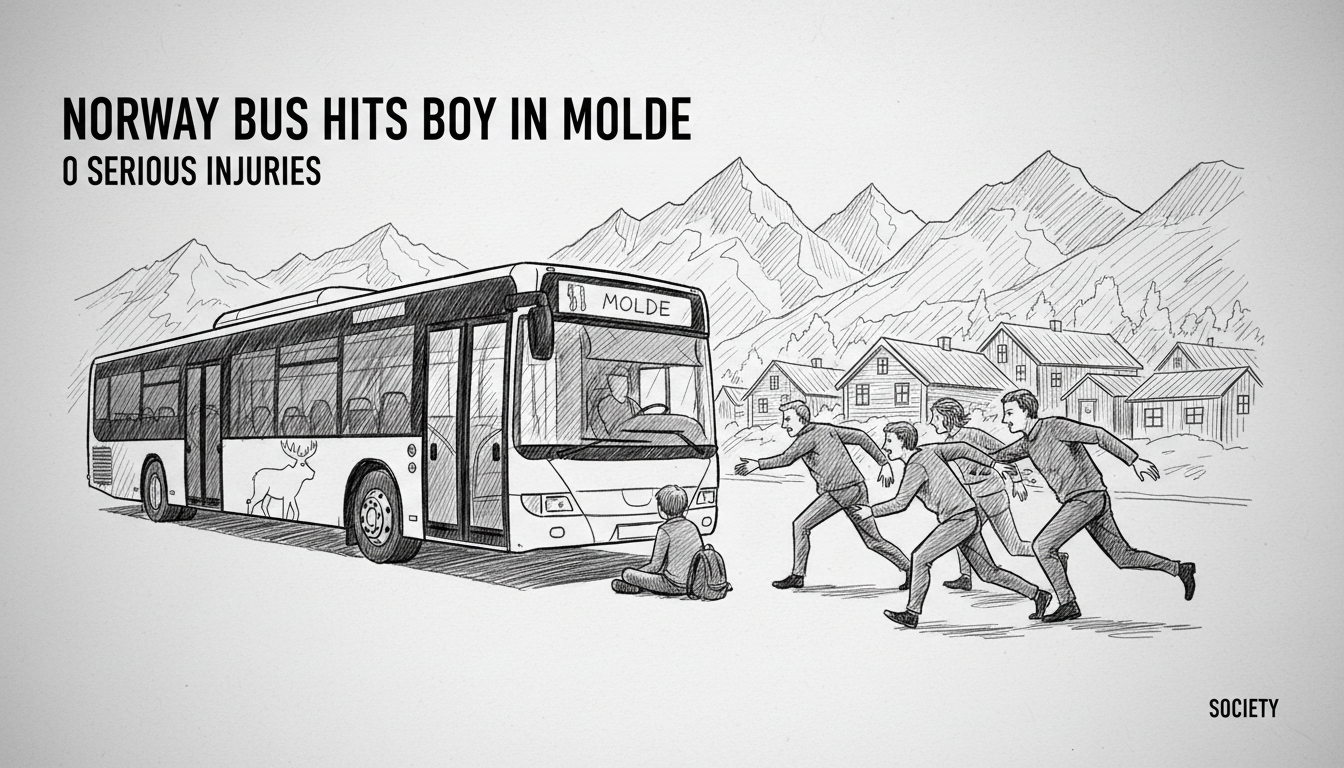
Norway police are investigating a bus-pedestrian collision on Frænavegen in Molde after a young boy was struck in a marked crosswalk. Authorities confirmed the incident appears non-serious, with the child sustaining minor or no physical injuries. The event has ignited a local conversation about road safety in the coastal municipality.
Emergency services responded to county road 538 in Molde on Thursday afternoon. A regional bus operated by Fram Møre Romsdal made contact with a young male pedestrian. Initial police reports suggested the bus front struck the boy, but investigators later clarified the impact occurred along the vehicle's side. The boy was assessed at the scene and did not require hospital transport.
"The driver has been questioned, and we have opened a case on the incident," a police spokesperson said. "We have not implemented a driver's license seizure at this time." The decision not to immediately confiscate the license suggests police do not suspect gross negligence or intoxication. The investigation will examine vehicle speed, road conditions, and visibility at the crossing.
A Close Call on a Key Corridor
Frænavegen, designated as county road 538, is a vital arterial route connecting Molde to surrounding districts in the Romsdal region. It carries significant commuter and commercial traffic, including regular bus services. The accident site, within Molde's urban area, features a designated pedestrian crossing, highlighting the constant interaction between vehicles and foot traffic.
Local residents expressed relief that the outcome was not more severe. "You hear about these things and your heart stops, especially when it involves a child," said Kari Larsen, who lives near the route. "It's a busy road, and people sometimes drive too fast past the crossings. We're just thankful the boy is okay." Her sentiment reflects a common concern in Norwegian towns where main roads bisect residential zones.
Molde, known for its panoramic view of the Romsdal Alps and its international jazz festival, has a population of approximately 32,000. Like many Norwegian municipalities, it faces the ongoing challenge of balancing efficient transport with stringent Vision Zero safety goals, which aim to eliminate all traffic fatalities and serious injuries.
The Investigation and Safety Protocols
Norwegian police follow a standardized procedure for traffic incidents. The Molde collision triggers an assessment of road layout, signage, and driver actions. Traffic accident investigators will likely examine skid marks, take measurements, and review any available dashcam footage from the bus or nearby vehicles. The bus company, Fram, is also conducting its own internal review as per standard safety management protocols.
"Every incident, even those without serious injury, is a learning opportunity," said transport safety analyst Henrik Ødegård. "The key questions are: Was the crossing design adequate? Was the driver's sight line obstructed? Was the pedestrian visible and acting predictably? Norway has excellent road safety standards, but continuous improvement relies on investigating these near-misses."
Ødegård noted that bus-pedestrian accidents, while relatively rare in Norway compared to other vehicle types, carry high potential consequences due to the mass and size of the vehicles. He emphasized that driver training for urban routes focuses intensely on scanning for vulnerable road users, particularly at intersections and crossings.
Norway's Pedestrian Safety Landscape
This incident occurs within the context of Norway's generally strong road safety record. The country has some of Europe's lowest rates of traffic fatalities. In 2023, preliminary figures showed 86 road deaths in Norway, a historic low. Pedestrian fatalities have also declined steadily due to lower urban speed limits, improved lighting, and traffic calming measures.
However, safety advocates argue complacency is not an option. "The trend is positive, but each accident reminds us that the work is never done," said Lisa Wang, a researcher at the Institute of Transport Economics. "Protecting children and elderly pedestrians is a particular priority. Near schools and in residential areas, we must constantly evaluate whether physical infrastructure and speed enforcement match the safety ambition."
Norwegian law gives pedestrians clear priority at marked crosswalks. Drivers are obligated to yield and prepare to stop. Failure to do so can result in substantial fines and license penalties, especially if an accident occurs. The legal framework places a significant duty of care on drivers in these zones.
Local Response and Preventive Measures
Following the Molde incident, local politicians have called for a review of safety on Frænavegen. "We must use this event to check all our pedestrian crossings," said Molde municipal council representative Per Bjørnstad. "Are they in the right places? Are they sufficiently marked and lit? We will request a report from the police and our own technical department to see if preventive measures are needed."
Possible interventions include enhanced road markings, installing flashing warning lights activated by pedestrians, or even considering a slight reduction in the speed limit on that stretch. The municipality of Molde, in cooperation with the Norwegian Public Roads Administration, which manages county roads, holds responsibility for implementing such measures.
Bus operator Fram Møre Romsdal reiterated its commitment to safety in a brief statement. "Our thoughts are with the young person and his family. We are cooperating fully with authorities and will use the findings to reinforce our safety culture," the company said. Fram operates a large fleet across Møre og Romsdal county and conducts regular driver safety training.
A National Focus on 'Vision Zero'
The Molde event is a minor incident within Norway's ambitious Vision Zero policy. Adopted from Swedish models, Vision Zero is an ethical principle that no loss of life on the roads is acceptable. It shifts responsibility from individual road users to system designers—planners, engineers, and policymakers. The approach has led to widespread use of roundabouts, median barriers, and automated speed cameras.
For pedestrians, this has meant more raised crosswalks, extended curbs, and islands that shorten crossing distances. In city centers like Oslo, car access has been radically reduced, leading to a dramatic drop in accidents. The challenge lies in applying these principles consistently across smaller towns and on regional roads like Frænavegen, which serve multiple transport functions.
"Vision Zero means investigating every incident, not just the fatal ones," Wang explained. "A non-injury accident can reveal the same systemic flaw as a fatal one. The response in Molde—a police investigation, a company review, and political scrutiny—is exactly how the system should work to prevent future harm."
The Human Element in Traffic Safety
Beyond engineering and regulation, the human factor remains critical. Driver attention, pedestrian awareness, and shared responsibility define daily interactions on the road. The boy involved in the Molde accident reportedly suffered no major injuries, a fortunate outcome that spares a family tragedy. Yet the psychological impact on the child, the driver, and witnesses can be significant.
Norwegian driver education includes modules on the psychological trauma of being involved in an accident, even a minor one. Support systems exist through employer programs and public health services. For the pedestrian, especially a child, municipalities often provide follow-up contact from health services to address any anxiety about returning to normal activities near roads.
As the investigation in Molde continues, the primary focus remains on understanding the precise sequence of events. The police have not released the boy's age or further details, citing privacy concerns for minors. The case will be concluded with a determination of fault or a finding of no criminal liability, often classified as an "unfortunate traffic accident."
Looking Ahead: Safety as a Continuous Process
The Molde bus incident will likely fade from headlines quickly, given the lack of serious injury. But its value as a case study in preventive safety endures. It tests the responsiveness of local institutions, the rigor of investigation protocols, and the willingness to invest in minor infrastructure improvements. In Norway's safety-centric transport culture, even a near-miss warrants a systematic response.
For international observers, Norway's handling of such an event demonstrates a core national characteristic: a profound, institutionalized aversion to preventable risk. This applies equally to offshore oil platforms, mountain highways, and urban crosswalks. The goal is not just to reduce accidents, but to engineer environments where human error does not lead to catastrophic outcomes.
The young boy in Molde will hopefully remember this only as a scare. For the community, it is a reminder that the safe, walkable towns Norway is famous for require constant vigilance, investment, and a collective commitment to protecting the most vulnerable among us, one crosswalk at a time.