
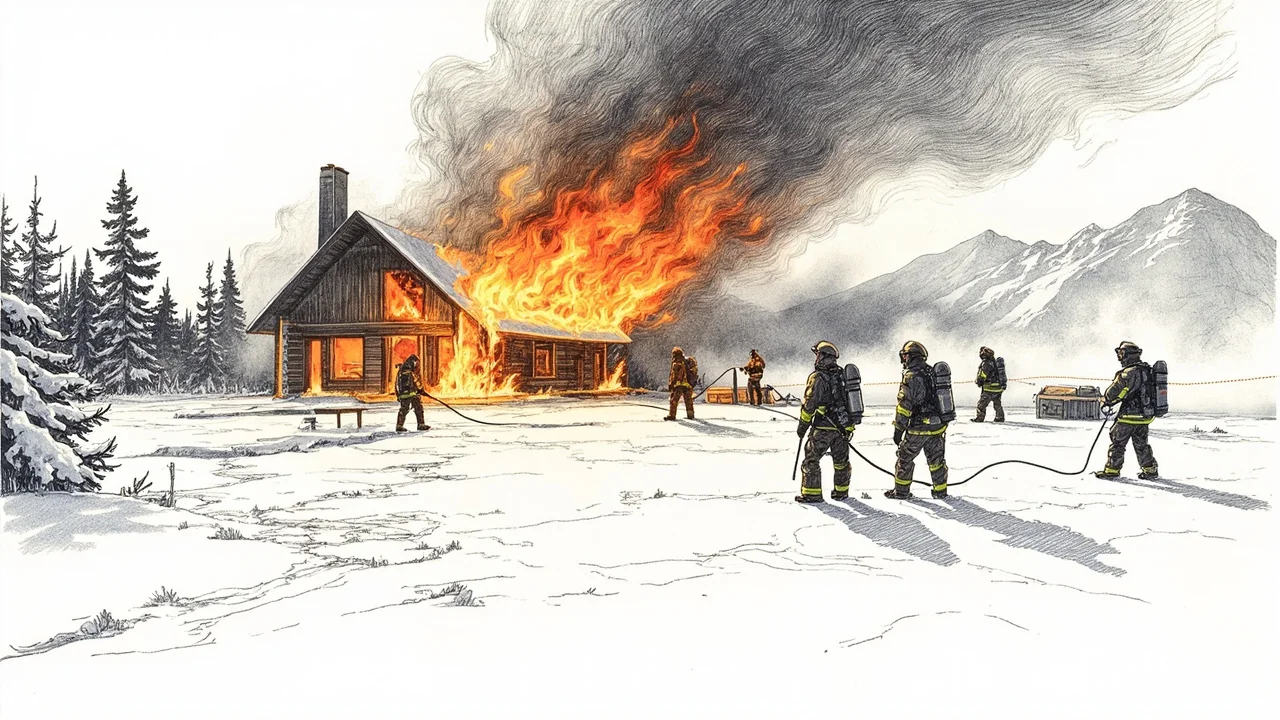
Norway's emergency services are responding to a cabin fire in Tuddal, Telemark, after a propane tank on the property triggered a major safety alert. Police helicopters have airlifted personnel to the remote site, where a 100-meter safety perimeter has been established. All occupants evacuated safely before the fire took hold, according to authorities.
This incident highlights the persistent risks associated with Norway's deep-rooted cabin culture, where remote locations and common use of propane for heating and cooking create unique challenges for first responders. The lack of a drivable road to the cabin in Tuddal significantly delayed the firefighting effort, a recurring issue in mountainous regions.
The Remote Response Challenge
Emergency coordination centers received the alarm for the Tuddal cabin fire in the early afternoon. Standard procedure for structure fires in populated areas involves a rapid dispatch of fire engines. This scenario was different. Initial reports confirmed a large propane tank was on the property, immediately elevating the risk level from a standard fire to a potential explosive hazard.
The terrain dictated the response. With no vehicle access to the cabin itself, the local police dispatch scrambled its helicopter. The aircraft, an Airbus H145, was tasked with inserting the first team of police and fire personnel directly at the scene to assess the threat and establish control. This air-mobile approach is a critical part of Norway's emergency protocol for incidents in its vast rural and mountainous areas.
"When we have a confirmed gas tank involved, distance becomes our primary tool for safety," a senior operations manager for the South-Eastern Police District said in a statement. "The 100-meter zone is non-negotiable until we can confirm the tank's integrity and temperature." This protocol is designed to protect emergency crews from the lethal threat of a boiling liquid expanding vapor explosion (BLEVE).
A Nation's Love Affair with the 'Hytte'
The cabin, or 'hytte', is a cornerstone of Norwegian identity. Over 400,000 of these recreational homes dot the coastline, mountains, and forests. They range from rustic, electricity-free log buildings to modern, well-appointed dwellings. A significant portion, especially older or more remote cabins, rely on propane tanks for cooking, refrigeration, and heating. These 45-kilogram steel cylinders are a common sight.
This dependency creates a specific vulnerability. While electric heating is becoming more common, the infrastructure is not universal in remote areas. The Norwegian Directorate for Civil Protection (DSB) has long emphasized the risks of gas systems in cabins that are often left unattended for weeks. Leaks can build up, and electrical faults or faulty installations can ignite them.
"The cabin is a place for relaxation, but safety cannot take a holiday," noted Lars Erik Borge, a fire safety advisor with the DSB, in a recent public awareness campaign. "We see the same factors repeatedly: aging gas systems, candles left unattended, and fireplaces that haven't been properly cleaned. Distance from professional help turns a small fire into a total loss."
Safety Versus Accessibility in the Fjords
The Tuddal fire underscores a broader policy tension. Norwegians fiercely defend the right to build and access remote properties, a tradition tied to friluftsliv, or 'open-air life'. Planning regulations have historically been lenient regarding access roads for private cabins. This preserves the natural environment but complicates emergency service delivery.
Municipalities bear the responsibility for emergency preparedness, and the cost of specialized responses—like helicopter deployments—is significant. Some local governments are now pushing for stricter requirements for new cabin builds, including mandates for better access routes or the installation of on-site water storage for firefighting.
There is no simple solution. Improving roads can be environmentally damaging and prohibitively expensive. The current system relies on a mix of local volunteer fire brigades, helicopter services, and the expectation that cabin owners take primary responsibility for their own safety. The DSB recommends all cabins have multiple fire extinguishers, working smoke detectors, and clearly marked addresses for air rescue teams.
The Aftermath and Ongoing Risks
As of evening, the fire in Tuddal was reported to be under control. The critical phase was ensuring the propane tank was cooled and did not rupture. Firefighters likely used unmanned monitors or carefully controlled streams of water from a safe distance to achieve this. The cause of the blaze is not yet known and will be investigated once the site is declared safe.
This incident is far from isolated. Each year, hundreds of cabin fires are reported across Norway. While most do not involve the dramatic element of a gas tank threat, the outcome is often the same: a total loss. The financial and emotional impact is profound, as these properties are often family heirlooms, passed down through generations.
The Norwegian insurance industry has taken note. Companies like Gjensidige and Tryg adjust premiums based on a cabin's remoteness, firefighting water access, and primary heating source. A cabin with an old propane system and no road access may pay considerably more for coverage than a modern, electrically heated cabin near a lake or with a dedicated fire hydrant.
A Cultural Reckoning with Risk
The Tuddal fire is a small drama in the Norwegian landscape, but it speaks to a larger story. It represents the collision between a cherished cultural tradition and the immutable laws of physics and risk management. The sight of a police helicopter circling a burning cabin in a peaceful valley is a powerful image of this conflict.
Authorities walk a fine line. They must promote safety without being seen as attacking a fundamental part of national life. The messaging focuses on owner responsibility: check your gas lines, clean your chimney, install detectors, and have an evacuation plan. For many Norwegians, the cabin represents freedom from rules and worry—a paradox that emergency services must constantly navigate.
As the investigation in Tuddal proceeds, the conversation will briefly resurface in community meetings and local news. The question remains: In a country defined by its breathtaking, challenging geography, how much risk is an acceptable price for a piece of solitude? The charred remains of a cabin, and the swift, expensive response it required, provide no easy answers, only a reminder that nature and fire show no respect for tradition.