
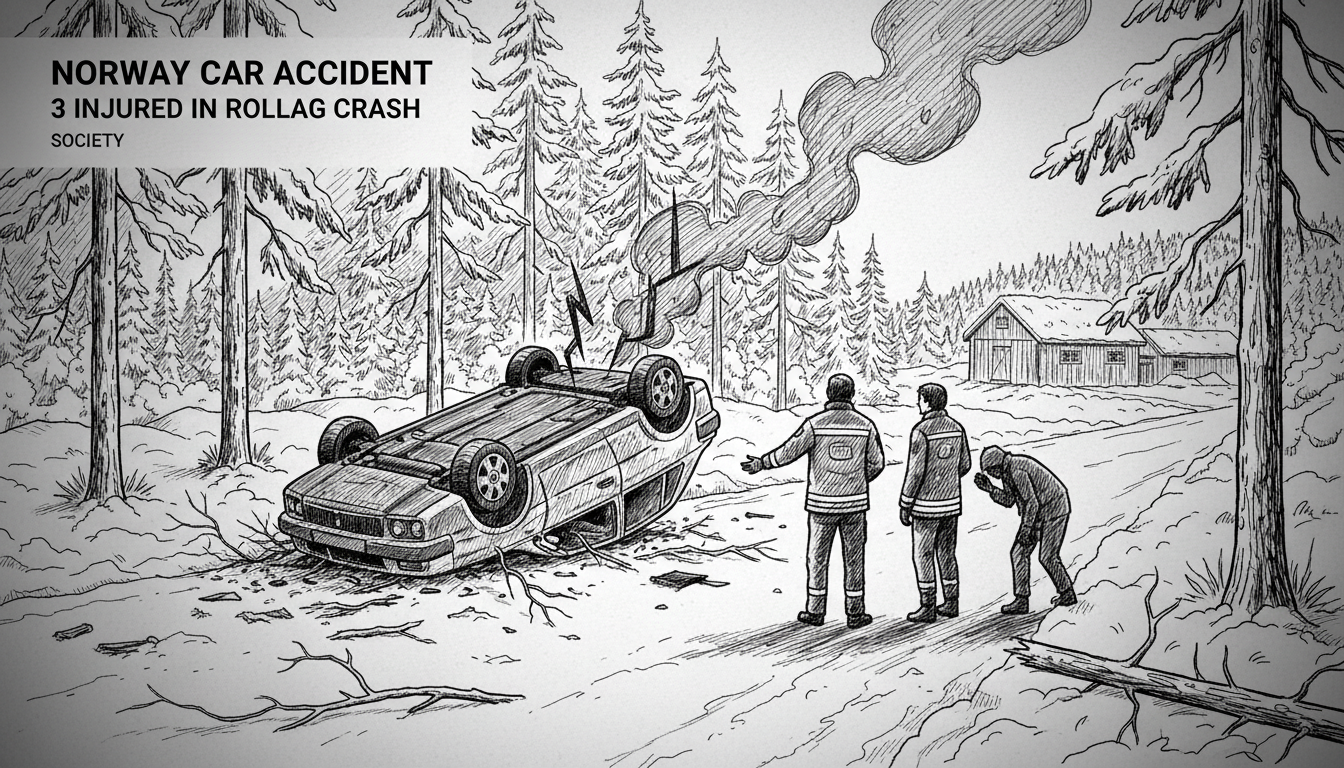
Norway car accident on Fylkesvei 40 has left three people hospitalized after their vehicle left the road near Stærnes in Rollag municipality. A man in his 30s, a woman in her 20s, and a three-year-old child were all transported for medical checks following the Friday evening collision. Police have registered the incident and will conduct a full investigation.
Emergency services responded rapidly to reports of the serious traffic accident. The crash occurred on a stretch of County Road 40, a vital artery through the Numedal valley. This route sees significant traffic, particularly during weekends, connecting southern towns with mountain destinations.
The Scene on a Rural Norwegian Road
Operational commander Jan Kristian Johnsrud confirmed the basic details shortly after the 4 PM incident. "It is a car that has driven off the road and several people are involved," Johnsrud said in a statement. The police district for South-East Norway mobilized resources to the remote location.
Initial reports indicate no other vehicles were involved. The single-vehicle accident suggests possible factors like driver error, mechanical failure, or an attempt to avoid an obstacle. Norway's extensive network of county roads, while generally well-maintained, presents challenges with changing weather and wildlife crossings.
Rollag municipality, part of Viken county, features a landscape of forests and traditional wooden architecture. The area's roads wind through valleys where conditions can shift quickly. Friday evening light in late autumn creates long shadows and reduced visibility, factors investigators will consider.
Understanding Norway's Road Safety Landscape
This accident occurs within a national context where road safety receives high priority. Norway consistently ranks among countries with the lowest traffic fatality rates globally. The government's Vision Zero policy aims to eliminate all serious injuries and fatalities on Norwegian roads.
Despite this strong record, rural roads like Fylkesvei 40 present particular risks. Traffic safety experts note that single-vehicle departures from the roadway account for a significant portion of serious accidents outside urban areas. These often involve complex interactions between speed, road design, and driver attention.
"Every accident is a tragic reminder that our work is never done," said a senior advisor with the Norwegian Public Roads Administration, speaking generally about road safety. "We analyze each serious incident to see if road engineering, signage, or other measures could prevent similar events."
Fylkesvei 40 runs approximately 150 kilometers from Kongsberg to Geilo. It serves as a primary route for local communities, tourism, and commercial transport. The road passes through varied terrain, with sections requiring careful driving.
The Human Cost and Emergency Response
The inclusion of a young child among the injured highlights the profound human impact of traffic collisions. All three occupants were taken to hospital for examination, a standard procedure following accidents of this nature. Their current conditions have not been disclosed, respecting Norwegian privacy regulations.
Norway's emergency response system integrates police, ambulance, and often local volunteer fire services. In rural municipalities like Rollag, this network depends on coordinated communication across large geographical areas. The effective response demonstrates this system's reach.
Medical evaluation following traffic trauma typically assesses both visible injuries and potential internal or psychological effects. Even accidents without immediate life-threatening injuries can result in long-term consequences, which Norwegian health services track carefully.
Community support networks in small municipalities often activate following such incidents. The social fabric of rural Norway means accidents affect not just individuals but entire networks of neighbors and acquaintances.
Investigation and Preventive Measures
Police confirmed the case has been formally reported and will be followed up during daytime hours. This process involves traffic investigators examining the vehicle, road surface, and any available witness statements or camera footage. Officers will look for technical defects, tire marks, and environmental factors.
Determining causation requires methodical work. Investigators may assess driver factors like fatigue or distraction, vehicle factors like brake failure, and road factors like surface condition or signage. The final report could take weeks to complete.
Data from such investigations feed into national safety programs. The Norwegian Public Roads Administration maintains detailed accident statistics, identifying high-risk road segments. Engineering countermeasures might include improved guardrails, better road markings, or altered speed limits.
Vehicle safety standards in Norway are among the world's highest. Regular mandatory inspections (EU kontroll) aim to identify mechanical problems before they cause accidents. The crashed vehicle will undergo thorough technical examination.
The Broader Context of Regional Transport
This accident touches on ongoing discussions about maintaining safe infrastructure across Norway's vast and sparsely populated regions. County roads are the lifelines for many communities, yet funding for upgrades and maintenance must be prioritized across a huge network.
Fylkesvei 40's role as a tourist route to mountain areas adds seasonal traffic fluctuations. Drivers unfamiliar with the road's specific characteristics may be overrepresented in accident statistics. Information campaigns often target these user groups.
Norwegian authorities continuously balance accessibility with safety. Road improvement projects compete for funding with other public needs. Each serious accident renews debate about whether specific stretches require accelerated investment.
Local politicians in Rollag and neighboring municipalities will likely monitor the investigation's findings. Their input helps regional transportation authorities set priorities for the coming years' investment plans.
A Look at Seasonal and Environmental Factors
Autumn in inland Norway brings specific driving challenges. Falling leaves can create slippery conditions, especially after rain. Temperature fluctuations around freezing cause ice formation, particularly on shaded road sections and bridges.
The period around dusk is statistically associated with increased accident risk. The transition from daylight to darkness reduces depth perception and contrast. Drivers may fail to adjust their speed adequately for the reduced visibility.
Wildlife represents another constant hazard on rural Norwegian roads. Moose and deer crossings are common, and collisions with these large animals can be devastating. Attempting to avoid an animal can lead to vehicles leaving the roadway.
Road maintenance crews work to mitigate these risks through salting, sanding, and clearing drainage. However, conditions can change rapidly between routine patrols. Drivers bear ultimate responsibility for adapting to the actual road environment.
What Comes Next for the Victims and the Road
The immediate focus remains on the well-being of the three individuals involved. Norway's universal healthcare system ensures they receive necessary treatment without financial barrier. Longer-term support for rehabilitation may be required depending on the injuries sustained.
For the community, the accident serves as a sobering reminder of traffic's inherent dangers. Local schools and organizations may revisit safety education programs. Norwegian schools extensively incorporate road safety into their curricula from an early age.
The stretch of Fylkesvei 40 near Stærnes will see increased attention from road authorities. Engineers may conduct a fresh safety audit, evaluating whether existing measures function as intended. Even minor adjustments can sometimes yield significant safety improvements.
Norway's commitment to Vision Zero means no serious accident is dismissed as inevitable. Each triggers analysis and, where justified, action. The goal remains creating a transport system where human fallibility does not lead to death or serious injury.
As police continue their investigation, the broader questions persist. How can a nation with such advanced safety standards further reduce risks on its rural roads? The answers require continuous effort from engineers, policymakers, and every driver who gets behind the wheel.