
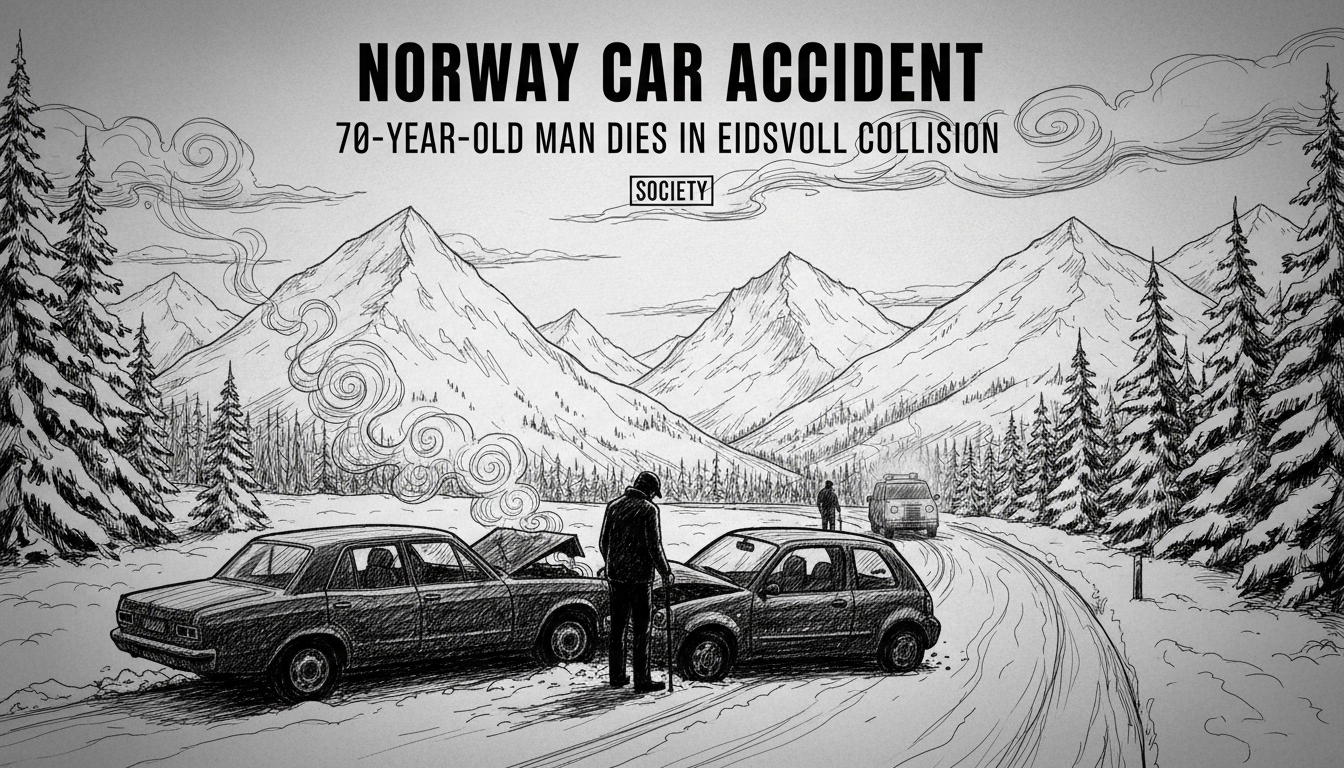
Norway car accident investigators are working to determine the cause of a fatal head-on collision in Eidsvoll. A man in his 70s died after his vehicle collided with another car on a slippery road. The other driver involved was reported to be unharmed, considering the circumstances of the crash.
Police suspect one vehicle crossed into the oncoming lane. Operations leader Ørjan Hustad from the East Police District confirmed the man's next of kin have been notified. The incident adds to Norway's ongoing road safety challenges as the country pursues an ambitious goal of zero traffic fatalities.
A Tragic Morning on Eidsvoll Roads
Emergency services responded to the scene of the collision on Tuesday morning. The force of the impact left both vehicles with significant damage. Paramedics provided immediate critical care to the elderly driver before transporting him to a nearby hospital. Despite medical efforts, he succumbed to his injuries shortly after arrival.
Police conducted a detailed forensic examination at the accident site. They also collected a statement from a witness who observed the crash. Initial reports from the scene indicated road conditions were slippery at the time. This factor will form a key part of the police investigation into the precise sequence of events.
The Persistent Challenge of Winter Roads
Norway's climate presents unique dangers for drivers, especially during seasonal transitions. Icy patches and black ice are common hazards that require heightened vigilance. Traffic safety experts consistently stress the legal and practical necessity of winter tires during colder months. They also recommend reducing speed and increasing following distances when conditions deteriorate.
"Every accident is a complex interplay of factors," said a senior traffic investigator, who spoke on background. "We look at vehicle speed, tire condition, driver attention, and external road factors. Slippery conditions demand a significant adjustment in driving behavior that not all motorists fully appreciate." The investigation will examine if proper tires were fitted and if speed was appropriate for the conditions.
Norway's Vision Zero Ambition
This fatality occurs against the backdrop of Norway's long-term road safety strategy. The government's Vision Zero initiative aims to eliminate all serious road injuries and fatalities. Preliminary figures for 2o22 recorded 116 road deaths in Norway. The national target is to reduce this number to below 50 per year, moving steadily toward the ultimate zero goal.
Vision Zero is based on the ethical principle that loss of life is unacceptable. It shifts responsibility from individual drivers to a shared duty between road users, vehicle makers, and infrastructure planners. The approach has led to widespread measures like lower speed limits in urban areas, more roundabouts, and improved road grading. Each fatal accident triggers a review to identify systemic improvements.
The Human Cost Behind the Statistics
While statistics frame the policy discussion, each number represents a profound personal tragedy. The death of the man in his 70s will resonate through his family and community in Eidsvoll. The municipality, historically significant as the birthplace of the Norwegian constitution, is a tight-knit area where such news travels quickly.
The other driver, though physically unharmed, will likely grapple with the psychological impact of the collision. Police noted this driver was "doing well under the circumstances," a phrase that acknowledges the inevitable emotional trauma. Support services are often engaged following serious accidents to assist those involved.
Investigating the Cause
The police investigation will follow a standard protocol for serious traffic accidents. Forensic teams document vehicle positions, skid marks, and debris patterns. They will download data from the vehicles' event data recorders, similar to black boxes in airplanes. This information can reveal speed, braking activity, and steering inputs moments before the crash.
Witness statements provide crucial context about driver behavior and environmental conditions. The report of slippery roads will be corroborated with weather data from the exact time and location. Investigators will also check if any road maintenance or salting was scheduled for that stretch. Determining whether the vehicle crossed the center line due to driver error, a medical episode, or loss of control on ice is a primary objective.
A National Conversation on Safety
Every fatal accident renews public debate about road safety in Norway. Discussions often focus on winter tire regulations, the adequacy of road maintenance, and the enforcement of speed limits. Some advocates call for more advanced driver assistance systems in all vehicles, such as lane departure warnings and automatic emergency braking.
Others emphasize the need for continuous driver education, especially for older motorists. Norway has a high rate of car ownership among seniors, who value the independence it provides. Ensuring they can assess their fitness to drive and understand modern vehicle safety features is an ongoing challenge.
The Road Ahead for Eidsvoll
Local authorities in Akershus county will review the accident site. Engineering assessments might consider if road design or signage could be improved to prevent similar tragedies. Even small changes, like anti-skid surface treatments or improved lane markings, can enhance safety.
The community will mourn the loss of one of its residents. The accident serves as a stark reminder during a season when road conditions can change rapidly. It underscores the message that safe arrival is more important than speedy travel.
As police complete their investigation, the findings will contribute to Norway's broader safety data. Each report helps refine strategies to protect drivers, passengers, and pedestrians. The country's progress toward Vision Zero is measured in painful, individual losses. The death in Eidsvoll represents both a failure of the current system and a catalyst for its improvement. The ultimate question remains: how many more tragedies must occur before the goal of zero is reached?