
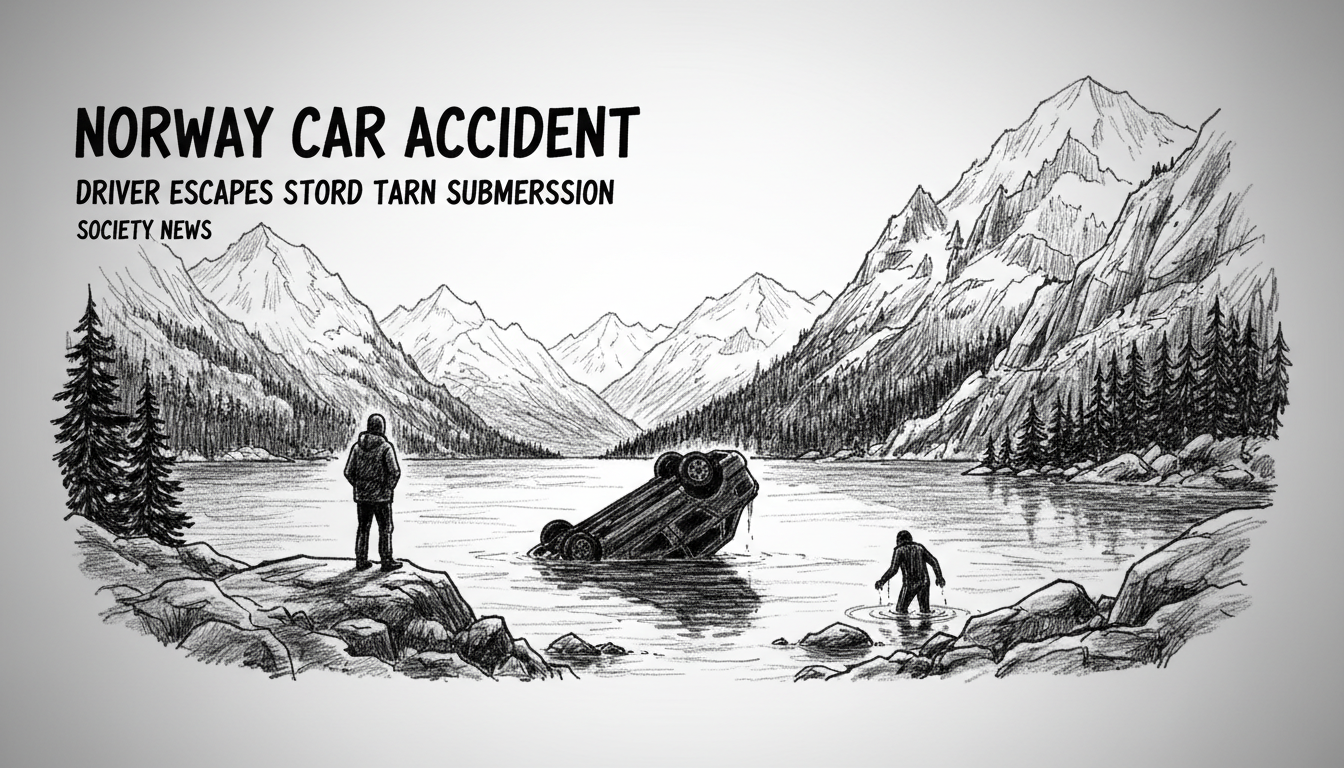
Norway road accidents often involve challenging winter conditions, but a dramatic overnight incident on the island of Stord ended with a fortunate escape. A man was transported to an emergency clinic by ambulance after the car he was driving ended up in a small mountain lake, known locally as a tarn, in the early hours of Monday. The driver managed to free himself from the partially submerged vehicle, climb onto the ice, and get out of the water before emergency services arrived.
"The man got out of the car and got up on the ice and out of the water, while the car was halfway under water," said operations manager Steinar Knudsen of the South-West Police District. The local fire department was tasked with the complex operation of retrieving the vehicle from the cold, icy tarn. Police indicate the cause remains unclear but point to a loss of control. "The car has probably hit a guardrail for an unknown reason and gone sideways before ending up in the tarn," Knudsen added.
A Miraculous Escape in Icy Waters
The sequence of events suggests a harrowing few minutes for the driver. After the vehicle left the road and entered the tarn, it became partially submerged. The presence of ice on the water's surface, while potentially a contributing factor to the accident's severity, may have also provided a precarious platform for the driver's escape. Exiting a vehicle as it sinks, especially in near-freezing conditions, requires presence of mind and physical effort. The fact the driver succeeded and was able to summon help marks this as an incident with a far better outcome than initial reports might suggest.
Emergency response protocols in rural and island municipalities like Stord are tested by such events. The coordination between police, ambulance services, and the fire department is crucial. Retrieving a vehicle from a body of water is a technical operation, requiring specialized equipment to prevent environmental contamination from vehicle fluids and to secure the scene for investigation. The South-West Police District, responsible for the region, will now oversee a standard post-accident procedure.
The Investigation and Road Safety Context
Norwegian accident investigators, often from the Public Roads Administration in collaboration with police, will examine multiple factors. The primary focus will be on determining why the vehicle left the roadway. Investigators will meticulously document the scene, examining tire marks, road surface conditions, and the damaged guardrail, referred to as an "autovern." This metal barrier is designed to prevent vehicles from leaving the road entirely, but in this case, it appears the impact was severe enough to deflect the car over or through it and into the adjacent tarn.
Road conditions at the time are a key line of inquiry. Was the road icy or wet? Was visibility poor due to the time of day—late night or early morning? The driver's condition will also be part of the standard investigation, ruling out any medical episode or other impairment as a cause. Finally, the vehicle itself will be inspected for potential mechanical failure, such as brake or steering system faults. The goal is not to assign blame, but to understand the accident's mechanics to improve future safety on that stretch of road.
Stord's Terrain and Accident Preparedness
Stord, an island municipality in Vestland county, features a landscape where roads often wind through rugged terrain, with bodies of water and steep embankments close to the pavement. This geography means that a relatively common loss of control can have extreme consequences, as a vehicle may not simply skid onto a soft shoulder but into a fjord, lake, or tarn. These small, often deep mountain lakes, common across Norway, present a unique and serious hazard.
Local emergency services train for these scenarios, but each recovery operation is unique. The depth of the water, the stability of the ice, and the vehicle's position all affect the recovery plan. Environmental protection is a major concern; firefighters will use booms and absorbent materials to contain any leakage of petrol, oil, or coolant from the submerged car to protect the freshwater ecosystem of the tarn. This adds a layer of complexity beyond simply pulling a car from the water.
The Human Factor in Winter Driving
While the investigation will provide specific answers, the incident serves as a seasonal reminder for all drivers in Norway. Winter conditions demand adjusted driving behavior, including reduced speed, increased following distance, and appropriate winter tires with adequate tread depth. Even with these precautions, black ice—transparent ice that forms on the road surface—can be virtually invisible and cause sudden loss of traction.
Driver training in Norway includes skid control techniques, but theoretical knowledge is tested in real, panic-inducing moments. The instinctive reaction to slam on the brakes or jerk the steering wheel can worsen a skid. Experts advocate for steering gently in the direction you want the front of the car to go and avoiding abrupt inputs. The driver in this Stord incident demonstrated critical survival instincts after the accident occurred, prioritizing escape from a potentially deadly situation.
Analysis: A Near-Miss with Broader Implications
This accident on Stord, while ultimately a non-fatal incident for the driver, fits a pattern of single-vehicle accidents in Norway where geography magnifies the risk. The Norwegian Public Roads Administration continuously analyzes accident data to identify high-risk roads. A cluster of incidents at a specific curve or section, particularly those involving vehicles leaving the road, can trigger a safety review. Possible interventions include improved road signage, enhanced barrier systems, lowering speed limits, or even altering the road's alignment.
The guardrail involved will be closely examined. Were it found to be of an outdated design or installed at an insufficient height for the terrain, it could lead to recommendations for upgrading similar barriers across the region. Norway has stringent standards for these safety features, but their effectiveness depends on proper installation and maintenance, as well as the angle and speed of impact.
From a community perspective, such accidents resonate deeply in smaller municipalities. They highlight the vulnerability of residents traveling on local roads, often in darkness and inclement weather. They also showcase the interdependence of community emergency services, where police, fire, and medical personnel work in close concert. The successful rescue and recovery, while routine for the responders, represents a critical service to the individual and the community.
A Conclusion Written on Ice
The image of a car half-submerged in a frozen Norwegian tarn is a potent one, encapsulating the clash between human mobility and the raw Nordic environment. This story's conclusion was written by the driver's swift action to escape and the efficient response of local emergency teams. It underscores a fundamental truth about road safety in Scandinavia: technology and infrastructure are vital, but individual preparedness and calm under pressure are equally important. As the vehicle is removed and the investigation begins, the road on Stord will quietly bear the marks of a night where circumstance, environment, and human response intersected, with a fortunate escape as the result. How many other similar stretches of road hide the same potential, waiting only for a moment of lost traction on a cold, dark night?