
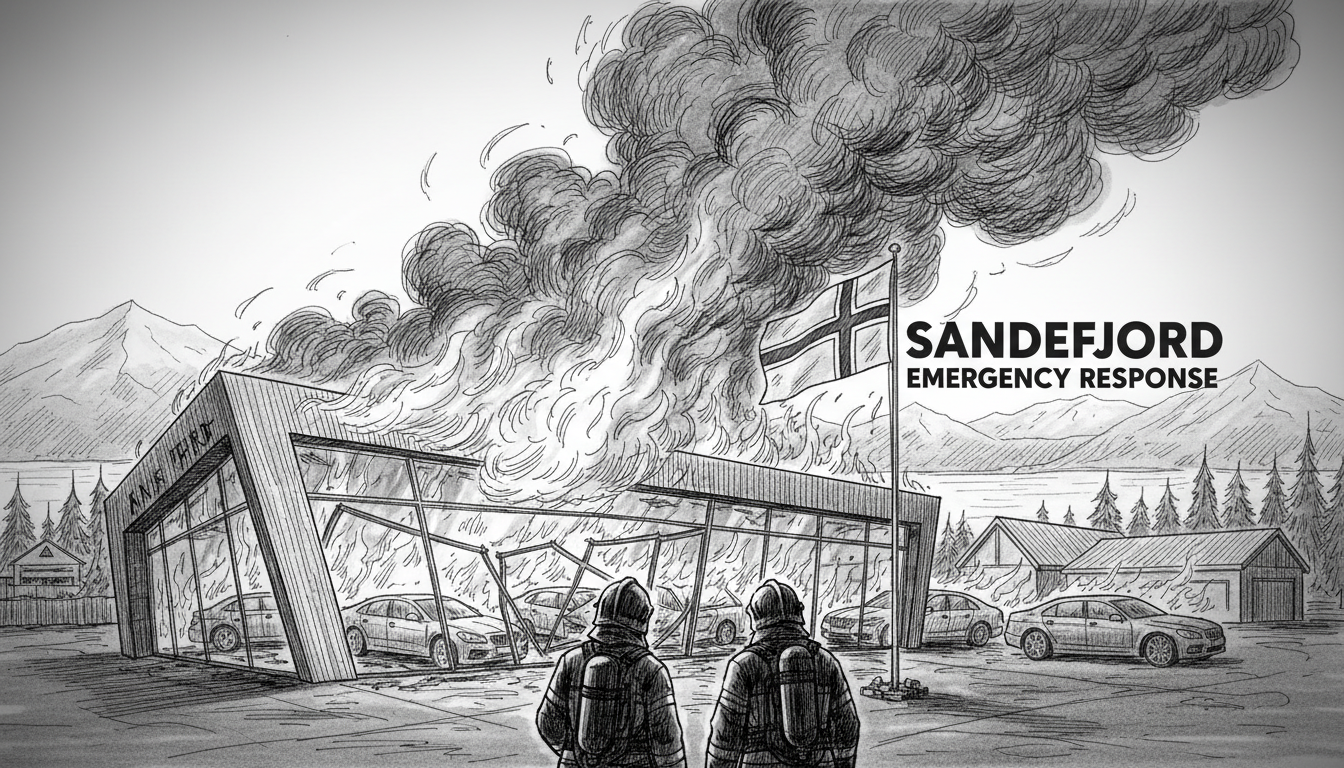
Norway's emergency services responded to a major vehicle fire at a Sandefjord car dealership early this morning, with police warning of a significant risk of the blaze spreading to buildings and other vehicles. The incident, reported at 4:32 AM, saw a rapid multi-agency deployment to a commercial area in the coastal Vestfold municipality.
A Pre-Dawn Alert in Vestfold
The Sørøst police district confirmed the fire involved a vehicle at a business property housing a car dealership. Initial reports focused on the immediate danger of the fire spreading, a critical concern given the potential fuel loads and flammable materials present at such a site. The location, in a mixed commercial and industrial zone, heightened the stakes for containment crews working in the dark hours before dawn.
Sandefjord, a city of roughly 65,000 people, is a hub for maritime industries and summer tourism. Its industrial areas, like the one affected, are vital to the local economy. A major fire here disrupts not just a single business but can impact supply chains and employment. The swift police announcement of a 'spread danger' signaled an understanding of the potential for a localized incident to escalate rapidly.
The Anatomy of a High-Risk Fire
Vehicle dealerships present unique challenges for fire safety. "A car lot is not just a collection of vehicles; it's a concentration of fuel, batteries, plastics, and other combustible materials," explained Lars Holmen, a former chief fire officer and now a safety consultant in Oslo. "Modern vehicles contain a significant amount of plastic and synthetic material in their interiors, which can produce intense heat and toxic smoke when alight."
Holmen noted that the proximity of vehicles to each other and to storage buildings creates a perfect scenario for fire to jump. A single burning car can generate enough radiant heat to ignite vehicles parked several meters away. If the dealership also stored tires, oils, or solvents, the fire's intensity and complexity would increase dramatically.
The early morning timing of the fire, while potentially limiting the number of people on site, also presents challenges. Response times can be marginally affected, and firefighting operations are conducted in darkness, requiring additional lighting and increasing operational complexity for crews.
Emergency Protocol and Containment Strategy
Norwegian emergency services operate on an integrated response model. The initial call to the police emergency line at 4:32 AM would have triggered simultaneous alerts to the local fire brigade and ambulance services. For a reported fire with explicit spread risk, the dispatch would likely be at the highest priority level.
The primary tactical goal in such a scenario is rapid containment. Firefighters would first work to establish a defensive perimeter, using water and foam to cool exposed buildings and adjacent vehicles to break the chain of radiant heat transmission. Access to sufficient water supply is critical, and in an industrial area, firefighters would connect to large-diameter hydrants.
"The first engine on scene is making a size-up decision that sets the tone for the entire operation," said Holmen. "They are assessing wind direction, the specific type of vehicle on fire—whether it's a standard combustion engine or an electric vehicle—and the integrity of the nearby structure. Their initial attack line placement is crucial to stop the spread."
Economic and Community Impact in Sandefjord
Beyond the immediate safety response, a fire of this nature carries economic weight. A car dealership represents a high-value inventory. The loss of even a portion of that inventory can run into millions of kroner. Furthermore, the business interruption—the inability to sell, service, or operate—can strain a local enterprise for months.
Sandefjord's municipality has worked to diversify its economy beyond its historic whaling and shipping base, promoting technology and commercial sectors. A significant fire in a business district tests the resilience of that economic planning. It also tests insurance systems and local business continuity networks.
For residents, such an event is a stark reminder of industrial risk nestled within community spaces. While Norway boasts stringent building and fire codes, acute incidents underscore that absolute safety is an ongoing effort. The visible plume of smoke and the sound of emergency sirens in the early morning hours create a tangible sense of disruption.
Investigation and Prevention Looking Forward
Once the fire is extinguished, the investigative phase begins. Police and fire authorities will work to determine the cause. Origins can range from technical faults in a vehicle, such as an electrical short circuit, to issues with charging systems for electric cars, or even external factors. The forensic process is methodical, sifting through debris to find a point of origin and a likely source of ignition.
This incident will likely prompt a review of fire safety protocols for similar businesses across Vestfold county. Are vehicle storage densities safe? Are flammable material storage regulations being followed? Is there adequate spacing and firebreak planning in commercial yards? The Sandefjord fire serves as a real-world case study.
Norway's focus on safety is embedded in its culture, from maritime regulations to mountain hiking advice. This extends to its industrial and commercial practices. A serious fire, even if contained without injury, acts as a catalyst for re-examination and reinforcement of those standards. The question for local authorities and business owners in the coming weeks will be: what can be learned from this pre-dawn alarm in Sandefjord to prevent a next time?
The full cost, both financially and in terms of community anxiety, will become clearer in the daylight. For now, the effectiveness of Norway's emergency response in limiting the spread of a dangerous fire remains the immediate story, one that unfolded quietly in the dark before most of Vestfold had begun its day.