
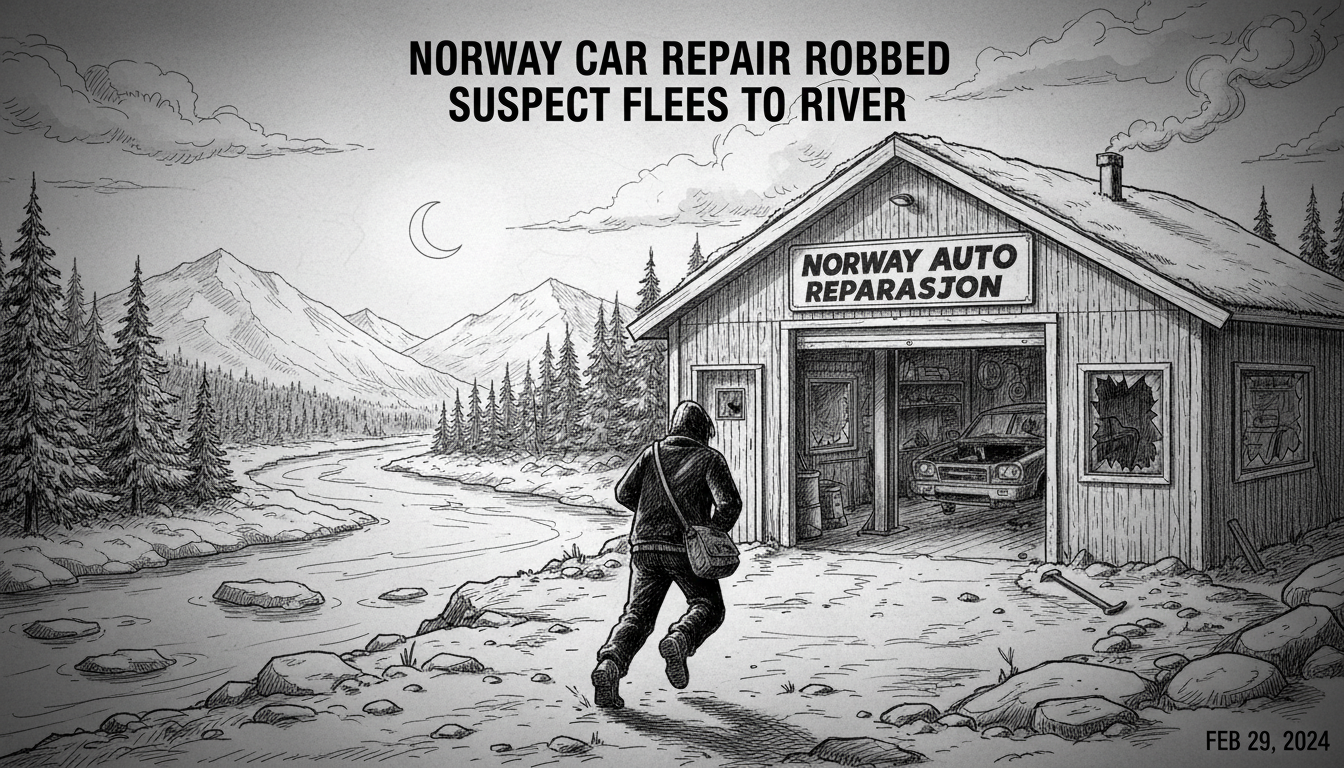
Norway police are investigating a robbery at a car repair shop in the Greåker district of Sarpsborg. The incident, reported to the Eastern Police District at 5:41 PM on Wednesday, saw a suspect flee on foot toward the Glomma river. Operations manager Rune Isaksen confirmed multiple patrols were on scene, speaking with victims and searching for the perpetrator.
A Quiet Afternoon Interrupted
The robbery disrupted the routine of a local business in a community better known for its industrial history than criminal activity. Greåker is part of Sarpsborg, one of Norway's oldest cities with roots stretching back to the Viking Age. Such violent crimes against businesses remain statistically uncommon in a nation consistently ranked among the world's safest. The suspect is described as a man approximately 40 years old, last seen wearing a black hooded sweatshirt and blue trousers. His escape route, heading in the direction of Northern Europe's longest river, the Glomma, presents both a challenge and a potential clue for investigators. The river's banks and adjacent areas offer numerous paths for concealment or further flight.
The Investigation Unfolds
Police methodology in such cases is systematic, focusing on immediate containment and evidence collection. "We are on the scene talking to the victims and searching for the perpetrator," Operations Manager Rune Isaksen said in a statement. The presence of multiple patrols indicates a coordinated response to secure the area and initiate a search. The primary leads will stem from witness accounts from the shop's employees and any potential customers, along with a thorough sweep for physical evidence left at the scene. A critical component will be the collection of any closed-circuit television footage from the business itself and surrounding properties in Greåker. This digital evidence can provide a clearer picture of the suspect's approach, actions during the robbery, and exact escape route.
Context in a Low-Crime Society
To understand the impact of this event, one must consider Norway's overall crime landscape. The country boasts one of the lowest rates of violent crime in the world. Robberies of businesses, while they occur, are not a frequent headline. This relative rarity means each incident receives significant police attention and can generate considerable local concern. The psychological effect on small business owners and their employees can be profound, shaking their sense of security in a place they consider a second home. For the community of Greåker and greater Sarpsborg, it serves as an unsettling reminder that no area is entirely immune to crime, despite the nation's strong social fabric and effective policing.
Criminologists note that while Norway's model of policing and social welfare suppresses most crime, isolated incidents often involve complex personal motivations or desperation. The focus on rehabilitation over pure punishment also influences how police engage during and after such events. The response to this robbery will follow established protocols designed to resolve the situation safely, apprehend the individual, and support the victims. The Eastern Police District has not released details on what was stolen or if any weapons were involved, which are factors that will shape the legal severity of the case and the ongoing investigative priorities.
The Path Forward for Police
The manhunt will likely concentrate on the corridor between the crime scene and the Glomma river. Police may use canine units to track a scent trail or deploy drones to survey the riverbank and wooded areas from above. They will also canvass the neighborhood, door-to-door, seeking additional witnesses or home security footage that may have captured the suspect. Given the specific clothing description, all patrols in the region will be alert for an individual matching it. The success of the investigation now hinges on the quality of the initial evidence and the ability to quickly process it into actionable intelligence.
For the car repair shop owners, the immediate aftermath involves dealing with police, assessing any loss or damage, and confronting the violation of their workspace. Business robberies can lead to increased insurance costs, investment in enhanced security measures, and lingering anxiety among staff. Community support in Sarpsborg will be an important factor in their recovery. Local residents often rally around affected businesses in Norway, reflecting a collective value of safety and mutual aid.
A Broader Look at Security and Society
This incident in Greåker does not signify a trend, but it does prompt reflection. It occurs against a national backdrop where debate occasionally surfaces about police resources, the visibility of patrols in smaller districts, and the balance between an open society and security measures. Norway's approach has long been that prevention through social equity is the most effective tool, yet reactive police work remains essential for incidents like this. The efficiency of the response and the subsequent clearance of the case will be watched closely as a measure of system efficacy.
As night fell on Wednesday in Viken county, the search continued. The Glomma river, a constant geographical force that has shaped Sarpsborg's history for centuries, now forms part of a modern police perimeter. The contrast is stark: the timeless flow of water against the urgent, time-sensitive work of a criminal investigation. The resolution of this case will provide answers for the victims and reassurance for a community unaccustomed to such disruptions. It also reinforces a universal truth—that maintaining public safety is a continuous, active effort, even in the world's most peaceful nations.
Will the distinctive description of the suspect's clothing and his choice of escape route lead to a swift arrest? The answer now lies with the meticulous work of the Eastern Police District and the cooperation of a concerned community.