
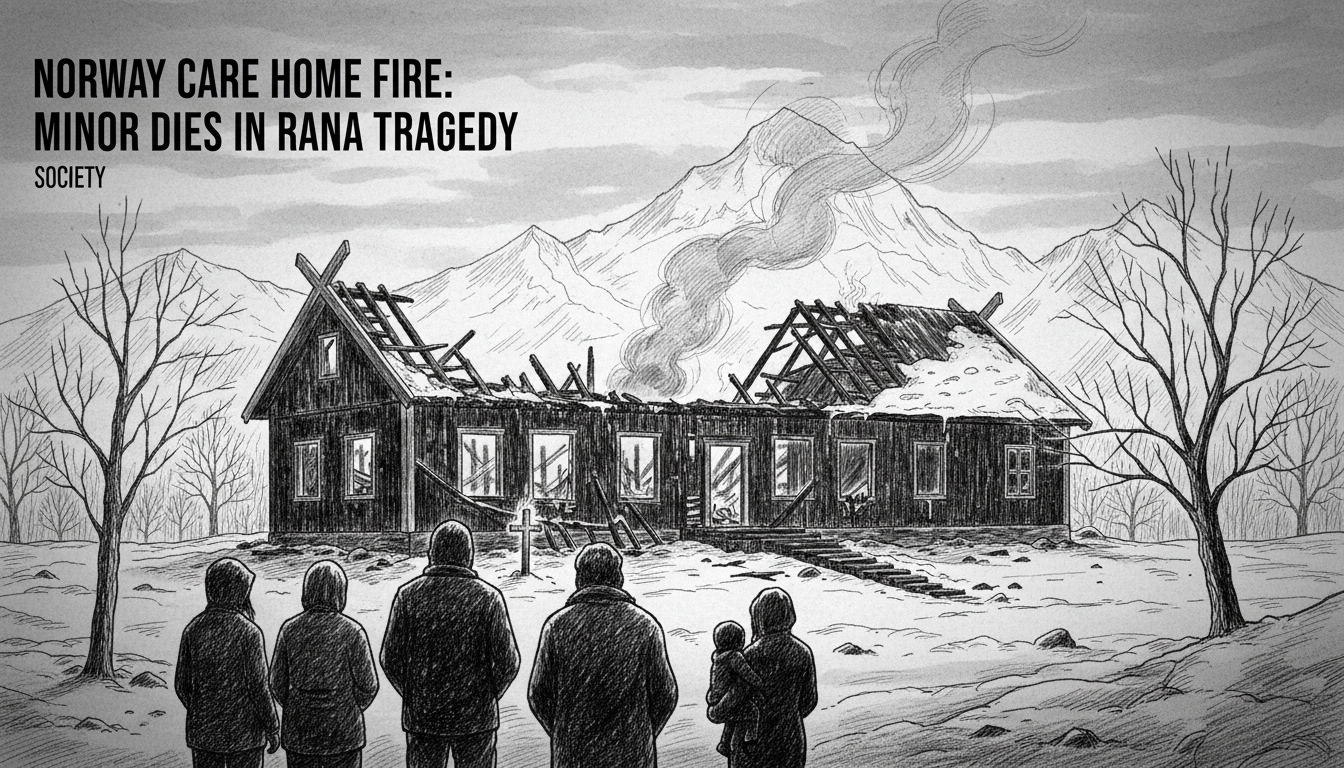
Norway's social care system faces urgent questions after a minor died in a fire at a combined care and elderly housing facility in Rana municipality. Emergency services found the victim, a person under 18, after evacuating 24 residents from the omsorgsbolig Friday night. The tragedy has cast a harsh spotlight on the safety protocols protecting Norway's most vulnerable citizens.
Operational leader Thomas Jarnæs Coe confirmed the death in a statement early Saturday. "After we evacuated residents and staff, it was quickly clarified that one minor was unaccounted for. Unfortunately, the person was found deceased in the home," Coe said. Police are investigating all hypotheses regarding the fire's origin and have described the incident as serious.
A Night of Evacuation and Loss
The first alarm reached emergency services around 8:00 PM Friday. By 10:00 PM, firefighters had contained the blaze, but the grim discovery had already been made. The evacuated residents, a mix of elderly individuals and younger people with various care needs, were moved to temporary accommodations. A municipal crisis team is now providing support to relatives, residents, and staff.
This facility represents a common model in Norwegian welfare: the omsorgsbolig. These are not full-scale nursing homes but supported housing units designed to offer a degree of independence while providing necessary care. Their mixed population—from the elderly to minors with special needs—creates a complex safety environment. The death of a young person in a state-supervised care home strikes at the core of Norway's self-image as a protector of its citizens.
The Legal Framework of Care
Norwegian municipalities bear direct responsibility for providing health and care services under the Health and Care Services Act. This legal obligation includes securing appropriate housing for those who cannot live independently. An omsorgsbolig is meant to fulfill this duty, offering a tailored level of support. The system is decentralized, with local authorities overseeing standards, staffing, and safety compliance for these facilities.
The tragedy in Rana immediately raises questions about whether those standards were met. Fire safety in buildings housing people with potentially limited mobility or cognitive impairments requires specific, rigorous planning. Evacuation protocols must account for residents who may not be able to exit quickly without assistance. The presence of a minor in such a facility, while legal and sometimes necessary for specialized care, adds another layer of vulnerability.
Expert Scrutiny on Safety Protocols
"When a tragedy like this occurs, we must examine every link in the safety chain," said Kari Nilsen, a professor of social work at the University of Bergen who studies municipal care services. "This includes physical safeguards like smoke alarms and fire doors, but critically, it also includes procedural safeguards: staffing levels at night, staff training for emergency evacuation, and individualized escape plans for each resident."
Nilsen points out that while Norwegian building codes are generally strict, older care homes may operate in adapted buildings. Regular, unannounced inspections by both fire authorities and health regulators are essential. "The investigation will need to determine if this was a catastrophic failure of a physical element, like wiring, or a failure in the human response system," she added. "Both are within the municipality's responsibility to manage."
The Human Cost of Systemic Failure
Beyond the immediate shock and grief, the incident exposes the tension within Norway's welfare model. Municipalities face increasing demands for care services amid budgetary pressures and an aging population. Omsorgsboliger are a cost-effective solution compared to institutional care, but they require diligent oversight to ensure safety does not become secondary to efficiency.
The death of a child in a public care facility is an almost unthinkable event in a country consistently ranked high for quality of life and child welfare. It will inevitably trigger a painful public and political examination. The Labour Party and Centre Party coalition government, which champions a robust welfare state, will face pressure to explain how such a failure could happen on the municipalities' watch.
Local politicians in Rana are already in a crisis response mode. The focus is on supporting the affected families and the evacuated residents, many of whom have now lost their homes and sense of security. The psychological impact on the other residents, particularly those who witnessed the event or the evacuation, could be profound and long-lasting.
A Pending Investigation and National Reckoning
The Nordland Police District is leading the investigation. Their work will be technical and meticulous, mapping the point of origin, searching for accelerants, and examining electrical systems. Simultaneously, they will interview staff and residents to reconstruct the timeline of the fire and the evacuation response. The findings will be forwarded to the local prosecutor, who will decide if criminal charges related to negligence are warranted.
Parallel to the police investigation, Rana municipality will likely conduct its own internal review. The Norwegian Directorate of Health and the Norwegian Fire Protection Association may also become involved, using the case to assess if national guidelines for care home safety need revision. Past fires in other types of residential facilities have led to tightened regulations on smoke alarms and building materials.
This tragedy arrives at a time when Norway's municipal services are under a microscope. Reports of long waiting lists for care and strained resources are common. This event shifts the concern from mere access to care to the fundamental safety of that care. It asks whether the system designed to protect is, in some instances, capable of failing those it is meant to shield.
The Path Forward from Grief
For now, a community in Nordland is mourning. The specific circumstances of the young person's life and needs are not public, protecting the family's privacy during an unbearable time. But their death is a public matter because it occurred in a publicly mandated facility.
The coming weeks will see a flood of statements from politicians promising scrutiny and change. The real test will be whether this incident becomes a catalyst for a strengthened, uniformly applied national safety regime for all supported housing, or merely a tragic footnote. Norway prides itself on learning from disaster to build a safer society. The memory of the minor lost in Rana will measure the nation's commitment to that principle for its most vulnerable citizens.
Can a welfare state guarantee not just care, but absolute safety? The investigation in Rana will provide difficult answers, and the political response will define Norway's care system for years to come.