
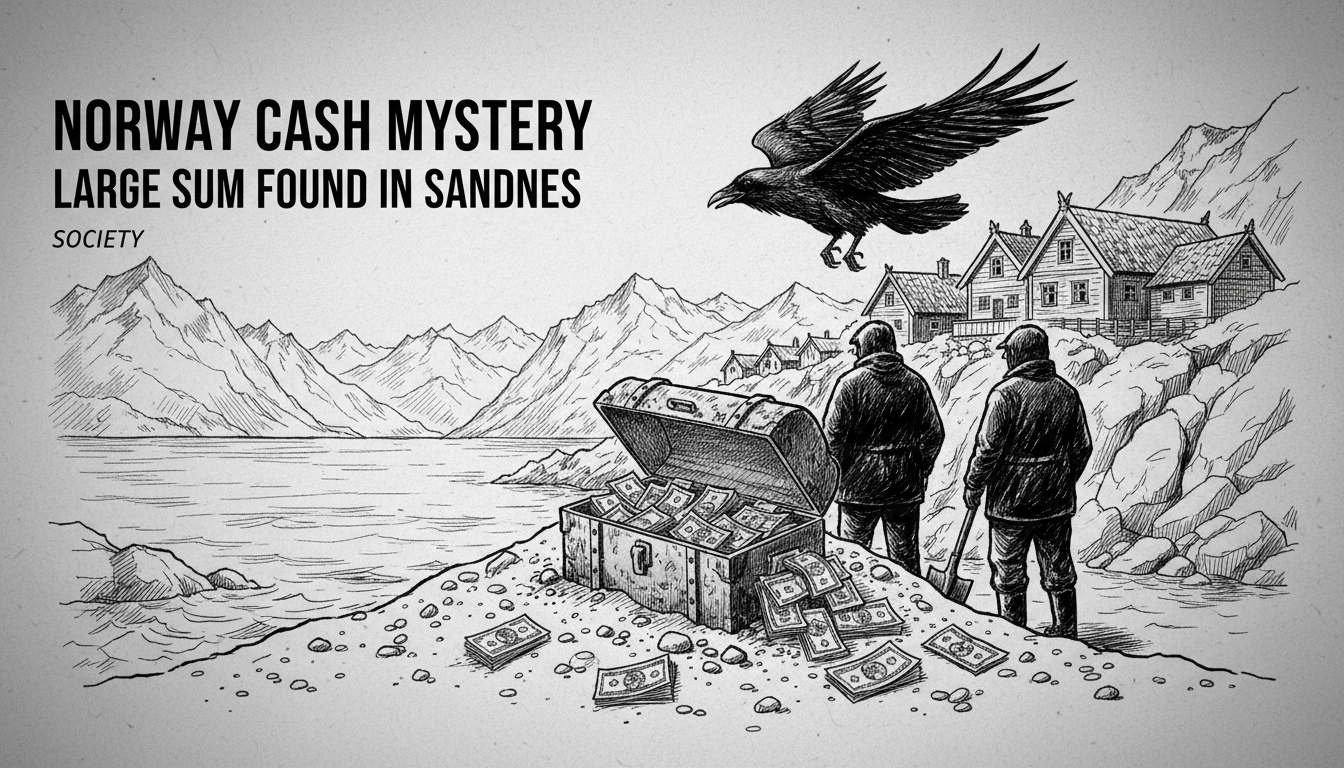
Norway's latest cash mystery unfolded on a quiet street in Sandnes this week. An excavation worker, renewing Oalsgata, discovered a significant sum of money buried underground. The South-West Police District confirmed they were called to the scene and have taken possession of the found cash, launching an investigation into its origins.
This discovery in southwestern Norway's oil-rich region raises immediate questions. Who buried the money, and why? Police must now determine if the cash is linked to criminal activity, represents forgotten savings, or has another explanation entirely. The find highlights the unexpected stories that can emerge from Norway's constant urban renewal.
An Unexpected Discovery on Oalsgata
The call came into the South-West Police District on Tuesday. A worker, engaged in routine municipal infrastructure upgrades, had unearthed something unusual. The project on Oalsgata, a street in central Sandnes, was part of standard city maintenance. Such work is common across Norwegian cities, where aging water pipes, electrical cables, and road surfaces are regularly replaced.
Operational leader Roger Litlatun stated police attended the location and collected the find. Authorities have not disclosed the exact amount, describing it only as a "significant sum." This deliberate vagueness is standard procedure in early investigations. It allows police to verify legitimate claims from potential owners while withholding key details that only the true owner would know.
Sandnes, often called "Norway's Bicycle City," is a municipality of over 80,000 people in Rogaland county. It sits just south of Stavanger, the energy capital of Norway. The region is defined by the North Sea oil and gas industry, high average incomes, and generally low crime rates. A buried cache of cash does not immediately fit the area's profile.
The Police Investigation: Procedure and Possibilities
The South-West Police District now follows a standard but meticulous process. Forensic officers will first examine the money and its packaging for any physical evidence. They will look for fingerprints, DNA, or distinctive markings on the notes themselves. The condition of the cash and any containers it was in can offer clues about how long it was buried.
"The primary goal is to establish lawful ownership," explains a former financial crimes investigator who wished to remain anonymous. "Police will check the serial numbers against databases of stolen or reported money. They will also review any missing persons or unresolved criminal cases in the area that might be connected."
If the money is suspected to be proceeds from crime, the investigation intensifies. In Norway, large, unexplained cash holdings can be linked to tax evasion, the black market, or more serious organized crime. The proximity to Stavanger's international energy sector adds another layer. It is a hub for high-value business, where large financial transactions are normal, but also a potential arena for economic crime.
If no criminal link is found and no one claims the money, Norwegian law is clear. According to the Lost Property Act, finders have a right to claim unowned property. However, for cash found under these circumstances, the state may ultimately take possession if the original owner cannot be identified and no crime is proven.
Historical Context: Buried Treasure in Modern Norway
While rare, discoveries of buried valuables are not unheard of in Norway. They often fall into two categories: historical hoards and modern caches. The former includes Viking-age silver or medieval coins, which are considered cultural heritage and belong to the state. The latter, like the Sandnes find, typically involve modern currency and more recent secrets.
In 2020, a man in Bærum discovered over 400,000 kroner in a used sofa he purchased. That money was eventually returned to its original owner, an elderly man who had forgotten about his savings. In 2012, a cache of gold coins from the early 20th century was found during a garden renovation in Oslo. Its origin remains a mystery.
Psychologists and criminologists note that people hide money for various reasons. Older generations, particularly those who lived through periods of economic instability or war, sometimes distrust banks. Others may hide assets during divorce proceedings or from tax authorities. Criminal elements, of course, bury cash to avoid detection by financial monitoring systems.
"In a largely cashless society like Norway, a physical hoard stands out," says sociologist Dr. Ingrid Moe. "It represents a disconnect from the formal, digital economy. It suggests a need for complete privacy or a lack of trust in institutions—something we don't see often in one of the world's most transparent societies."
The Legal and Social Implications
The case touches on several aspects of Norwegian law and social values. Norway has strict regulations against money laundering. Financial institutions must report suspicious transactions, and carrying large amounts of cash across borders is heavily regulated. A buried sum bypasses all these controls.
From a social perspective, the story captivates the public precisely because it seems so anomalous. Norway consistently ranks high in global trust surveys. Citizens have profound trust in their government, police, and banking system. The act of burying wealth underground contradicts that fundamental social contract.
Furthermore, the find occurs in a region experiencing significant wealth from the oil and gas sector. While prosperity is widespread, it also creates opportunities for financial crime. The police investigation will need to consider whether this cash is linked to the region's dominant industries.
Local residents on Oalsgata have reacted with curiosity and surprise. Many describe their neighborhood as quiet and ordinary. The idea that a potential small fortune was buried nearby is both thrilling and unsettling. It introduces an element of mystery into their everyday environment.
What Happens Next?
The South-West Police District will likely take weeks or months to complete its inquiry. The first step is a public appeal, asking anyone with legitimate information to come forward. Claimants will need to provide convincing evidence, such as specific details about the amount, the denominations, or the container used.
If the money is clean and unclaimed, the excavation worker who found it could be in for a windfall. Norwegian law rewards honesty in such matters. However, the worker's immediate decision to contact the police aligns with the strong civic duty felt by most Norwegians.
For now, the cash sits in a police evidence locker. Its journey from there depends on what the investigation reveals. It could be returned to a relieved citizen, seized as evidence in a criminal case, or eventually deposited into the state treasury.
This Sandnes discovery is a reminder that even in the most orderly societies, secrets can lie just beneath the surface. It raises questions about history, trust, and the lingering role of physical cash in an increasingly digital world. The true story behind the buried money on Oalsgata remains, for now, underground.