
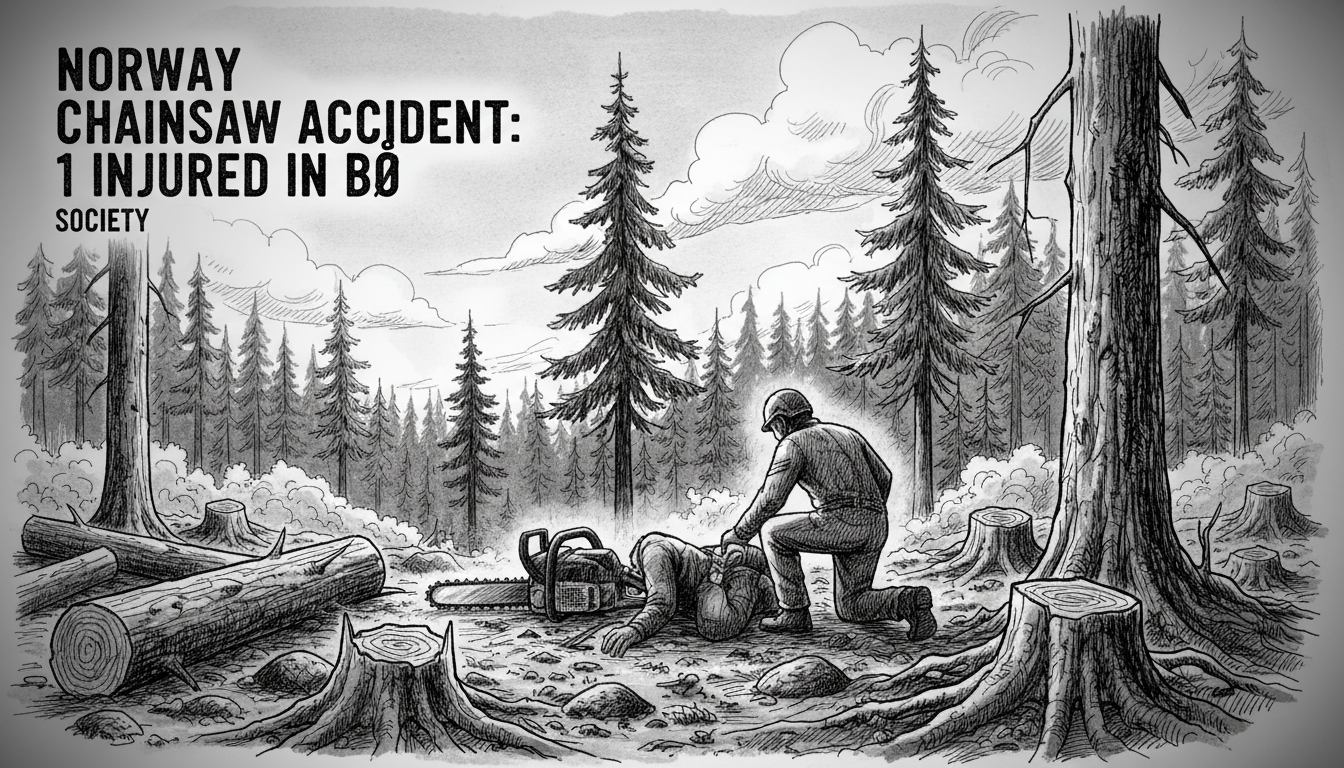
Norway work accident authorities are investigating a serious chainsaw injury in Nordland county. Emergency services responded to a report of an industrial accident in Bø municipality on Thursday. Police confirmed one person sustained a leg injury while operating a chainsaw. The individual was reportedly wearing personal protective equipment at the time of the incident. This case highlights persistent safety challenges in Norway's high-risk industries despite stringent national regulations.
A Routine Day Turns Dangerous
The incident occurred during what was likely a standard forestry or construction operation. Bø, a municipality of roughly 2,600 residents, is situated in a region where forestry and land management are common activities. The immediate police response and involvement of emergency medical services underscore the incident's severity. Initial reports indicate the injured worker was using safety gear, a detail that will form a critical part of the official investigation. Norway's Labour Inspection Authority, known as Arbeidstilsynet, has been notified and will lead the probe into how the accident happened.
Workplace safety is a cornerstone of Norwegian labour policy, making any serious accident a significant event. The country operates under the Systematic Health, Environment, and Safety Activities framework, which mandates rigorous risk assessment. Every employer is legally required to identify hazards and implement preventive measures. For chainsaw operations, this includes mandatory training, certified protective clothing, and documented safety procedures. The fact that an injury occurred despite these layers of protection raises important questions for inspectors.
The Persistent Risk of Forestry Work
Statistics from Arbeidstilsynet reveal that the agriculture and forestry sector consistently reports a higher rate of serious injuries compared to other industries. While comprehensive 2023 data is still being finalized, historical trends show these sectors are disproportionately dangerous. In one recent year, forestry alone accounted for several fatal accidents despite having a relatively small workforce. Chainsaws are involved in a substantial percentage of these incidents, often resulting in deep lacerations, amputations, or severe trauma.
“When a serious injury occurs with protective equipment in use, we must look beyond basic compliance,” said a senior safety engineer with expertise in forestry, who spoke on condition of anonymity as the investigation is active. “It forces us to examine equipment maintenance, the worker's specific training and experience, fatigue levels, and whether the safety protocols were truly followed in practice, not just on paper. Even the best gear has limitations.” The expert emphasized that chainsaw protective trousers, designed to clog the chain with special fibers, require proper fit and can be compromised by wear or damage.
The Investigation Process Begins
Arbeidstilsynet's investigation will follow a standardized process. Inspectors will secure the scene, document the equipment involved, and interview the injured worker, witnesses, and the employer. They will examine the chainsaw for mechanical faults and review the victim's training certificates. A key focus will be the employer's written risk assessment for the task being performed. Under Norwegian law, the employer carries the ultimate responsibility for providing a safe working environment.
“The goal is never to assign blame as a first step, but to understand the root cause,” explained Lars Holm, a former regional director for the inspection authority. “Was it a procedural failure, a training gap, an equipment malfunction, or a combination? The findings will be used to prevent a recurrence at that specific workplace and may inform broader national safety advisories.” The authority has the power to issue immediate injunctions, levy fines, and in extreme cases, recommend criminal charges for negligence.
Safety Culture Versus Complacency
Norway prides itself on a robust safety culture, developed over decades through cooperation between unions, employers, and the state. The Norwegian model of inclusive working life, known as inkluderende arbeidsliv, emphasizes worker participation in safety matters. Employees have a right and duty to report hazards and halt work they deem unsafe. This high level of trust and responsibility is a key reason for Norway's generally excellent workplace safety record internationally.
However, experts warn that this very success can breed complacency, especially in smaller firms or among experienced workers. “Familiarity with a dangerous tool can lead to shortcuts,” the safety engineer noted. “A worker might have performed a task thousands of times safely. That experience is valuable, but it can also reduce perceived risk. The moment of inattention or the one time you don't position yourself correctly is when a chainsaw, which cuts through wood in seconds, causes life-altering injuries.” This psychological aspect is increasingly a focus of modern safety training.
The Human and Economic Cost
The immediate cost of the Bø accident is measured in human pain and recovery. Leg injuries from chainsaws can involve complex muscle, nerve, and bone damage, requiring extensive surgery and rehabilitation. The long-term impact on the worker's mobility and ability to return to their profession can be severe. Beyond the personal tragedy, there are significant economic costs. These include lost productivity, healthcare expenses, and potential long-term disability insurance claims administered by NAV, the Norwegian Labour and Welfare Administration.
For the employer, a serious accident triggers mandatory reporting, disruptive investigations, potential increases in insurance premiums, and possible operational shutdowns. It also damages morale and can strain the trusted relationship between management and staff. In tight-knit communities like those in Nordland, the ripple effects are felt widely, reminding every local business of the stakes involved in daily operations.
A National Pattern in Remote Regions
While details from Bø are still emerging, similar incidents occur with regularity in Norway's rural and remote regions. The geography of Nordland, with its vast forests and dispersed population, creates logistical challenges for both work and emergency response. Forestry operations are often conducted in isolated areas, far from immediate medical help. This underscores the critical importance of first-aid training and reliable communication equipment for all crews.
The Norwegian government has invested in air ambulance services and improved first responder networks to address these challenges. Yet, the fundamental solution remains prevention. Industry groups like Skogbruket's Kurs- og kompetansesenter run specialized chainsaw safety courses that combine theoretical knowledge with intense practical drills. These courses stress not just how to use the saw, but how to plan the work, assess tree tension, and maintain constant situational awareness.
Looking Ahead: Technology and Training
The outcome of the Arbeidstilsynet investigation in Bø will contribute to this ongoing national conversation about safety. Potential recommendations could include mandates for newer chainsaw models with additional safety features like chain brakes and kickback reduction technology. There may be calls for more frequent refresher training, especially for veteran workers, or stricter protocols for working alone in remote areas.
This incident serves as a stark reminder. Norway's system is designed to learn from every accident. The detailed report from Bø, once completed, will become part of the data guiding policy and training for years to come. The core question remains: in a country that does workplace safety as well as any in the world, how do you protect against the unpredictable moment when a routine task goes wrong? The search for that answer continues, underscored by the recovery of a worker in Nordland.