
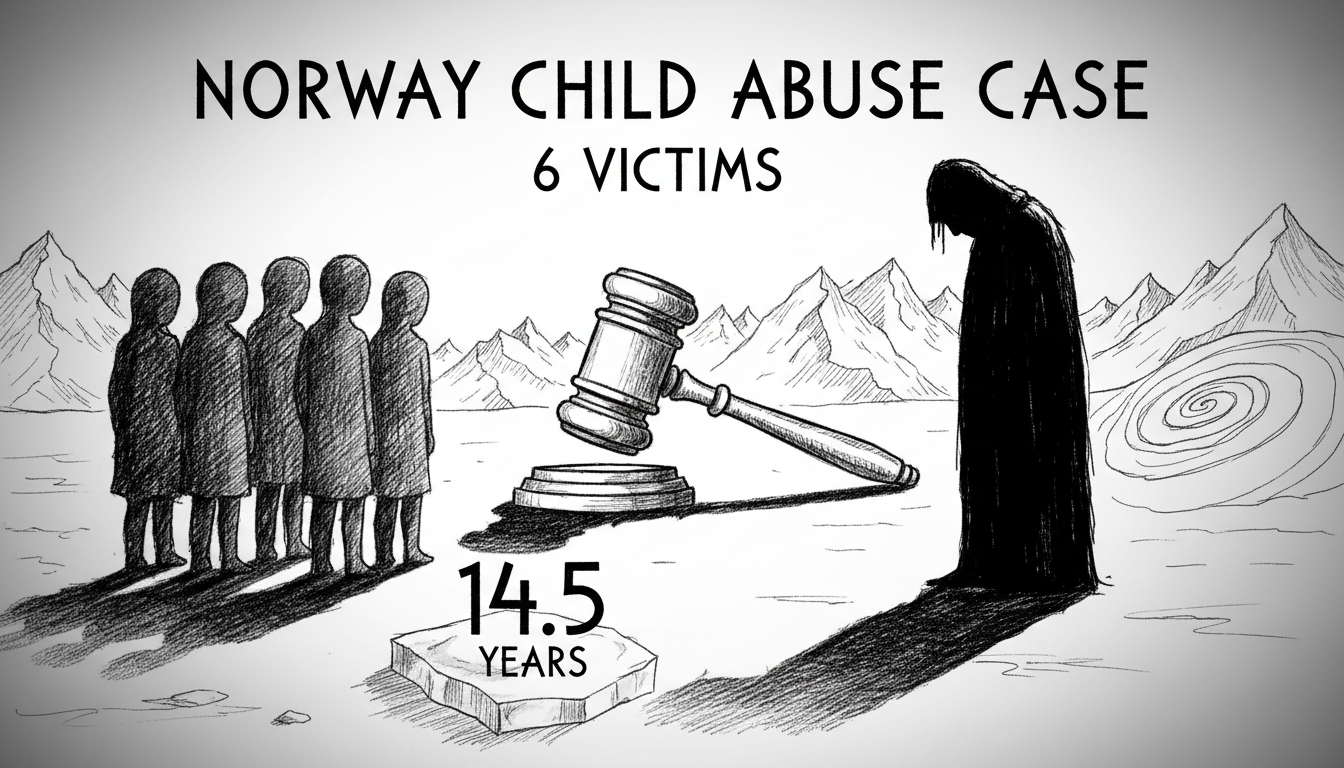
Norway's legal system has delivered one of its most severe sentences for child sexual abuse in recent years, jailing a man for 14.5 years for crimes against six children. The Sunnfjord District Court convicted the man in his 40s after he admitted guilt to all charges spanning an 18-year period. The sentence includes a landmark compensation order of over 15 million Norwegian kroner (approximately $1.4 million) to the victims, highlighting the court's focus on restorative justice alongside punishment.
Police investigations revealed the man was a trusted family friend to several of the victims' parents, often having the children stay overnight. This position of trust allowed the abuse to continue undetected for nearly two decades. Digital forensic searches uncovered extensive collections of child abuse material on the man's devices, providing crucial evidence for the prosecution.
Defense lawyer Svein Holden had argued for a 12-year sentence during proceedings. Following the verdict, Holden stated simply, "I have no comment on the judgment." The court's decision to exceed this request by 2.5 years signals judicial assessment of exceptional severity in this case.
A Pattern of Betrayal and Secrecy
The case reveals disturbing patterns common in abuse within trusted circles. All six victims were under 14 years old when the abuse began, with some subjected to repeated violations over years. The 18-year timeframe suggests the perpetrator operated with calculated secrecy, exploiting social trust to avoid detection. Such prolonged abuse often causes complex trauma, affecting victims' development, relationships, and mental health long into adulthood.
Norwegian child protection experts note that cases involving multiple victims over extended periods present particular challenges for investigation and prosecution. Victims may disclose abuse at different times, and corroborating evidence becomes essential. The digital evidence in this case likely played a decisive role in securing the conviction and the substantial sentence.
"When abuse happens within what should be a safe network, it represents a profound betrayal," said a clinical psychologist specializing in trauma, who requested anonymity due to the sensitive nature of the case. "The sentencing and compensation must acknowledge this breach of trust as a central element of the harm caused."
The Legal Framework and Sentencing Gravity
Norwegian law treats sexual abuse of children as among the most serious crimes. Penalties have been strengthened through legislative reforms over the past two decades, influenced by greater public awareness and advocacy from victim support organizations. The maximum penalty for aggravated sexual abuse of children under 16 is 21 years imprisonment.
A 14.5-year sentence sits at the higher end of actual sentences imposed, reflecting multiple aggravating factors: the number of victims, their young ages, the duration of the abuse, the breach of trust, and the possession of abuse material. The court clearly viewed these elements as warranting a punishment approaching the upper limits of sentencing guidelines.
Legal scholars point to the compensation award as equally significant. The 15 million kroner total, to be divided among victims, represents one of the largest sums ordered in a Norwegian abuse case. This serves both a compensatory function for therapy, lost opportunities, and suffering, and a symbolic function recognizing the scale of harm.
"The compensation order sends a clear message about the value the justice system places on the victims' recovery and the seriousness with which it views their lifelong losses," said Professor Johanne Sundby, a legal expert in victimology at the University of Oslo. "It moves beyond pure punishment of the perpetrator to tangible acknowledgment of the victims' needs."
Digital Evidence: A Changing Investigative Landscape
The discovery of large quantities of child abuse material on digital devices has become a common feature in modern abuse prosecutions. This digital evidence often provides the conclusive proof needed in cases that otherwise rely on victim testimony, which can be challenging to present in court, especially for children.
Norwegian police have invested significantly in digital forensic capabilities in recent years. The National Criminal Investigation Service (Kripos) operates a dedicated unit for investigating digital crimes against children. Their work involves not only prosecuting individual offenders but also identifying victims from material shared online and collaborating with international agencies like Interpol.
This digital dimension adds another layer to the crime—the consumption and potential distribution of abuse material—which extends the harm beyond direct contact offenses. It also creates a permanent record of the crime, which can be retraumatizing for victims if they know images or videos exist.
Societal Response and Prevention Challenges
Norway registers approximately 2,000 cases of sexual abuse against children under 18 annually, according to Statistics Norway. The conviction rate for reported cases is estimated around 70%, a relatively high figure compared to many jurisdictions, suggesting robust investigative and prosecutorial processes.
Yet experts agree most abuse remains unreported. Cases involving family friends or acquaintances, like this one, are particularly difficult to prevent through standard child safety education, which often focuses more on stranger danger. Building environments where children feel safe to disclose abuse and where adults recognize subtle signs remains an ongoing challenge.
National initiatives like the "Barnas Voksen" (The Child's Adult) campaign aim to educate adults about their role in protection and recognition. Child welfare services (Barnevernet) also conduct preventative work, though their mandate primarily begins after concerns are raised.
"The ultimate prevention lies in cultural change—creating communities where children's bodily autonomy is respected, where they are listened to, and where adults intervene when boundaries are crossed," said child protection advocate Mari Trommald. "No legal sentence, however severe, can replace that preventative work."
The Road to Recovery and Systemic Implications
For the six victims in this case, the legal conclusion marks the end of one arduous journey and the beginning of another. Compensation can fund necessary therapeutic support, but recovery from complex, long-term trauma is a lifelong process. Norway's public health system provides psychological care for victims of crime, but waiting lists can be long, and specialized trauma therapy may require private resources.
Victim support organizations emphasize that while justice is important, societal support systems must be equally robust. This includes schools, healthcare providers, and community networks that can offer sustained support beyond the media attention of a trial.
The case also raises questions about how communities rebuild trust after such violations. When an offender is embedded in social networks, the ripple effects of betrayal touch many families beyond the direct victims. Restorative justice practices, though not a substitute for criminal proceedings, are sometimes used in Norway to address these community impacts, though not in cases of this severity.
As Norway continues to confront the reality of child sexual abuse within its communities, cases like this serve as grim reminders of both the depths of human cruelty and the strength of legal systems built to defend the most vulnerable. The 14.5-year sentence and substantial compensation order represent more than just numbers; they are measured responses to immeasurable harm, balancing retribution with recognition in the slow pursuit of justice.