
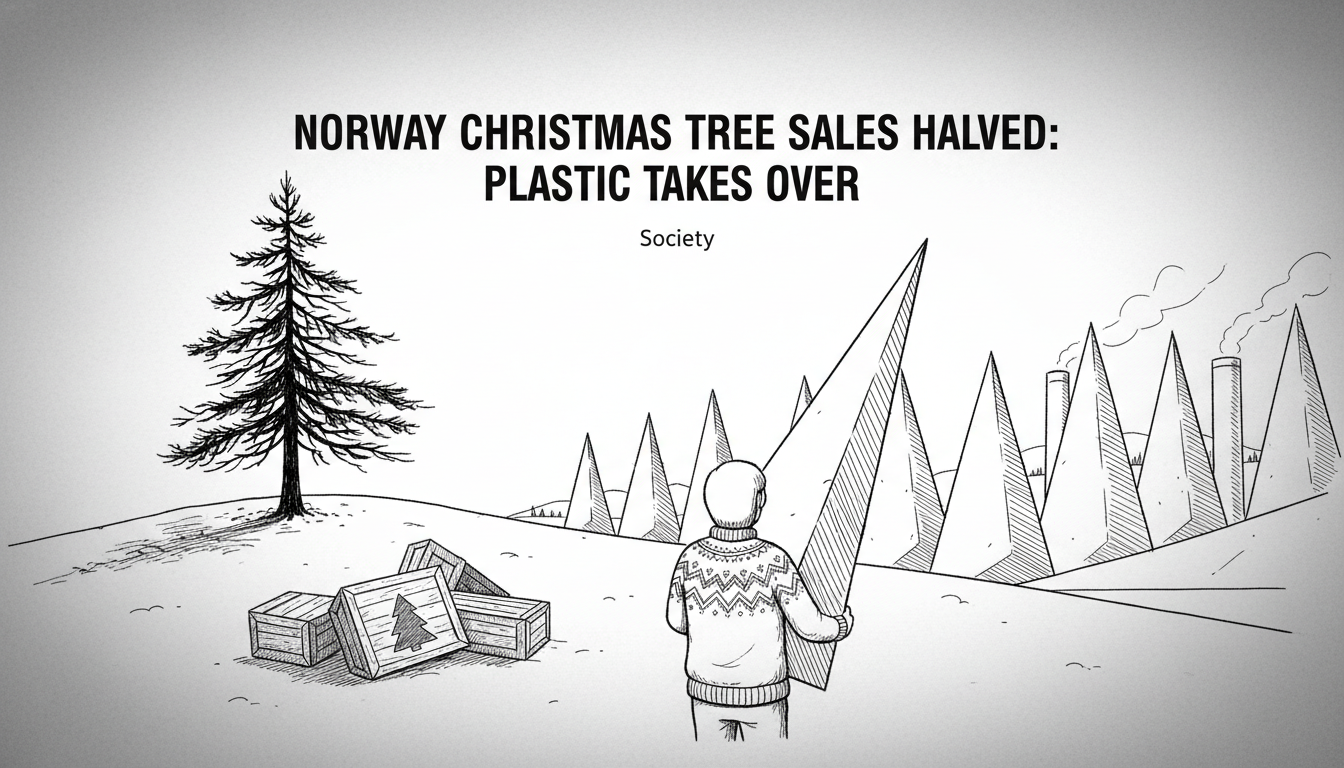
Norway Christmas tree sales have plummeted by half over the last 15 years. Only 800,000 real trees were sold last season, a dramatic decline that is forcing producers to scale back or shut down entirely. The culprit is a familiar one: plastic. Artificial trees are winning the holiday battle, reshaping a century-old tradition and threatening a rural industry.
Arnt Kristian Stensholt, a co-owner of the producer Vestfold Edel juletre, is watching his livelihood change. "It's terrible that it's like this. That plastic is taking over. This is an industry for many," he said. His farm is planting far fewer trees than before, a direct response to falling demand. He points to a painful irony. "It's strange that you have to pay seven kroner for a plastic bag at the store because you want to get rid of it, while at the same time they advertise plastic trees."
A Tradition Under Threat
The Christmas tree tradition in Norway, popularized in the 1800s, is deeply woven into the national culture. The scent of a Norway spruce or noble fir in the living room defines the holiday season for many families. Yet, that sensory experience is being traded for convenience and practicality. For Rigmor Galtung, the choice was made for health reasons. She now uses a plastic tree out of consideration for an allergic relative. "But it's a bit of a shame, because it's nicer with a real tree," she admitted. "You don't quite get the same smell in the living room? No, but you can fortunately arrange that in other ways," she laughed, acknowledging the compromise.
Industry data confirms the stark trend. A horticultural census conducted every ten years shows the number of Christmas tree producers in Norway has collapsed from around 1,000 in the year 2000 to barely 400 in 2020. Morgan Andersson, Secretary General of the Norwegian Gardeners' Association, confirms the decline has continued sharply in the last five years. "The producers are really feeling it now," Andersson said. He cites import competition and price wars as central challenges, but the primary driver is the consumer shift to artificial alternatives.
The Allure of Artificial
The reasons for choosing plastic are clear and, for busy modern families, compelling. An artificial tree is a one-time purchase. It requires no watering, sheds no needles, and can be reused for a decade or more. It is perfectly symmetrical, requires no trip to a tree lot, and eliminates the annual disposal task. For urban apartment dwellers or those with allergies, the benefits are even more pronounced. The upfront cost, while higher, is amortized over many years, often making it cheaper in the long run than buying a fresh tree annually.
Environmental claims are a major part of the marketing for artificial trees, though the reality is complex. Producers tout the reusability as a green choice, avoiding the annual cultivation and transport of a real tree. However, most artificial trees are made from PVC plastic and metal, manufactured overseas, and are not biodegradable. Their true environmental footprint depends heavily on how many years they are used before being discarded in a landfill. A real tree, while a renewable resource that absorbs carbon during its growth, involves farming inputs and transportation emissions.
The Human Cost of Convenience
The economic impact is concentrated in rural areas where tree farming provides crucial seasonal income. For farmers like Stensholt, the decline isn't just a statistic; it's a forced reduction in a family business. "If the turnover had been better, we would definitely have continued as before," he stated plainly. The drop in sales means less work for local crews who plant, tend, and harvest the trees. It represents a slow erosion of a specific agricultural niche. The industry's contraction also makes Norway more reliant on imported trees, which further pressures domestic growers on price.
Andersson from the Gardeners' Association sees broader implications. He warns that the loss of local producers weakens food and product security. It also distances consumers from the origin of their holiday traditions. "There is a cultural loss here," he noted. "The ritual of selecting a tree, the fresh smell, the connection to nature—these are intangible values that a box from a warehouse shelf cannot replicate."
Can Real Trees Fight Back?
The real tree industry is not giving up. Some producers are emphasizing the authenticity and sustainability of a natural, locally grown product. They promote the tree-buying experience as a family event. Others highlight the positive environmental aspects of tree farms, which provide green spaces and habitats. In some markets, there is a growing trend towards renting potted living trees or using trees that can be replanted, though these options are less common in Norway's climate.
However, the convenience factor is a powerful opponent. The hectic pace of modern December, with its parties, shopping, and travel, makes the simplicity of an artificial tree highly attractive. For young families, the appeal of a pre-lit, no-mess tree is significant. The industry's challenge is to reframe the real tree not as a chore, but as an essential, joyful part of the holiday tradition worth preserving.
A Changing Holiday Landscape
The story of Norway's Christmas trees is a microcosm of a global shift. Traditional practices are being reshaped by consumer preferences for convenience, cost-saving, and perceived practicality. The outcome is a quiet transformation of the holiday aesthetic. Living rooms across Norway are increasingly adorned with identical, needle-free pines stored in attics for most of the year.
For traditionalists, the loss is palpable. "I always think it's very cozy to come home to people who have a real tree. It's something special," said Rigmor Galtung, despite her own plastic choice. The question for Norway is whether the cultural and sensory value of the real tree can withstand the efficient, reusable appeal of plastic. As another season approaches, farmers like Arnt Kristian Stensholt will be watching the sales figures closely, hoping for a reversal in a trend that currently shows no sign of slowing. The future of the Norwegian Christmas tree, it seems, is hanging in the balance.