
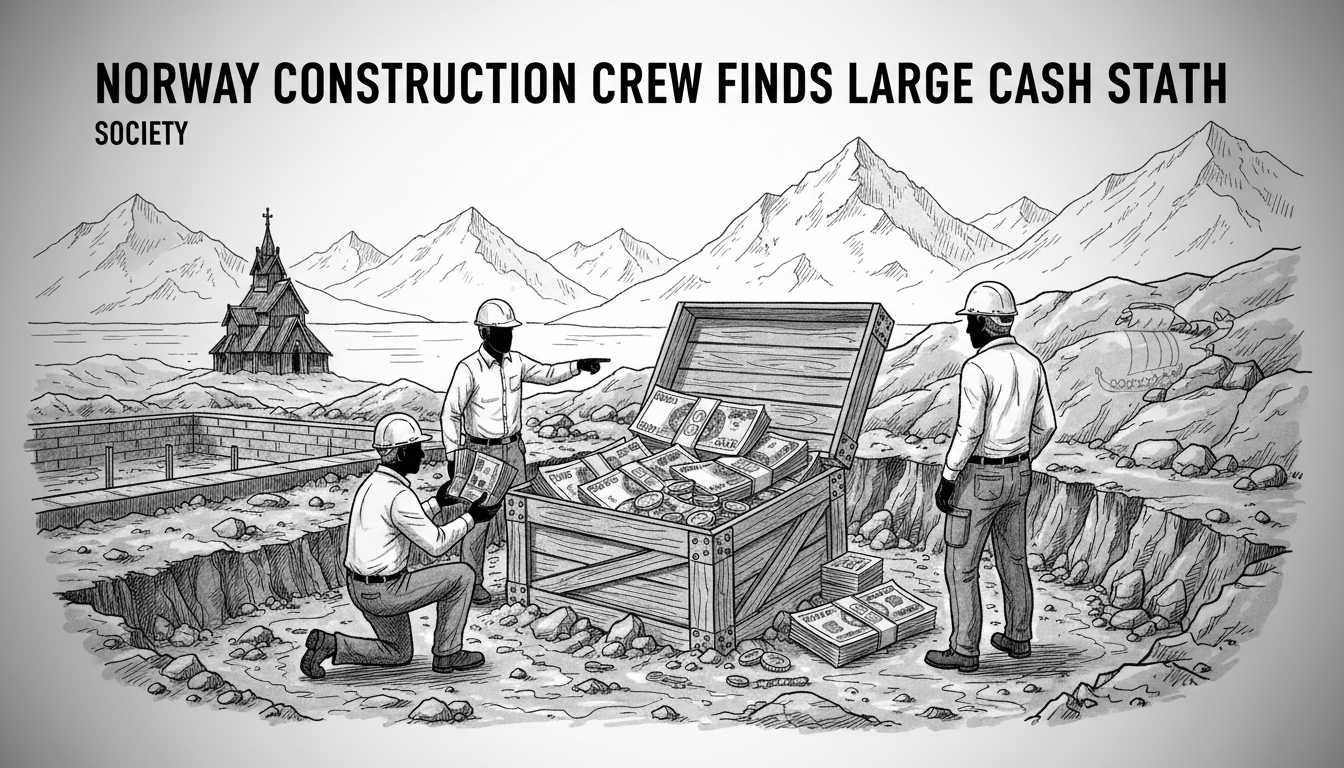
Norway construction workers in Sandnes uncovered a significant sum of cash during routine excavation work on Tuesday. The discovery on Oalsgata street prompted an immediate police response and has launched a formal investigation involving the national criminal investigation service, Kripos. Police have secured the money but refuse to disclose the amount, citing an ongoing probe into its origins.
"The caller had, during excavation, found a significant sum of cash," said Operations Manager Roger Litlatun of the South-West Police District. "The police have been on site and retrieved the find." Litlatun confirmed that examinations of the money are now underway and that a case has been officially opened. The secrecy surrounding the details is standard procedure to protect investigative integrity, but it fuels immediate public speculation in a nation with low tolerance for financial crime.
A Discovery That Halts Progress
The find occurred during municipal renewal work on Oalsgata, a central street in Sandnes, a city just south of Stavanger in Norway's oil-rich Rogaland county. Such infrastructure projects are commonplace, aiming to upgrade utilities and paving. The work crew, following protocol, stopped operations and contacted authorities immediately upon making the discovery. This swift action preserved the scene for forensic examination, a critical step in tracing the money's history.
Police cordoned off the area, a move that underscores the find's potential seriousness. In Norway, discovering large, unexplained cash caches is rare. The country has a predominantly cashless society and strict anti-money laundering regulations. A "significant sum" found buried in a public street does not align with typical lost property scenarios, immediately raising red flags for financial crime investigators.
The Legal and Investigative Pathway
Norwegian law has clear procedures for handling found property. The Lost Property Act generally governs items of value discovered in public. However, the police's rapid involvement of Kripos, Norway's equivalent to the FBI for serious and organized crime, signals this case transcends a simple lost-and-found matter. Kripos specializes in complex financial investigations, organized crime, and corruption.
"The police are initiating a case and cannot, at present, release further details about the find due to considerations for the further investigation," Litlatun stated. This language indicates detectives are treating the cash as potential evidence, not merely misplaced assets. The primary questions are straightforward but difficult to answer: Who buried the money? Where did it come from? And why was it hidden in a public roadway?
Forensic analysis will be key. Specialists can examine the bills for serial number sequences, soil composition on the notes, and the condition of the packaging. This can help establish how long the money was buried and potentially link it to specific criminal activities, such as drug trafficking, tax evasion, or the proceeds of robbery. The excavation depth and method of concealment will also form part of the investigative report.
Context in a Low-Crime Society
This discovery strikes a particular chord in Norway, which consistently ranks among the world's least corrupt nations. Major financial crime scandals, when they occur, receive intense media and public scrutiny. The country's tax authority, Skatteetaten, is highly effective, and cultural norms strongly favor transparency. The image of dirty money literally buried in the ground contradicts the national self-image of a clean, orderly society.
Furthermore, Sandnes sits in the heart of Norway's energy industry. The region has immense wealth generated from offshore oil and gas. While this wealth is largely managed responsibly through the Government Pension Fund Global, it also creates an environment where large financial transactions are normal. Investigators will likely explore any potential link to undeclared income or fraud within the lucrative offshore sector, though such speculation is premature.
The case also touches on Norway's ongoing battle against organized crime groups, which are often involved in narcotics and use cash-intensive businesses for money laundering. While violent crime rates are low, police have repeatedly warned about the increasing sophistication and financial power of criminal networks. A buried cash stash could represent a "hide" for such a group, perhaps abandoned or forgotten.
Public Reaction and Next Steps
Local residents and business owners on Oalsgata are left with more questions than answers. A police investigation introduces an element of uncertainty into the neighborhood. The municipal renewal project, a symbol of progress and investment, is now temporarily associated with a mysterious criminal inquiry. This irony is not lost on the community.
For the police, the immediate next steps are methodological. The cash will be counted and forensically processed in a secure facility. Detectives will review recent reports of major thefts or robberies in the region. They will also analyze financial intelligence reports for unusual cash movements. If the sum is linked to a specific crime, such as a bank heist, the path forward may be relatively clear.
If no direct link is found, the investigation becomes more complex. Police may need to trace the money's origin through banking records if any serial numbers are logged, a painstaking process. The possibility that the money represents untaxed income or the savings of someone distrustful of banks cannot be entirely ruled out, though burying it in a public street is an irrational method of storage.
A Broader Lesson in Civic Duty
The construction crew's decision to immediately call the police is a textbook example of civic responsibility. In many jurisdictions, discovering a large sum of cash might tempt individuals to keep it quiet. Norway's high level of institutional trust and the severe penalties for interfering with an investigation likely influenced their actions. Their compliance provides a clean starting point for detectives.
This case serves as a reminder that illicit economies, however small in Norway compared to other nations, still operate in the shadows. Money from illegal activities must be physically stored or laundered, and sometimes old-fashioned methods like burying it are employed. The discovery proves that even in a digital age, physical evidence of crime can literally surface from the ground during the most mundane activities.
The investigation may take weeks or months to conclude. If the rightful owner cannot be identified—or if the owner is determined to have acquired it illegally—the money could eventually be forfeited to the state. Norwegian law allows for the confiscation of assets derived from criminal activity. Those funds would then flow into the public treasury, a fitting end for money that sought to operate outside the system.
For now, Oalsgata returns to normal. The excavation work will resume, the street will be renewed. But the brief interruption by a hidden past offers a stark narrative: economic crime leaves traces, and in a society built on transparency, even the earth can give up its secrets. The ultimate fate of the cash, and the story it tells, now rests in the hands of Norway's meticulous investigators.