
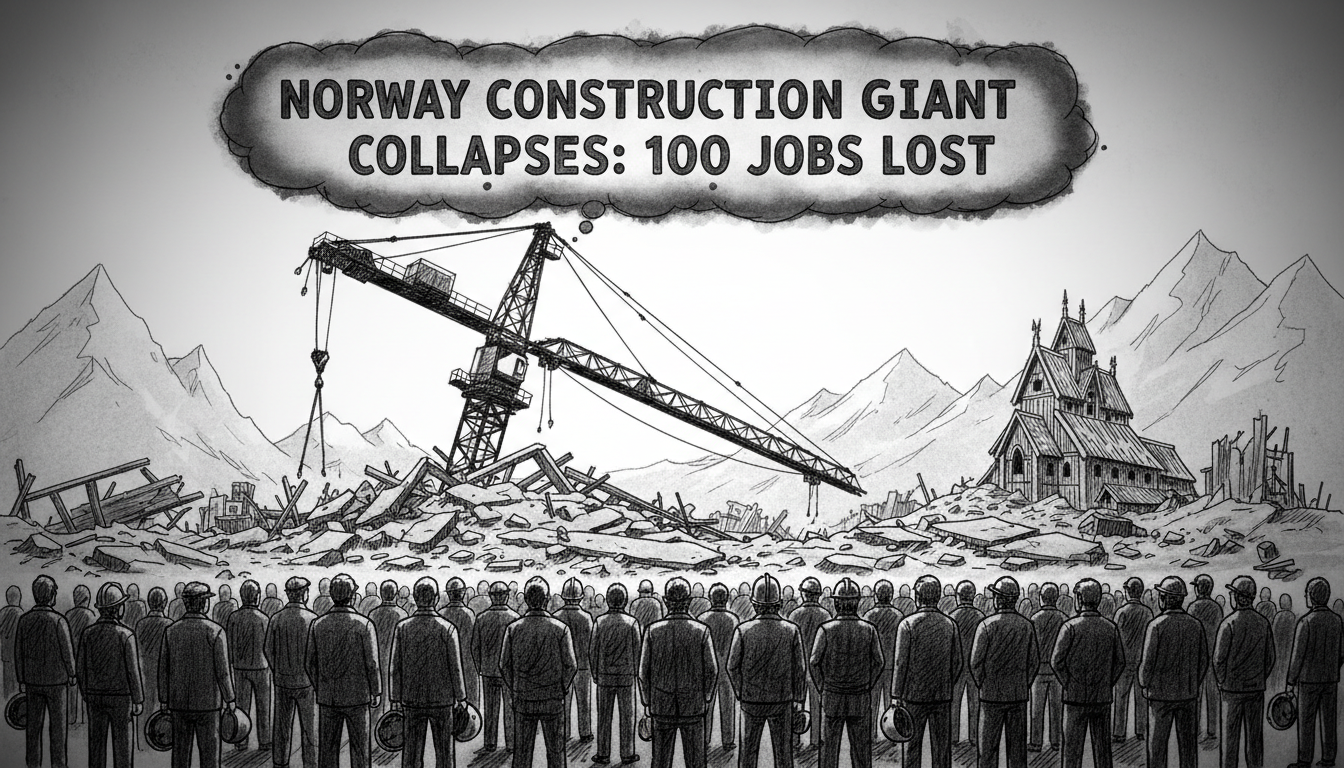
Norway's construction sector faces a significant blow as Bergen-based Byggmester Markhus files for bankruptcy, leaving at least 100 workers unemployed. The company's collapse follows a sudden VAT claim from the Norwegian Tax Administration, Skatteetaten, delivered just before Christmas Eve. This marks the end of a two-year struggle for survival that included court-ordered bankruptcy protection and a creditor-led rescue plan.
"This has completely blindsided them," said the company's lawyer, Egil Horstad, describing the tax demand. "They simply do not have the means to meet this claim." The VAT obligation relates to the period before the company's 2025 restructuring. All ongoing construction projects managed by Markhus have now been halted indefinitely, creating ripple effects for clients and subcontractors across the Hordaland region.
A Sudden Tax Blow Ends a Precarious Fight
The bankruptcy petition, filed Monday, concludes a protracted financial battle. Byggmester Markhus first received bankruptcy protection from the Hordaland District Court in 2024, providing a temporary shield from creditors. In 2025, several key creditors intervened with a formal rescue plan, pulling the company back from the brink. Industry analysts viewed this as a last-chance restructuring, common in Norway's system which often favors corporate rehabilitation over immediate liquidation.
"The Norwegian model typically allows for breathing room, but it is not a guarantee," explained Lars Moe, a senior lecturer in business law at the Norwegian School of Economics. "A significant, uncontested claim from a public authority like Skatteetaten can be the final straw. It demonstrates that even with creditor support, underlying fiscal health is paramount." The specific size of the VAT claim has not been disclosed, but its timing—just days before the Christmas holiday—left no opportunity for the company to arrange new financing or negotiate a payment plan.
The Human Cost of Corporate Failure
The immediate consequence is the loss of over 100 skilled jobs in the Bergen area. Norway's strong social safety net, including unemployment benefits (arbeidsledighetstrygd) and active labor market policies, will provide a buffer for the displaced workers. However, the psychological impact and the disruption to careers in a specialized field are substantial.
"These are carpenters, project managers, electricians, and administrative staff who believed the company had turned a corner," said union representative Anita Solberg. "They went through the uncertainty of reconstruction, only to face this now. The priority is ensuring they receive all outstanding wages and benefits owed, and that they get swift support in finding new positions." The construction industry in western Norway has been relatively stable, but this bankruptcy may signal tighter margins and increased scrutiny from tax authorities for other firms.
Navigating Norway's Complex Bankruptcy Landscape
Norway's approach to bankruptcy, governed by the Konkursloven, emphasizes orderly processes and fair treatment of creditors. The system distinguishes between voluntary bankruptcy, as in this case, and compulsory bankruptcy forced by creditors. The prior reconstruction process (rekonstruksjon) under court supervision is designed to salvage viable businesses, protecting jobs and maintaining economic activity.
"Byggmester Markhus is a textbook case of the limits of reconstruction," noted financial analyst Per Strand. "When a new, large debt emerges from the period before restructuring, it can unravel the entire rescue plan. The tax authority is a privileged creditor, and its claims must be addressed. This situation will prompt other construction firms to rigorously audit their tax positions, especially regarding VAT on long-term projects." Value-Added Tax (merverdiavgift or MVA) management is a known pressure point for construction companies due to the lag between incurring costs, billing clients, and settling tax accounts.
Ripple Effects on the West Coast Economy
Bergen, as Norway's second-largest city and a key hub for maritime and onshore industries, relies on a healthy construction sector for housing, commercial, and public infrastructure projects. The sudden halt of all Markhus projects leaves clients—potentially including municipalities, private developers, and homeowners—in a difficult position. They must now find new contractors to complete the work, likely at higher costs and after significant delays.
Subcontractors and suppliers who worked with Markhus also face uncertainty regarding outstanding payments. While they can register claims with the bankruptcy estate, recovery is often partial and slow. "This isn't just one company failing; it disrupts an entire local ecosystem," said Bergen Chamber of Commerce head, Kari Nilsen. "It affects material suppliers, equipment rentals, and professional services. The trust in ongoing projects is damaged, which can cool investment in the short term."
A Warning Sign for the Industry?
The collapse of a established firm like Byggmester Markhus raises questions about the current state of Norway's construction industry. While broadly healthy, the sector faces challenges from high labor costs, volatile material prices, and complex regulations. The role of Skatteetaten's enforcement actions will come under particular scrutiny. Was this an unavoidable claim on legitimate debt, or could earlier communication have allowed for a different outcome?
"Tax compliance is non-negotiable, but the dialogue between authorities and struggling businesses is critical," argued Moe. "A bankruptcy of this scale has significant public costs in terms of unemployment benefits and lost tax revenue. The state, as a creditor, must balance its duty to collect with the economic consequences of forcing a liquidation." There is no indication of wrongdoing by Markhus; the issue appears to be an inability to pay a historical liability that resurfaced.
Looking Ahead: Picking Up the Pieces
The bankruptcy trustee will now take control of Byggmester Markhus's assets. Their task is to liquidate the estate to pay creditors in a legally defined order, with employee wage claims typically enjoying high priority. The 100-plus former employees will navigate the transition with support from NAV (the Norwegian Labour and Welfare Administration) and their trade unions.
For the Norwegian construction sector, this event serves as a stark reminder of fiscal fragility. It highlights how even companies that survive court-sanctioned rescues remain vulnerable to shocks from past liabilities. As the dust settles in Bergen, the industry will watch closely to see if this is an isolated case or a precursor to a wider tightening, where tax authorities take a harder line and economic headwinds expose other weakened firms. The true test will be whether the robust demand for construction in Norway can absorb this sudden influx of skilled labor, or if confidence in the sector has been dented.