
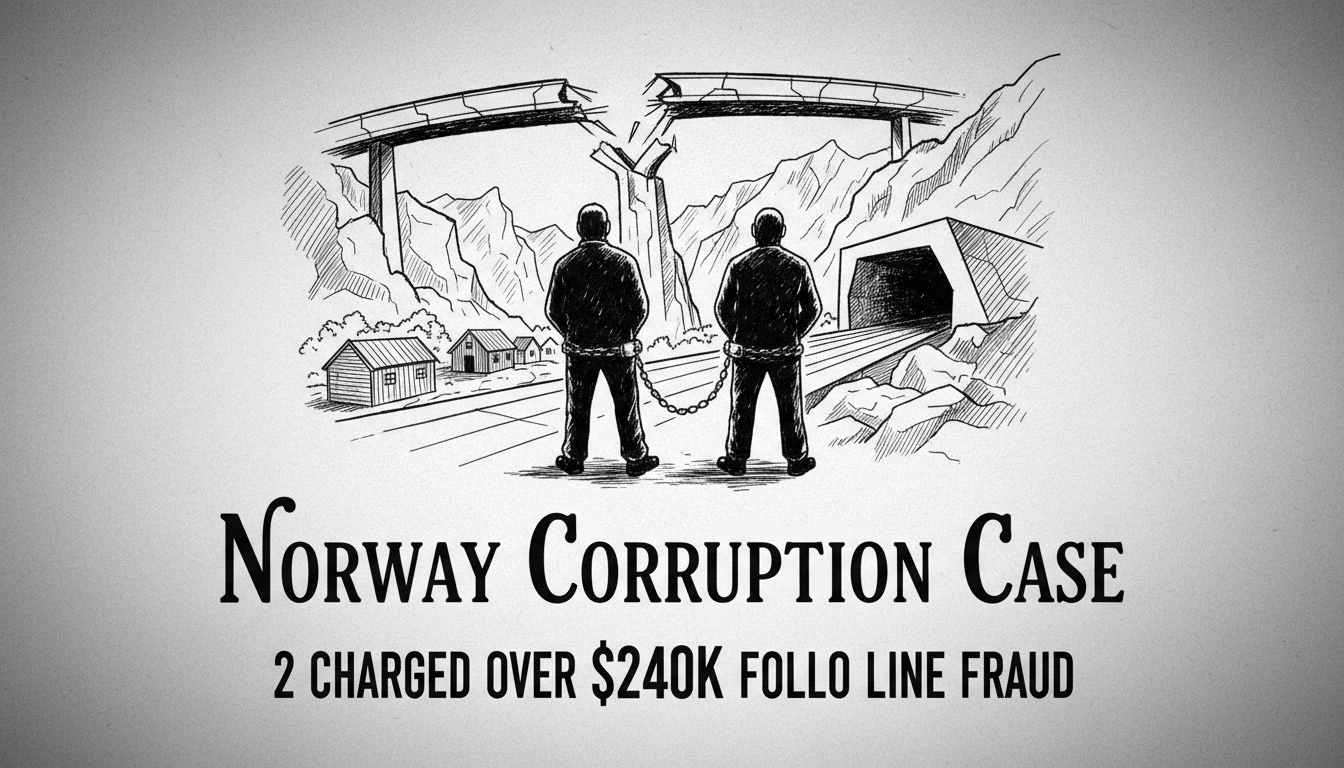
Norway's reputation for clean governance faces scrutiny after two senior figures were formally charged in a significant corruption case tied to the country's largest-ever railway project. A former manager from the state-owned railway company Bane Nor and a contractor face charges of gross corruption and gross financial infidelity. The charges relate to private work and materials worth 2.6 million Norwegian kroner (approximately $240,000) billed to the public Follo Line project. Both defendants have admitted guilt, and the case will be heard as a confession case on January 20th in the Follo and Nordre Østfold District Court.
A Scar on a Prized Project
The charges stem from the massive Follo Line project (Follobanen), a 22-kilometer twin-track railway tunnel between Oslo and Ski. As Norway's largest transport infrastructure project, its budget exceeded 36 billion kroner. It was designed to halve travel time and increase capacity on a critical southern corridor. The project, managed by Bane Nor Eigendom, symbolized national engineering prowess and public investment in sustainable transit. This scandal strikes at the heart of its administration. According to the charges, work and materials for private properties owned by the accused were fraudulently financed by Bane Nor and the Follo Line project's accounts. The precise nature of the private work has not been publicly detailed in the indictment.
The Legal Reckoning Ahead
The judicial process will now move swiftly due to the confessions. Gross corruption carries a maximum penalty of ten years imprisonment under Norwegian law. Gross financial infidelity carries a maximum of six years. "The severity of the potential sentences reflects how seriously the legal system views breaches of trust in public office," noted a legal scholar specializing in economic crime, who spoke on condition of anonymity ahead of the trial. "In a confession case, the court's primary role is to consider the validity of the confession and determine an appropriate sentence within the statutory framework." The court will examine the details of the scheme, the sum involved, and the positions of trust held by the defendants. A conviction is virtually certain, making the sentencing decision the focal point of the January hearing.
An Exception in a System of Trust
This case is notable precisely because of its rarity. Norway consistently ranks at the very top of global indices for low corruption and high public trust, such as the Transparency International Corruption Perceptions Index. Major corruption scandals involving public officials are uncommon front-page news. "The high level of institutional trust in Norway is a social asset," said Professor Arnstein Myhre, a sociologist at the University of Oslo who studies public administration. "When a case like this emerges, it generates significant attention not because corruption is endemic, but because it is an exception that tests the system's resilience. The public reaction is one of disappointment rather than cynical expectation." The state-owned model for critical infrastructure, from Bane Nor to Equinor and Statnett, relies heavily on this embedded trust. Any breach risks political calls for increased oversight, even for a single incident.
Implications for Public Procurement and Oversight
Beyond the courtroom, the case prompts questions about internal controls within major public enterprises. Bane Nor manages assets worth hundreds of billions of kroner and oversees continuous national rail investment. Experts suggest the case will trigger internal audits and reviews of procurement and invoicing verification processes, especially for external contractors. "Large infrastructure projects are complex ecosystems with many subcontractors and fluid budgets," said an engineer with decades of experience in public projects. "The system relies on multiple layers of oversight. This case suggests those layers failed at a specific point. The question for Bane Nor's board is whether this was a localized failure or indicative of a wider procedural weakness." The company has not yet issued a detailed public statement on the charges beyond acknowledging the judicial process.
A Test for Transparency and Response
The handling of this case will now be a public test. The Norwegian National Authority for Investigation and Prosecution of Economic and Environmental Crime (Økokrim) is likely overseeing the prosecution. Their work, and the court's transparent handling, will be scrutinized as a benchmark for the system's integrity. "The correct and firm application of the law in this case is crucial for maintaining trust," Professor Myhre added. "It demonstrates that the mechanisms of accountability function effectively, even when the defendants are from within the system itself." There is also potential for civil recovery actions, where Bane Nor could seek to reclaim the misappropriated 2.6 million kroner from the defendants in separate proceedings.
The Follo Line itself opened to great fanfare in December 2022, a technical marvel celebrated for its efficiency. This legal chapter, unfolding over a year later, presents a stark counter-narrative about its administration. As Norway continues to invest heavily in green infrastructure and railway modernization, the lessons from this scandal will inform procurement policies and oversight for years to come. The final word rests with the district court in January, but the broader conversation about safeguarding public funds has already been reignited.