
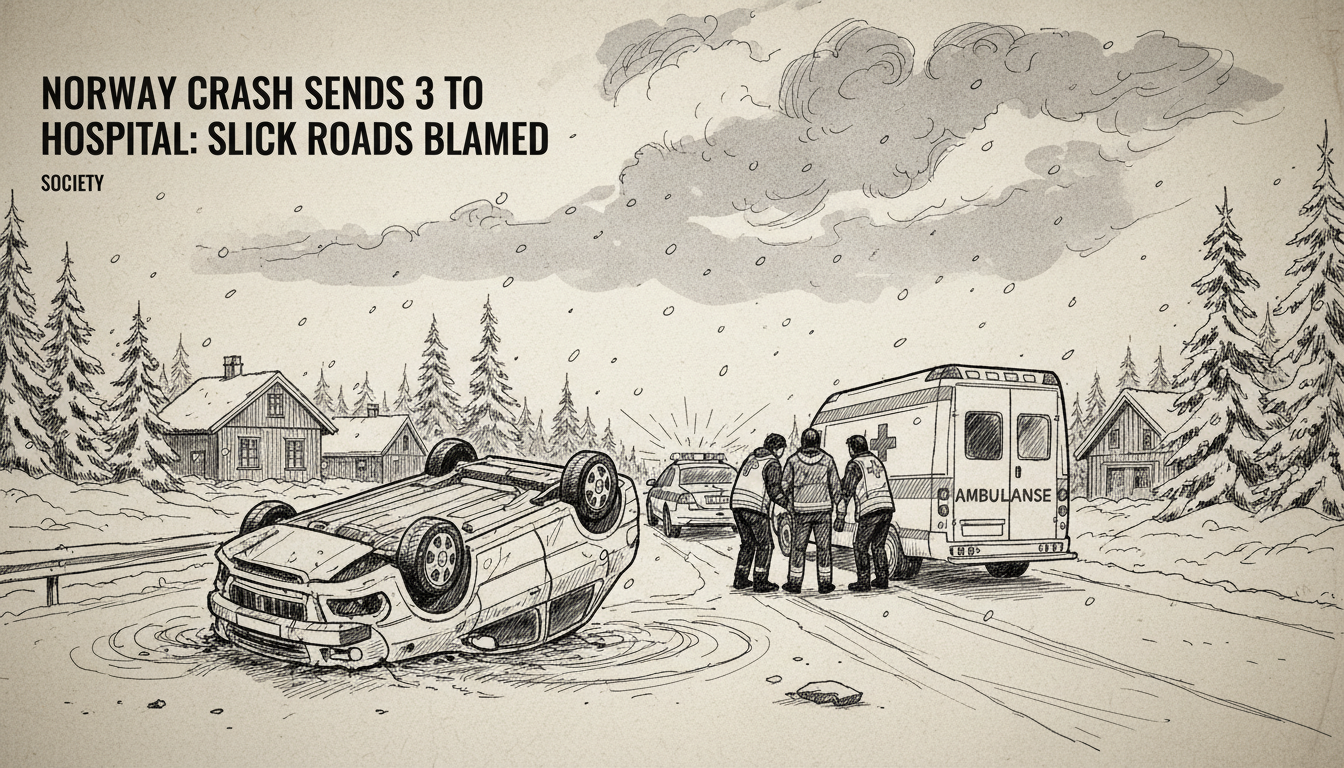
Norway road accident statistics, which show a generally improving safety record, were underscored by a serious crash in Arendal Sunday night. Three people were hospitalized after their car lost control on an icy curve. Emergency services responded to the scene around 9 PM.
Police immediately pointed to hazardous road conditions. “There is reason to believe the car lost its grip on a very slippery road surface in a curve,” the Agder Police District said in a statement. The exact severity of the injuries was not disclosed, but hospitalization indicates significant concern.
The incident occurred during a typical late-winter evening in Southern Norway. Temperatures around freezing can create treacherous black ice, especially on shaded road sections and curves. This particular accident highlights the persistent gap between Norway's advanced safety policies and the raw challenge of its climate.
Norway's Road Safety Paradox
Norway is a global leader in road safety. In 2022, the country recorded only 116 road fatalities. This figure represents one of the lowest rates per capita in the world. Serious road injuries have plummeted by roughly 50% since 2005.
This success stems from decades of sustained investment. Measures include stringent vehicle inspections, widespread use of winter tires mandated by law, and extensive road engineering. Guardrails, improved lighting, and forgiving roadside areas are common.
Yet, as the Arendal crash demonstrates, environmental factors remain a formidable opponent. “We have optimized the systems, but we cannot control the weather,” notes a traffic safety researcher from the Institute of Transport Economics. “The final and most critical safety component is always the driver’s adaptation to conditions.”
The Human Factor in Winter Driving
Expert consensus emphasizes that technology and regulation can only go so far. The mandatory switch to winter tires between November and Easter is a cornerstone of Norwegian policy. These tires provide essential traction on snow and ice.
However, tires are not a panacea. Driving behavior must adjust to match the conditions. This means reducing speed, increasing following distance, and avoiding sudden steering or braking maneuvers.
“On ice, a car’s physical limits are reached very suddenly,” explains a veteran driving instructor from the Norwegian Automobile Federation (NAF). “A curve taken just 10 km/h too fast on a dry summer road might be manageable. On black ice, that same speed difference means you leave the road.”
The police investigation in Arendal will likely focus on this interplay between speed, road surface, and vehicle handling. Preliminary reports strongly suggest a loss of grip exceeding the driver's ability to correct.
Infrastructure and Local Challenges
Arendal, a picturesque coastal municipality in Agder county, features a mix of modern highways and older, winding regional roads. The terrain, with its hills and proximity to the sea, can create localized microclimates and rapid icing.
Municipalities are responsible for winter maintenance on local roads. This includes salting and sanding. Budget constraints and the sheer scale of the road network mean treatment is not instantaneous.
A local councilor for technical services in the region acknowledges the challenge. “Our crews are highly skilled and respond as quickly as possible to weather forecasts and sensor data,” he said. “But ice can form in minutes. We rely on drivers to understand that ‘cleared’ does not always mean ‘safe,’ especially at night.”
This accident will likely prompt a review of that specific road section. Engineers may examine the curve's radius, banking, and drainage. They will assess if additional warning signs, anti-icing spray systems, or improved surface texture are warranted.
The Aftermath and National Context
The three individuals involved face a difficult recovery. Hospital stays for traffic injuries can be long, involving surgery and rehabilitation. The psychological impact of a serious crash also carries significant weight.
Financially, the costs are absorbed by Norway’s comprehensive welfare and insurance systems. Personal liability insurance (ansvarsforsikring) is compulsory for all vehicle owners. It covers injury to others and damage to other vehicles or property.
For the broader public, such incidents serve as a somber, annual reminder. Each winter, Norwegian media carries stories of collisions caused by glatt føre—slippery conditions. Public service announcements flood airwaves advising motorists to fit proper tires and drive according to the conditions.
The national road safety strategy, Vision Zero, aims to eliminate all fatal and serious injuries. Achieved through safer roads, safer vehicles, and safer road use, the Arendal crash represents a setback within a long-term positive trend. It shows that the “safer road use” component is perpetually tested by Norwegian winters.
A Persistent Winter Reality
Norway’s investment in road safety has saved countless lives. The statistical trend is undeniable and commendable. Yet, the physical laws of friction, ice, and momentum remain unchanged.
As climate change introduces more volatile weather patterns with freeze-thaw cycles, this challenge may evolve. Road maintenance and driver vigilance will continue to be the first line of defense.
The incident in Arendal is not a statistical anomaly. It is a concrete example of the ever-present risk that accompanies mobility in a Nordic winter. It reinforces the message known to every Norwegian driver: respect the season, prepare the vehicle, and slow down.
The question for authorities is whether further incremental gains can be made through technology, or if the focus must remain squarely on human behavior. For the three people in the hospital, the answer is academic. Their reality is a painful encounter with a hazard that no Scandinavian country has fully mastered.