
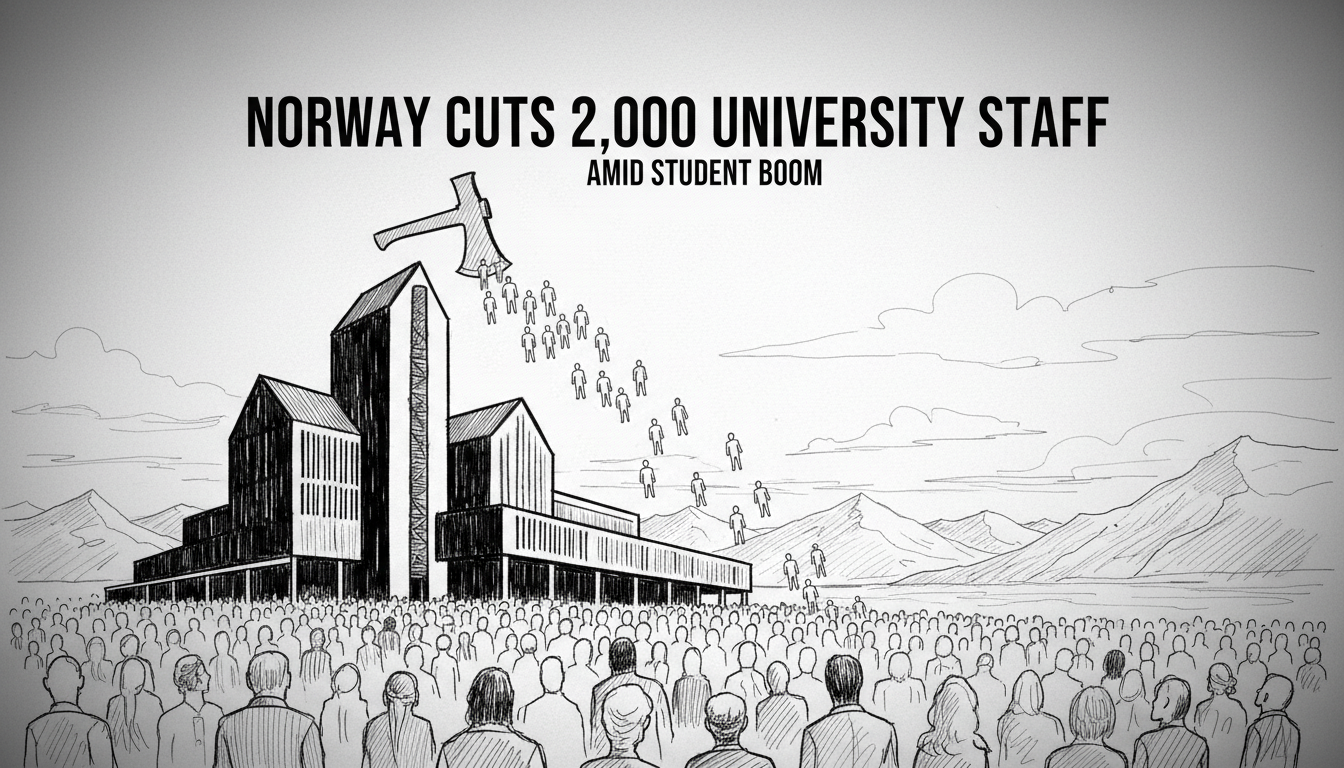
Norway's universities and colleges have cut nearly 2,000 full-time equivalent positions since 2023, even as student numbers surge by over 13,000. This stark divergence has sparked alarm among academic unions and student representatives, who warn of eroding quality in one of Europe's most robust higher education systems. The cuts primarily target scientific and academic roles, tightening resources precisely when demand for education is climbing.
Steinar A. Sæther, leader of the Forskerforbundet (Norwegian Researchers' Union), states the issue plainly. 'There are now significantly fewer staff, both academic and administrative, to follow up on a growing number of students,' Sæther said. 'It stands to reason that this will have consequences for the quality of higher education.' The Norwegian Student Organisation (NSO) has echoed this concern, highlighting the strain on student support and learning conditions.
The Numbers Behind the Squeeze
Official figures reveal a clear trend. From 2023 to 2025, the sector lost approximately 2,000 årsverk, or full-time equivalent positions. The majority of these reductions are in vitenskapelige stillinger—scientific and academic posts encompassing teaching and research. Conversely, the student population grew by roughly 13,000 during the same two-year period. When viewed from 2019, the expansion is even more pronounced, with an additional 30,000 students entering the system.
This shift directly impacts the student-to-faculty ratio, a key metric for educational quality. While a precise new ratio is not provided in the data, the inverse movement of staffing and enrollment points to a significant deterioration. More students are competing for less direct academic guidance, smaller seminar groups, and reduced access to laboratory time or research supervision.
A System Built on Public Trust
Norwegian higher education is a cornerstone of the nation's social democratic model, heavily funded by the state and designed for broad accessibility. Tuition is free for domestic and international students, fostering high participation rates. Recent government policy, however, has emphasized efficiency and fiscal responsibility across the public sector. Universities and university colleges have faced budget constraints and calls to do more with less, setting the stage for the current imbalance.
The resource allocation debate often centers on balancing open access with maintaining excellence. 'We are seeing the practical outcome of this tension,' explains a policy analyst familiar with the sector, who spoke on background. 'The funding model has not dynamically adjusted to the dual pressures of mass education and world-class research ambitions.' The analyst points to fixed budget increments that fail to match demographic growth or inflation in research costs.
Consequences for Quality and Research
The immediate human impact is felt in crowded lecture halls and overburdened professors. Academic staff report increased teaching loads, leaving less time for the research and publication that bolster institutional rankings and innovation. For students, the effects range from longer waiting times for academic advising to reduced feedback on assignments. Graduate and doctoral students, who often serve as teaching assistants, face their own pressures as they bridge the gap.
Long-term implications threaten Norway's competitive edge. The nation's economy is transitioning from oil and gas dominance towards knowledge-based industries. A weakened research base at public universities could slow innovation in sectors like renewable energy, marine biology, and Arctic technology. 'Sustained cuts to academic staff undermine our very capacity to generate new knowledge,' Sæther argues. 'This is not just an education issue; it's an industrial and economic policy issue.'
The Political Calculus in Oslo
The Storting, Norway's parliament, oversees the education budget through the Ministry of Education and Research. Political parties on the right have generally championed public sector efficiency, while those on the left prioritize safeguarding welfare state institutions. The current situation places the government in a difficult position, needing to reconcile fiscal goals with its stated commitment to education as a public good.
Discussions in government buildings near Karl Johans gate often revolve around outcome-based funding. Some politicians suggest tying a portion of university funding more directly to graduation rates or research publications. Critics counter that this metric-driven approach can incentivize quantity over quality and further strain staff. The NSO has consistently advocated for increased per-student funding to match enrollment reality.
A Look to the Nordic Neighbors
Comparatively, other Nordic nations also grapple with funding higher education amid expanding enrollment. Denmark and Sweden have experimented with tuition fees for non-EU students and increased competition for research grants. Norway's model remains distinct in its blanket free tuition, but the staffing crunch highlights a potential vulnerability. If the trend continues, Norway risks falling behind its peers in research intensity and student satisfaction surveys.
The situation at institutions like the University of Oslo, Norwegian University of Science and Technology in Trondheim, and the University of Bergen is particularly critical. These are research powerhouses that drive national innovation. Cuts here have a disproportionate impact on Norway's international academic standing.
An Uncertain Academic Future
What happens next depends on political will and public pressure. The Forskerforbundet and NSO are mobilizing to make the case for reinvestment. They argue that the economic returns from a well-educated workforce and cutting-edge research far outweigh the costs. The coming state budget negotiations will be a key test.
The core question remains: Can Norway uphold its high standards for universal education while thinning the ranks of those who deliver it? The numbers paint a worrying picture, one where access expands but the supportive infrastructure contracts. For a nation that prides itself on egalitarian values and future-proofing its economy, the path forward requires a recalibration. The world is watching to see if the Norwegian model can adapt without breaking its fundamental promise.