
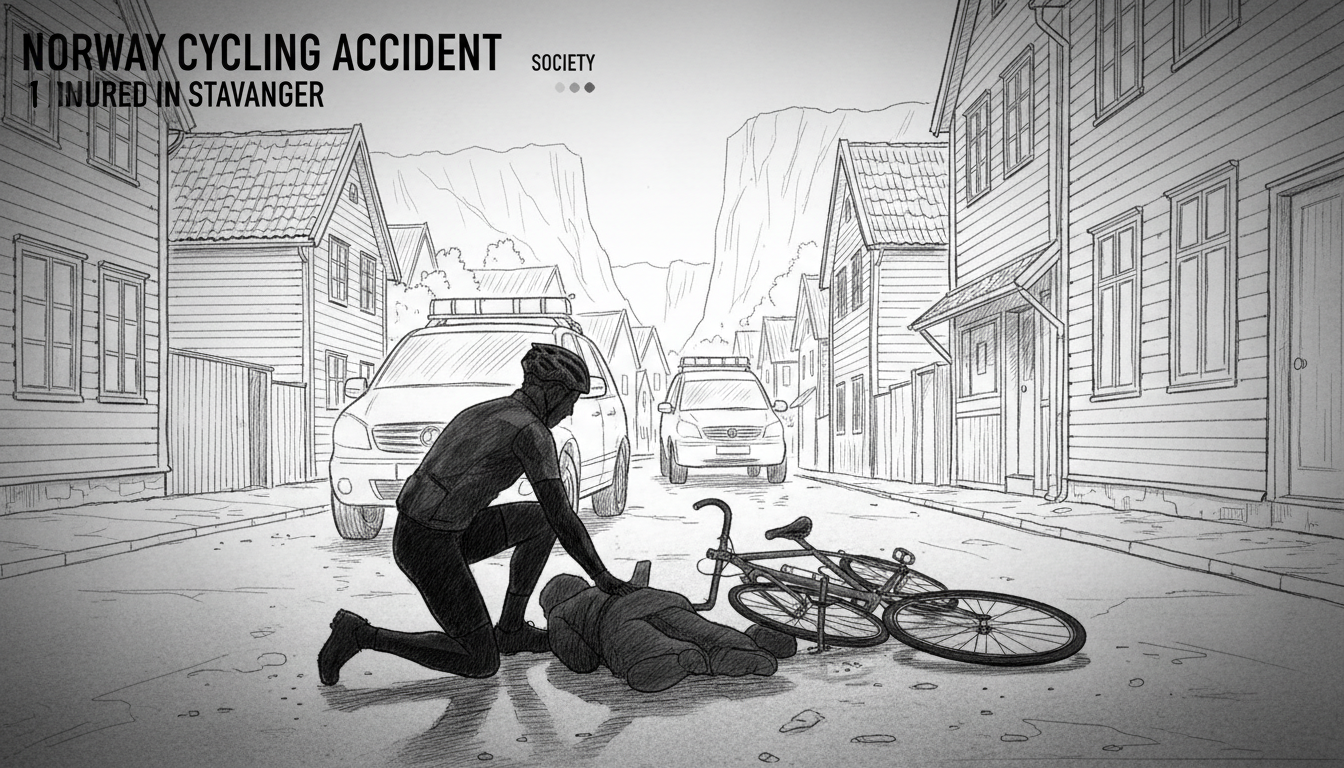
Norway road safety is under renewed scrutiny after a cyclist was struck by a vehicle on Madlaveien in Stavanger. Emergency services rushed to the major thoroughfare on Thursday afternoon, where traffic was blocked in both directions. The incident highlights persistent dangers for cyclists in Norwegian cities, despite the country's global reputation for progressive urban planning and traffic safety.
A Recurring Urban Challenge
The injured cyclist was transported to Stavanger University Hospital for treatment. Their condition was not immediately disclosed by authorities. Madlaveien is a critical artery connecting Stavanger's city center with western residential districts, known for its high traffic volume. This accident follows a pattern of collisions involving vulnerable road users on similar multi-lane urban roads. Local police have launched an investigation to determine the exact circumstances, including vehicle speed and road conditions at the time.
Norway recorded 116 traffic fatalities in 2022, according to preliminary data from the Norwegian Public Roads Administration. While this figure represents a long-term decline, the number of cyclists seriously injured has shown concerning fluctuations in recent years. Each incident fuels a national conversation about the pace of safety improvements. "Every accident is one too many," said a spokesperson for the Norwegian Council for Road Safety. "Our goal is zero fatalities and serious injuries. This requires constant work on infrastructure, vehicle technology, and behavior."
The Infrastructure Debate Intensifies
Traffic safety experts point to separated bicycle lanes as a paramount solution for urban areas like Stavanger. "When cyclists and motor vehicles share the same space, the risk of conflict is inherent," explained Dr. Lena Hagen, a transportation planner at the University of Stavanger. "The most effective measure is physical separation—dedicated, protected cycling paths that remove the possibility of collision. On roads like Madlaveien, this often requires reallocating space from cars."
This philosophy is central to Norway's National Transport Plan, which mandates that all major state road projects must include safe cycling and walking facilities. However, implementation in existing urban corridors is slow and often contentious. Municipalities face budget constraints and political pressure when proposing changes that could reduce vehicle capacity. The city of Stavanger has its own cycling strategy aiming to increase the bicycle share of all trips, but progress on building a fully connected, protected network has been incremental.
A National Push for 'Vision Zero'
The accident underscores Norway's commitment to the 'Vision Zero' policy, adopted from Sweden, which aims to eliminate all traffic fatalities and serious injuries. This ethical framework shifts responsibility from individual road users to system designers—politicians, planners, and engineers. It has led to widespread implementation of lower speed limits, particularly 30 km/h zones in residential and city center areas. Research shows that reducing impact speed dramatically increases a cyclist's chance of survival.
Yet, as this incident shows, high-risk corridors remain. "Vision Zero is not just about speed limits," said Marius Andersen, a project manager with Trygg Trafikk, Norway's leading road safety organization. "It's about systematic risk management. We must identify these high-risk roads and intersections through data and redesign them. It's an ongoing process of improvement, and public pressure after accidents like this one can accelerate necessary changes."
The Human and Policy Impact
Beyond statistics and infrastructure debates, each accident carries a profound human cost. For the injured individual, it can mean life-altering physical trauma and a long recovery. For their family and the driver involved, it brings psychological distress. For the local community, it serves as a frightening reminder of vulnerability. These human stories are the driving force behind advocacy groups like Syklistenes Landsforening (The Norwegian Cyclists' Federation), which campaigns tirelessly for safer conditions.
Their efforts have yielded results, including stricter liability rules in traffic law that often place greater responsibility on motor vehicle drivers in collisions with cyclists. The federation argues that while legal protection is important, prevention through design is better. "We need to stop talking about 'accidents' as inevitable and start talking about predictable and preventable system failures," said a federation representative. "This crash in Stavanger will be analyzed, and we expect the municipality to act on the findings to prevent the next one."
The Stavanger police investigation will conclude whether charges are warranted. Possible outcomes include fines for traffic violations or, in severe cases, prosecution for negligent driving. The findings may also contribute to a formal risk assessment of Madlaveien by the Norwegian Public Roads Administration, potentially leading to redesign proposals.
The Road Ahead for Norwegian Cities
As Norway's fourth-largest city and an energy hub, Stavanger embodies the national tension between car-centric development and a sustainable urban future. The city's growth has historically been tied to the automobile, but like Oslo and Bergen, it now faces demands for more people-centered streets. This accident places immediate pressure on local politicians to fast-track planned safety upgrades and consider more radical interventions, such as continuous protected bike lanes along key routes.
The challenge is not unique to Norway. Cities across the Nordic region and Europe are grappling with how to rapidly retrofit old infrastructure for new mobility patterns. Norway's advantage is its strong political consensus on the Vision Zero goal and substantial public funding for transport. The test is whether this political will translates quickly enough into physical changes on streets like Madlaveien.
Will this tragic event be a catalyst for faster change, or will it become another data point in a slow statistical trend? The answer lies in the hands of Stavanger's municipal government and the national authorities who set safety standards. For the cycling community and safety advocates, the message is clear: safe infrastructure cannot wait for another serious injury or worse. The time for decisive action is now, before the next call to emergency services echoes across another busy Norwegian street.