
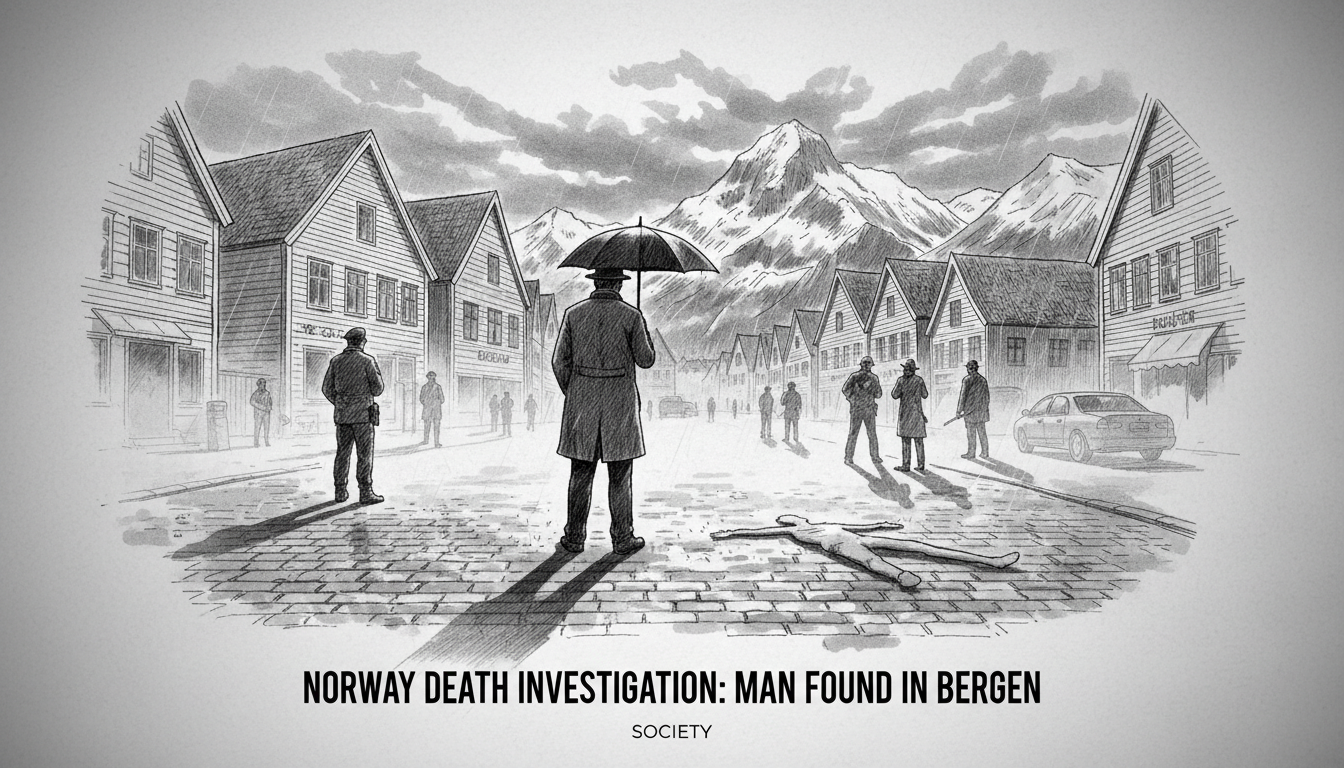
Norway death investigation protocols are underway after a man in his 50s was found dead in a Bergen neighborhood. Police responded to a call at 3:46 PM Sunday afternoon at Melkeplassen, a residential area in Norway's second-largest city. The man was pronounced dead at the scene. Police operations leader Knut Dahl-Michelsen of the West Police District confirmed the death and stated that initial findings do not point to criminal activity. Next of kin have been notified. The body has been removed by a funeral home, and a standard autopsy will be performed to determine the cause of death.
A Standard Procedure in an Unforeseen Death
The discovery of a deceased person in a public or private space triggers a meticulous, standardized response from Norwegian authorities. Every unattended death is treated as a potential crime scene until evidence proves otherwise. This systematic approach is a cornerstone of Norway's justice and health systems. It ensures no foul play goes undetected while also gathering crucial public health data. The police secure the area, document the scene, and initiate a preliminary investigation. Forensic technicians may be deployed even when criminal suspicion is low. Their work creates an official record and helps rule out external factors. The involvement of a funeral home only occurs after police conclude their on-site examination. This process unfolded methodically in Melkeplassen on Sunday. "The police have finished their investigations," Dahl-Michelsen said in a statement. "A funeral home is now on site to collect the deceased. An autopsy will be performed, and a case will be opened."
The Critical Role of the Forensic Autopsy
The upcoming autopsy is not an indication of suspicion but a routine and legally grounded procedure. In cases where the cause of death is not immediately clear from the circumstances or a recent medical history, Norwegian law mandates a post-mortem examination. This is particularly true for individuals who die outside of a hospital or care facility without a known, terminal illness. The autopsy serves multiple purposes. It provides a definitive medical cause of death, which is essential for the official death certificate. It can identify unknown natural diseases, such as cardiac conditions or aneurysms. It also offers closure and answers to the bereaved family, explaining what happened to their loved one. From a societal perspective, these autopsies contribute to national mortality statistics. They help track epidemiological trends, such as heart disease patterns or the impact of seasonal flu. The results from the Melkeplassen case will be added to this dataset, informing broader public health understanding.
Bergen's Context and Community Impact
Bergen, nestled between the Seven Mountains and the North Sea, is a city of close-knit neighborhoods. Melkeplassen is part of the larger Fyllingsdalen area, a largely residential district with apartment blocks, schools, and local businesses. News of a death in such a community resonates deeply. While police have indicated no criminal activity, the sudden loss of a middle-aged man sends ripples through his immediate circle and the local area. Residents may reflect on their own health or the fragility of life. The man's family now enters the formal and emotional process of grieving, compounded by the administrative tasks following a death. They will work with the funeral home, likely the one that collected the body, to arrange a burial or cremation. They will also await the autopsy report from the Haukeland University Hospital department of forensic medicine, which typically handles such cases for the region. This period of waiting can be stressful, even when no crime is suspected.
Norway's Approach to Mortality and Investigation
Norway's low crime rate and high institutional trust shape its response to incidents like this. Police resources are directed toward thorough preliminary investigations to maintain that societal safety. The principle is one of preventive thoroughness. By checking every case, they ensure that the rare homicide is not mistakenly classified as a natural death. This system functions efficiently due to strong coordination between police, forensic pathologists, and municipal health services. The cost is absorbed by the state as part of its legal and public health obligations. For citizens, this means that the death of a loved one, while tragic, is handled with procedural clarity and respect. The process aims to be transparent for the family while protecting the privacy of the deceased. The police statement, which included the man's age bracket but not his identity, reflects this balance between public information and personal dignity.
What Happens Next in the Investigation
The case now moves from the scene to the laboratory and the desk of a investigating officer. Forensic pathologists will perform the autopsy, examining both external and internal factors. They will look for signs of disease, trauma, or toxicity. Samples may be sent for toxicological analysis to check for alcohol, prescription medications, or other substances. This can take several weeks. Concurrently, police will continue their administrative investigation. They will interview family members, friends, or colleagues to understand the man's recent health and state of mind. They will review his medical history with consent from next of kin. All this information will be compiled into a report. If the autopsy concludes the death was from natural causes, the police case will be closed. The death certificate will be issued, allowing the family to finalize estate matters. If the autopsy reveals an accidental cause, such as a fall or unintended overdose, the case may also be closed unless negligence by another party is suspected. Only a finding of unnatural injury or poison would trigger a criminal investigation.
A Reflection on Sudden Loss in a Safe Society
This incident in Bergen is a somber reminder that even in one of the world's safest and healthiest countries, death can arrive suddenly and unexpectedly. The man in his 50s was in what many consider the middle of life. His passing underscores that health is not guaranteed by geography or societal structure. Norway's robust response system exists not because death is common, but because each individual life is valued highly. The meticulous process honors that value by seeking answers and ensuring justice, even when justice is not needed. For the community in Melkeplassen, life will continue. But for one family, Sunday afternoon marked a profound and permanent change. They are supported by a system designed to handle such events with competence and care, from the first police responder to the final signature on a death certificate. The true investigation now is a personal one, as they piece together life without him.