
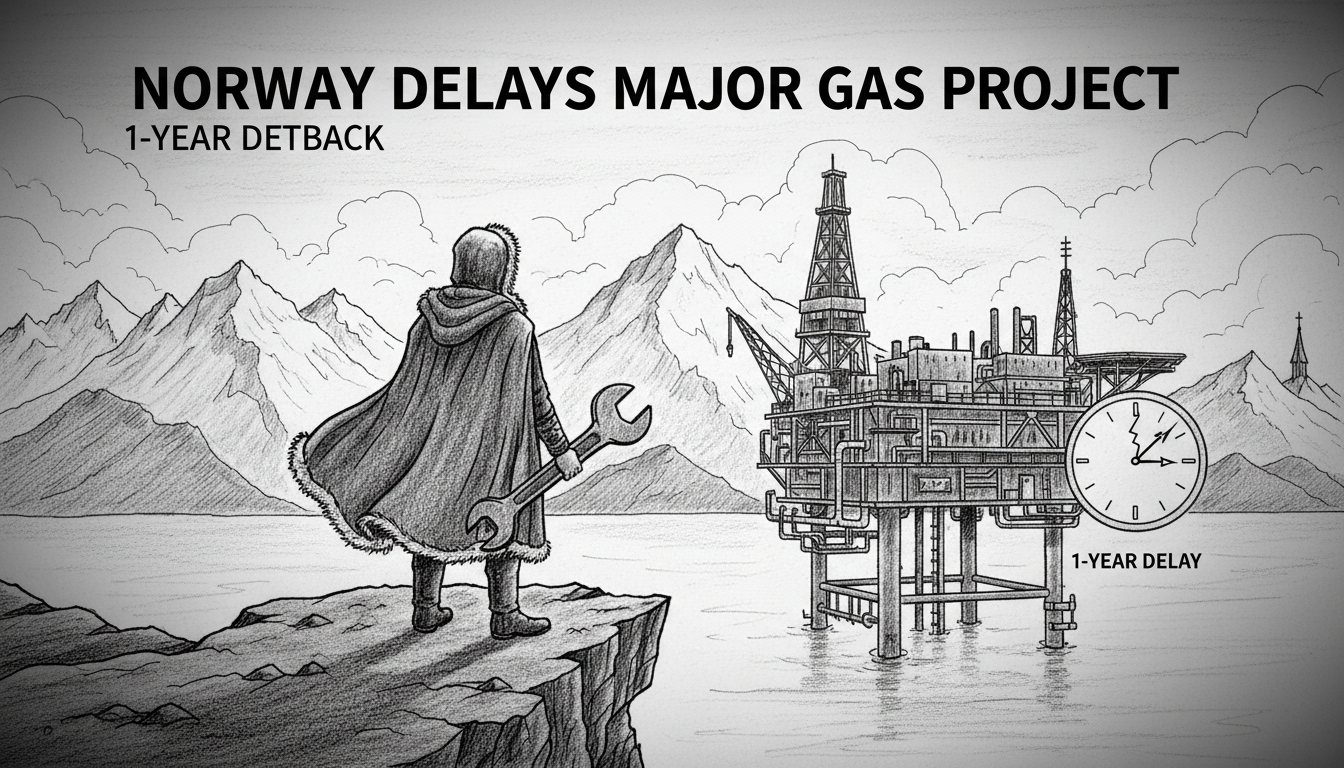
Norway's largest industrial project in the northern region faces a significant delay and cost overruns, casting doubt on the nation's intricate timeline for reducing emissions from its vital oil and gas sector. State-owned energy giant Equinor announced the 'Snøhvit Future' project at the Hammerfest LNG plant will now start in 2029, a full year later than planned. The initiative's estimated cost has also risen by approximately 4 billion Norwegian kroner since last year.
The Snøhvit Future project is central to Norway's strategy for lowering emissions from its offshore industry. It aims to electrify the Hammerfest LNG facility on Melkøya Island using clean hydropower from the mainland. This switch from gas-fired turbines is projected to cut 850,000 tonnes of CO2 annually from the plant's operations. That figure represents about two percent of Norway's total yearly emissions.
The delay poses a direct challenge to the government's climate policy framework. It also introduces uncertainty for Europe's gas supply chain, which has come to rely more heavily on Norwegian exports since the war in Ukraine.
The Snøhvit Future Blueprint
Hammerfest LNG, often called 'Melkøya', is Europe's first large-scale export terminal for liquefied natural gas. It processes gas from the Snøhvit field in the Barents Sea, located about 140 kilometers offshore. The field contains an estimated 193 billion standard cubic meters of recoverable gas. The plant itself has a production capacity of 4.3 million tonnes of LNG per year, making it a cornerstone of Norway's gas infrastructure.
The Snøhvit Future project involves two main components. The first is the full electrification of the Melkøya plant. The second is the installation of onshore compression technology to maintain stable gas flow from the Snøhvit field as reservoir pressure naturally declines over time. Together, these investments are meant to secure the plant's long-term operational future while drastically lowering its carbon footprint.
'This is about maintaining production and strengthening export capacity with a significantly lower climate impact,' an Equinor spokesperson said in a statement announcing the revised timeline. 'The schedule change is due to the need for further maturation of the project, including finalizing key supplier contracts.'
Rising Costs and Industry Pressures
The four-billion-krone cost increase highlights the broader inflationary pressures facing complex energy projects worldwide. Supply chain bottlenecks, rising wages, and increased material costs have hit the offshore sector hard. This trend is evident from the North Sea to the Barents Sea.
Analysts note that such overruns are becoming commonplace. 'We are seeing cost growth across the board for major engineering projects, particularly those involving clean technology integration,' said Lars Jacob Tellnes, an independent energy analyst based in Oslo. 'The complexity of tying a major industrial facility like Melkøya to the national power grid, while also adding new compression systems, is immense. Delays and budget revisions were, unfortunately, predictable.'
The added financial burden will be scrutinized by Equinor's partners in the Snøhvit field and by politicians in the Storting, Norway's parliament. The project's economics remain favorable due to high European gas prices, but continued volatility creates risk.
Clashing Timelines: Climate Goals vs. Industrial Reality
The one-year postponement creates a tangible gap in Norway's climate action plan. The country has committed to cutting greenhouse gas emissions by 55 percent by 2030 compared to 1990 levels. The oil and gas sector is Norway's largest emitter, responsible for over a quarter of national emissions.
Electrification of offshore installations like Hammerfest LNG is the government's primary tool for achieving these sectoral cuts. Each delay in a major project like Snøhvit Future makes the 2030 target harder to reach. The 850,000-tonne annual reduction from Melkøya is a substantial chunk of the planned cuts.
'This setback shows the inherent tension in Norway's dual role as a climate leader and a fossil fuel exporter,' said Kari Nessa Nordtun, a Member of Parliament for the Labour Party who sits on the Energy and Environment Committee. 'We have set ambitious targets, but our tools for reaching them are complex, expensive megaprojects that are vulnerable to delays. The government must assess whether the current pace of electrification is sufficient.'
The delay also has implications for Norway's carbon tax regime. The country imposes one of the world's highest taxes on CO2 emissions from the petroleum sector. This policy is designed to make investments in electrification financially worthwhile for companies. A later completion date means the plant will incur higher tax costs for a longer period before the emissions cuts are realized.
Regional Impact in the High North
In Finnmark county, Norway's northernmost region, the project is more than a climate initiative. It is a vital economic engine. Hammerfest LNG is the largest industrial workplace in the region. The Snøhvit Future project promises significant local contracts and long-term job security.
The postponement may dampen near-term economic activity for suppliers. However, local officials express confidence in the project's ultimate execution. 'We are of course noting the new timeline, but the important thing is that the investment is confirmed and moving forward,' said Hammerfest Mayor Marianne Sivertsen Næss. 'This project secures the future of Melkøya for decades, which is crucial for our community and the entire North.'
The development underscores the strategic importance of the Barents Sea as Norway's newest energy frontier. Ensuring stable, lower-emission production from Snøhvit is key to maintaining Norway's position as a reliable, long-term gas supplier to Europe.
The Path Forward to 2029
Equinor maintains that the revised 2029 start date is firm. Project teams are now focused on finalizing engineering designs and locking in major equipment orders. The company must also coordinate closely with Statnett, Norway's state-owned grid operator, to ensure the power infrastructure from the mainland is ready to deliver the substantial electricity required.
The coming years will test Norway's ability to execute its energy transition strategy. Other major electrification projects, including for the Troll and Oseberg fields in the North Sea, are also in the planning stages. The experience with Snøhvit Future will likely serve as a benchmark for their progress.
Norway's climate ambitions are now locked in a race against the clock of industrial reality. The delay at Melkøya is a single setback, but it highlights a systemic challenge. Can a nation that built its wealth on hydrocarbons successfully re-engineer its cornerstone industry fast enough to meet its own stringent climate deadlines? The answer will continue to unfold in the cold waters off Hammerfest.