
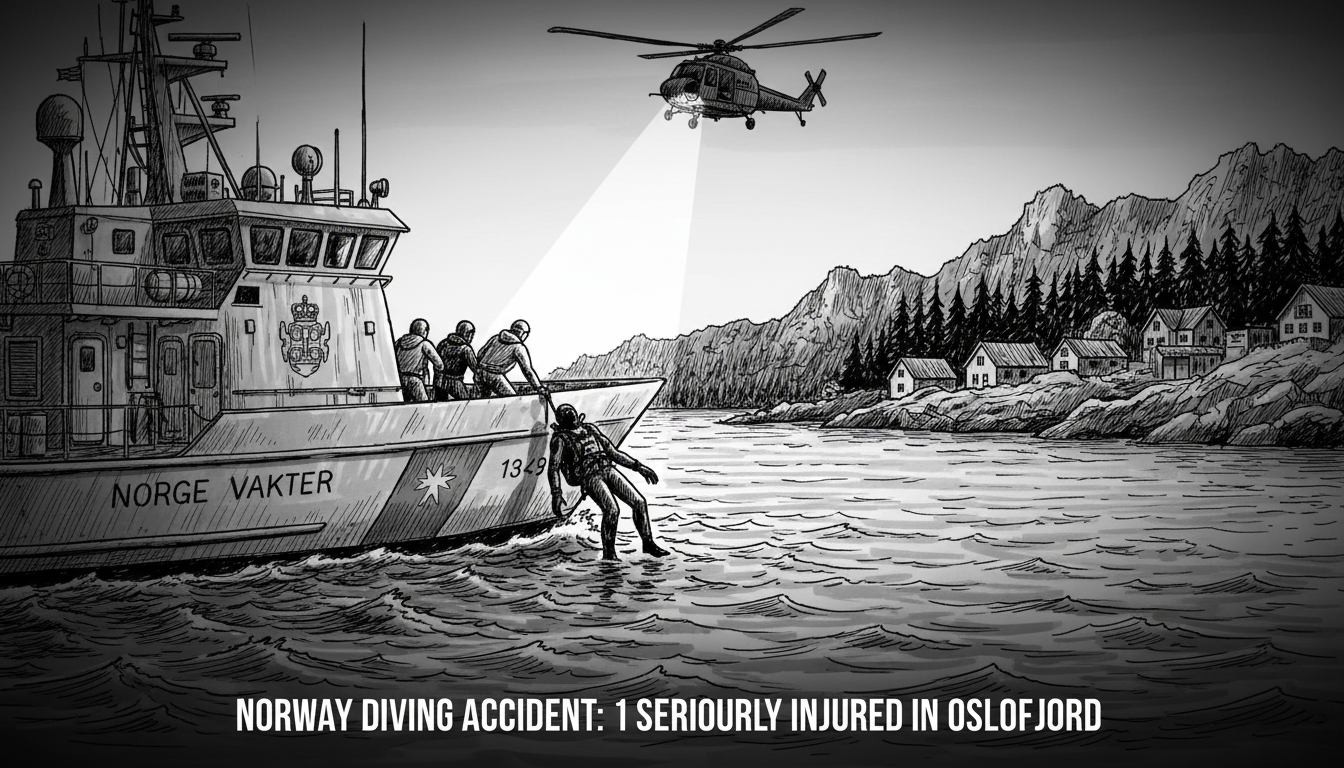
Norway diving accident in the Oslofjord has left one person seriously injured after a rapid ascent without proper decompression. The incident occurred near the town of Drøbak in Akershus county on Tuesday evening. Police confirm the diver was conscious throughout and was quickly assisted by people on a boat at the scene before being airlifted to Oslo's major trauma center, Ullevål Hospital.
Emergency services, including an air ambulance and a rescue helicopter, were dispatched to the location. The rescue helicopter departed the scene shortly after 8:40 PM. Police indicate the preliminary assessment points to a case of decompression sickness, commonly known as 'the bends,' which occurs when a diver surfaces too quickly.
A Calm Evening Turned Critical
The waters near Drøbak, a popular boating and recreational area just south of Oslo, are typically calm. This makes the sudden and serious nature of the accident particularly jarring for the local community. Eyewitness accounts describe a swift response from fellow boaters, who pulled the injured diver from the water and provided initial care while awaiting emergency services. The diver's maintained consciousness is a positive sign, but decompression sickness requires immediate and specialized hyperbaric treatment.
Police have not released the identity or experience level of the diver. The investigation will focus on the dive plan, equipment used, and the specific circumstances that led to the uncontrolled ascent. Norway's extensive coastline and clear, cold waters make it a destination for divers, but this environment also demands rigorous safety protocols.
The Silent Threat of 'The Bends'
Decompression sickness is a well-known but dangerous risk in diving. As a diver descends, increased pressure causes nitrogen from breathing air to dissolve into the bloodstream and tissues. During a controlled ascent, this nitrogen has time to safely leave the body. A rapid ascent, however, causes the nitrogen to form bubbles, similar to opening a shaken soda bottle. These bubbles can block blood vessels, damage tissues, and cause severe pain, neurological symptoms, paralysis, or death.
"This is a classic failure-to-follow-procedures scenario," said Lars Jensen, a retired commercial diving supervisor and safety instructor based in Bergen. "Dive computers and tables exist for one reason: to give you a safe ascent profile. Ignoring them, either due to panic, equipment failure, or misjudgment, is how these accidents happen. The cold water in the Oslofjord can also accelerate air consumption and disorient a diver."
Treatment involves placing the patient in a hyperbaric chamber, which simulates increased pressure to reduce the bubble size, followed by a slow, controlled decompression. Ullevål Hospital houses one of Norway's leading hyperbaric medicine units, making it the critical destination for such incidents in the region.
Safety in Norway's Popular Depths
Diving is a regulated activity in Norway. The Norwegian Sub-Aqua Federation (Norges Dykkeforbund) sets training standards and safety guidelines for recreational divers. Most fatal diving incidents globally are attributed to drowning, often preceded by another issue like equipment trouble or a medical event. Arterial gas embolism—a severe form of decompression sickness where bubbles enter arterial circulation—is another leading cause.
A 2018 global study on recreational diving fatalities estimated a rate of 1.7 to 2.4 deaths per 100,000 dives. While Norway has a strong safety record, its environment presents unique challenges. "Norwegian waters are beautiful but demanding," Jensen explained. "Low temperatures increase the risk of hypothermia, which can impair judgment. Good buoyancy control is non-negotiable. Every diver here must respect the environment and their own limits."
Accidents often trigger reviews of safety protocols. This incident will likely prompt local diving clubs and charter operators in the Oslofjord to reiterate the importance of dive planning, buddy checks, and maintaining control during ascent. It serves as a stark reminder that even in familiar, seemingly benign waters, procedural discipline is the primary defense against tragedy.
A Community and an Industry Reflect
The Drøbak accident resonates beyond the diving community. For coastal towns, the sea is both a playground and a workplace. Incidents like this underscore the ever-present risks associated with maritime activities, from professional fishing to recreational sailing and diving. The efficient multi-agency response, involving police, local boaters, air ambulance, and the rescue helicopter service, highlights Norway's integrated emergency preparedness system.
However, the ultimate responsibility rests with individual divers. Experts consistently emphasize the fundamentals: obtain proper certification, maintain equipment meticulously, dive within the limits of your training and fitness, and always follow a planned dive profile with a safety margin. Panic is a frequent factor in accidents; regular practice of emergency skills, like controlled emergency swimming ascents, can build the muscle memory needed in a crisis.
As the injured diver receives treatment at Ullevål, the investigation will work to piece together the exact sequence of events. The findings could contribute to broader safety discussions. For now, the focus is on recovery and the sobering lesson that the water's surface, while a relief, must be reached with patience and care.
Norway's relationship with the sea is deep and enduring, built on both respect and enjoyment. This incident in the scenic Oslofjord is a painful interruption of that harmony, a warning etched not in storm waves, but in the invisible, lethal physics of pressure and gas. It asks every person who enters the water: is your respect for the rules as deep as your dive?