
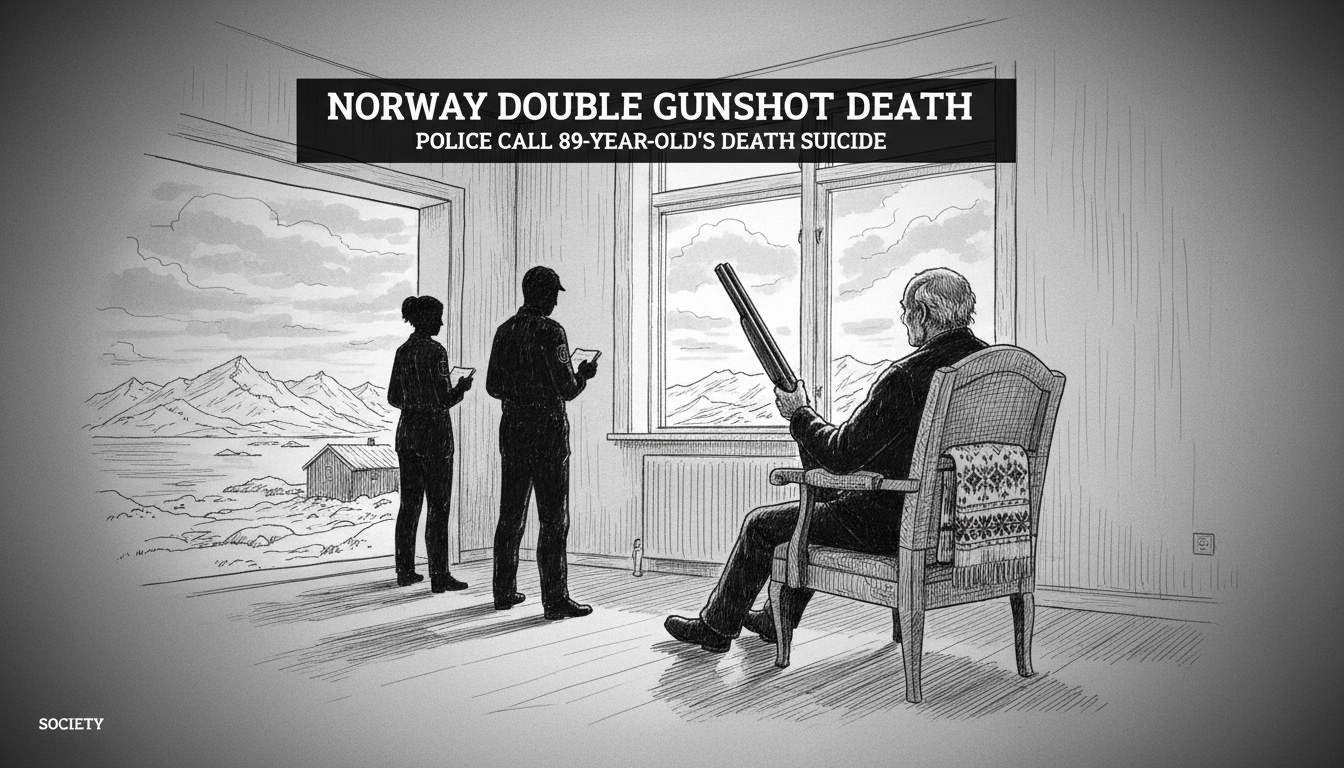
Norway police are investigating the death of an 89-year-old man found with two gunshot wounds to his head. Authorities in Bergen have concluded the death was a suicide, a finding now under intense scrutiny from forensic experts and the man's grieving family.
The man was discovered in his bedroom after a house fire in Kalandseidet, Bergen, on January 15, 2025. Firefighters extracted him from the burning home. An initial assumption was that the blaze caused his death. The subsequent autopsy report delivered a shocking revelation. The elderly man died from two separate gunshot wounds to his head. Forensic evidence indicated he was likely dead before the fire reached his room, as investigators found no soot in his lungs.
A Forensic Puzzle Emerges
This finding immediately complicated the investigation. A death involving a firearm in Norway triggers a meticulous forensic process. Police must definitively rule out foul play before any other determination. The presence of two gunshots, however, presented an unusual circumstance. The National Criminal Investigation Service, known as Kripos, was consulted for its expert analysis. Kripos specialists assessed the scene and the evidence. Their initial assessment raised a significant question. They found it would not have been possible for the man to fire the weapon, given the bullet trajectories, in either a sitting or standing position.
This technical assessment from the country's top criminal investigators created a clear point of contention. It directly challenged the plausibility of a self-inflicted death. Police investigators, however, have presented a different interpretation of the forensic facts. They maintain that suicide remains the most likely scenario.
The Police's Stance and a Family's Doubt
Police prosecutor Are Nygård Bergh addressed the Kripos assessment publicly. "According to the forensic pathologist who performed the autopsy, it would be possible to survive such a shot and then reload the weapon and fire a second shot," Bergh stated. This perspective hinges on a specific medical and ballistic possibility. It suggests the man could have sustained a first, non-immediately fatal wound, retained consciousness and motor function, and then fired again.
This official conclusion has not brought closure to the man's family. They have grown deeply critical of the police investigation. Relatives believe the case has not been examined thoroughly enough. The discrepancy between the Kripos assessment and the police conclusion lies at the heart of their concern. They question how two expert bodies can arrive at such different interpretations of the same physical evidence. The family's public criticism adds a layer of human anguish to a complex forensic puzzle.
Understanding Norway's Death Investigation Protocols
To grasp the significance of this case, one must understand Norway's rigorous approach to death investigations. Every sudden or unexplained death is treated with extreme seriousness. The primary goal is always to exclude criminal activity. Police work alongside forensic pathologists and, in complex cases, specialists from Kripos. The process is methodical and evidence-driven. Even in cases where suicide is suspected, the investigation must conclusively prove no other person was involved. This protocol is designed to ensure justice and maintain public trust in the system.
The use of a firearm in a suicide, while tragic, is not unprecedented. However, a double gunshot suicide is exceptionally rare. It demands an extraordinarily high level of forensic scrutiny. Experts would typically analyze gunshot residue on the hands, the precise angles of entry wounds, the location of the firearm, and any signs of disturbance in the room. Each piece of data forms part of a narrative that must be physically and logically consistent.
The Central Question of Possibility
The core of this investigation now rests on a single, grim question of biomechanical possibility. Can an 89-year-old man fire two shots to his own head? The Kripos assessment, based on the spatial dynamics of the scene, suggests the shot could not have been self-administered in a conventional posture. The police theory, supported by a forensic pathologist, argues for a scenario where the man survived the first shot long enough to act again.
Forensic experts outside the case note the critical factors that would be examined. The wound paths would show if the angles were consistent with a person's own reach. The presence or absence of defensive wounds would be noted. The condition of the weapon and its placement relative to the body are crucial details. The complete forensic report, which remains private, holds these answers.
A Family Seeks Answers Amidst Grief
For the family, the statistical rarity and forensic disagreement translate into profound doubt. They are left navigating grief compounded by uncertainty. When an official cause of death feels unresolved to the next of kin, it can prevent the healing process from beginning. Their call for a more thorough investigation is a plea for certainty. They seek a definitive explanation that aligns all the known facts without contradiction.
This case highlights the delicate balance police must strike. They must follow evidence to a conclusion, even when that conclusion seems counterintuitive. Simultaneously, they must communicate their findings transparently to families who deserve clarity. The gap between a technical forensic conclusion and a family's acceptance can be wide.
What Happens Next?
The Bergen police have stated their position. The family has stated theirs. The discrepancy with the Kripos assessment remains a matter of public record. In Norway, if a family remains profoundly dissatisfied with a death investigation, they can pursue avenues for review. They may request further independent analysis or seek legal counsel to examine the investigative steps taken.
The house fire itself adds another layer of complexity. Investigators must determine whether the fire was connected to the man's death or was a separate, subsequent event. Was it an accident, perhaps related to the incident that caused the death, or an intentional act? This question, too, requires a definitive answer.
This tragedy in Kalandseidet is more than a police report. It is a story of a life lost under deeply puzzling circumstances. It is about the limits of forensic science in reconstructing final, solitary moments. It is about a family's right to answers that are coherent and complete. As the investigation stands, the official finding of suicide is punctuated by a significant question mark from both experts and loved ones. In the meticulous world of Norwegian death investigation, such a pronounced disagreement is uncommon. It ensures this case will not simply be filed away, but will linger as a somber reminder of the questions that can outlive a man, even after the flames are extinguished.