
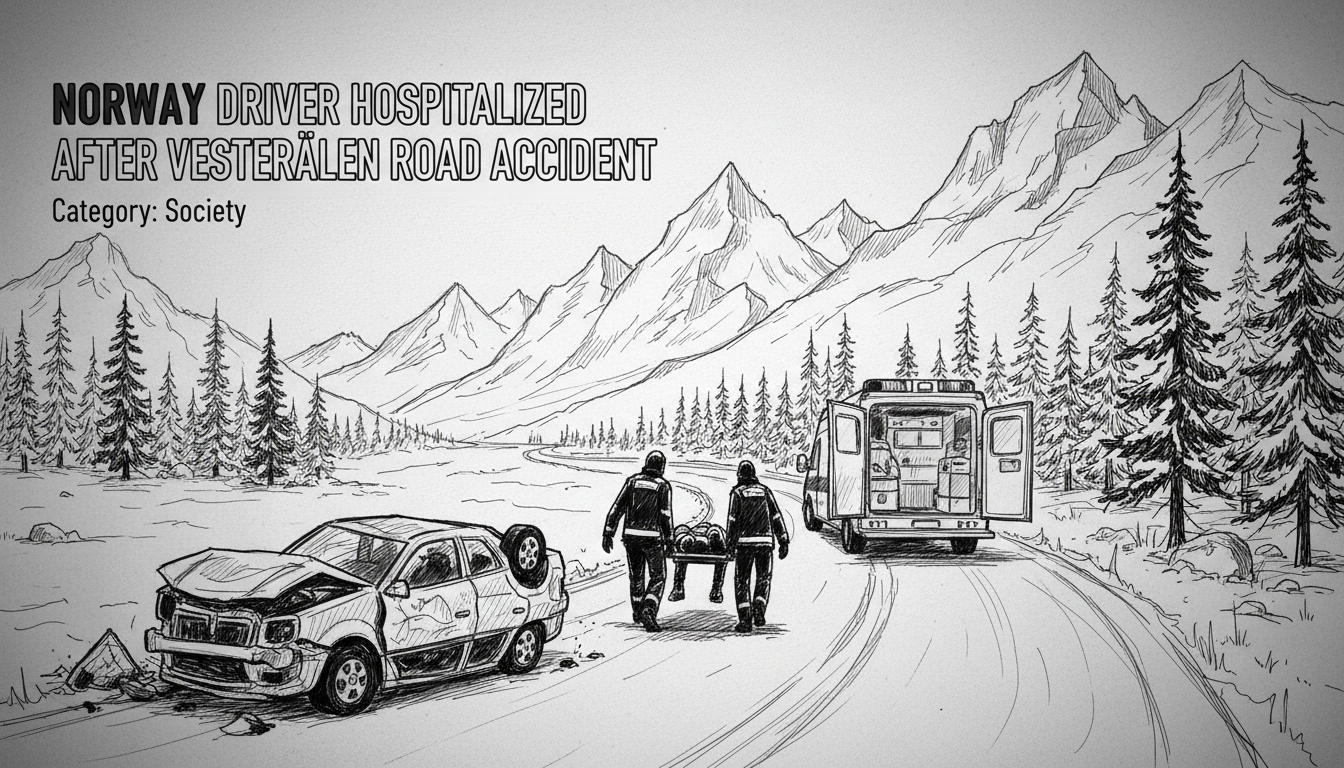
Norway's Vesterålen archipelago saw a serious traffic incident on County Road 82 in Hadsel municipality, Nordland county. A single-vehicle accident resulted in the driver being transported to Stokmarknes hospital for treatment. Police reported that life-saving first aid was administered at the scene. Investigators are exploring whether a sudden medical episode may have caused the driver to lose control. This incident highlights the unique challenges of road safety in Norway's northern regions, where remote locations and vital transport corridors intersect with concerns over driver health and infrastructure.
A Critical Artery in the Arctic
Fylkesvei 82 is not just any road. It serves as a primary transportation link connecting communities across the Vesterålen islands. This region, situated above the Arctic Circle, relies heavily on its road network for daily life, commerce, and tourism. An accident on this route disrupts more than traffic; it impacts the logistical lifeline for residents. The road's conditions, which can vary dramatically with the seasons, are a constant factor for local drivers. While initial police reports did not cite weather or road surface as factors, the context of northern Norwegian driving is always relevant. Long stretches between settlements and variable Arctic weather patterns mean any incident requires a significant emergency response.
Police officer Mads Bernhoft from the Nordland Police District confirmed the serious nature of the response in an initial statement. "Life-saving first aid is being administered on site," he wrote. This level of intervention indicates the potential severity of the driver's condition at the time of the accident. The focus quickly turned to the driver's health as a possible cause. "Police do not yet know what caused the accident," the statement read, "but one theory is that the driver may have taken ill while driving."
The Medical Episode Theory
The police's working theory—that a medical event preceded the crash—shifts the investigation from external factors to internal ones. This is a significant pivot. It moves the focus away from road design, signage, or vehicle failure and toward the driver's physical condition. Such incidents, while statistically less common than accidents caused by distraction or impairment, present complex questions for traffic safety authorities. They touch on issues of medical privacy, licensing regulations, and individual awareness of health risks.
In Norway, driver's license renewals for individuals over certain ages require medical self-declarations. For ordinary passenger car licenses (Group 1), a medical certificate from a doctor is required for first-time applicants with certain conditions and for renewals at ages 75, 80, and every two years thereafter. The system operates largely on self-reporting and a doctor's assessment. An accident potentially caused by an unforeseen medical issue, such as a cardiac event, stroke, or seizure, tests the limits of this regulatory framework. Can any system reliably predict every sudden health crisis?
Traffic safety expert Lars Tingelstad, who has studied Nordic accident data, notes the difficulty. "Single-vehicle accidents where the car leaves the roadway without obvious evasion maneuvers often trigger an investigation into driver health," he explained. "In remote areas like Vesterålen, the consequences can be more severe simply due to longer response times, even with excellent emergency services. The question becomes whether the medical event caused the accident, or if the accident caused injuries that mimic a medical event. That takes careful forensic and medical analysis."
The Human and Systemic Response
The driver was taken to Stokmarknes Hospital, which serves as a central medical facility in the region. The hospital's capacity and the nature of the injuries sustained are not detailed in public reports, respecting patient confidentiality. However, the event mobilizes multiple public safety systems: police, ambulance services, and hospital trauma teams. In Nordland county, with its low population density and vast geographic area, these resources are stretched across great distances. A serious accident demands a coordinated effort that is both rapid and resource-intensive.
For the local community in Hadsel, such events resonate deeply. With a population of around 7,500 spread across islands and fjords, news travels quickly. Roads like Fylkesvei 82 are daily conduits for neighbors, friends, and family. An accident is seldom just a news item; it is a community event that prompts concern and reflection on shared risks. The rugged beauty of Vesterålen, with its dramatic mountains meeting the Norwegian Sea, comes with the practical challenge of maintaining safe transit along coastal roads and bridges.
Broader Implications for Norwegian Road Safety
This accident occurs within a national context where Norway boasts some of the world's lowest traffic fatality rates. This achievement is the result of decades of investment in safer road infrastructure, strict enforcement of drunk driving laws, and a strong vehicle safety culture. However, the challenge of driver health is a growing focus as the population ages. The Norwegian Public Roads Administration (Statens vegvesen) continuously analyzes accident data to identify new risk patterns.
The agency's research indicates that while health-related accidents are a minority, they are often serious. Their prevention relies on a combination of individual responsibility, effective communication between healthcare providers and licensing authorities (within legal privacy bounds), and public awareness campaigns. The Norwegian Directorate of Health recommends that individuals with known conditions that could cause sudden incapacity, such as some heart arrhythmias or poorly controlled epilepsy, discuss driving risks with their physician.
There is no indication that this specific accident in Hadsel is linked to a known condition. It may have been a completely unforeseen event. This randomness is what makes prevention so difficult. Technology offers some potential solutions. Some newer vehicles are equipped with systems that can detect if a driver becomes unresponsive and gradually bring the car to a stop while activating hazard lights. However, the penetration of such advanced technology in the general vehicle fleet, especially in remote regions, is gradual.
A Look at the Road Ahead
The investigation by Nordland police will follow standard procedures. They will examine the vehicle for mechanical faults, review any available camera footage, and await medical reports from the hospital. The goal is to establish a clear sequence of events. This information is crucial not only for any potential legal or insurance proceedings but also for the national database used to improve overall safety.
For now, the community's thoughts are with the injured driver and their family. The incident serves as a sobering reminder of the vulnerability inherent in travel, even on familiar roads. It underscores the importance of emergency medical services in rural Norway and the vital role of roads like Fylkesvei 82 in connecting Arctic communities. As the midnight sun returns to Vesterålen, bringing increased tourist traffic, the balance between accessibility and safety on these northern routes remains a perpetual focus for engineers, policymakers, and every driver who turns the key. The ultimate question, one that traffic safety agencies worldwide grapple with, is how to guard against the unpredictable—the sudden medical crisis that turns a routine drive into an emergency call in the Arctic.