
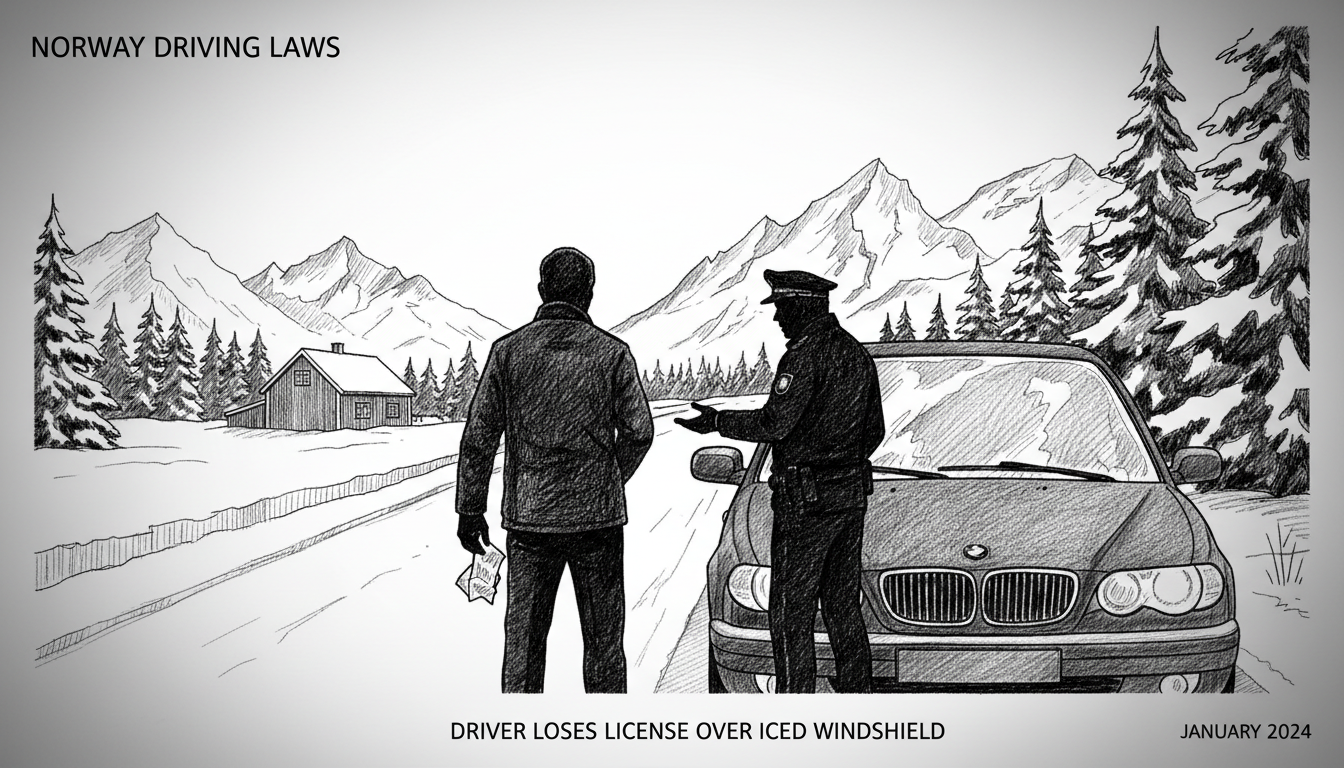
Norway driving laws carry strict penalties for winter safety violations. A driver in Oslo lost their license on Monday morning after police stopped their car with completely iced-over windows. The incident occurred in the Hauketo area during the morning commute. Officers noted the driver had insufficient visibility due to the frozen windshield and side windows. Police immediately confiscated the driver's license and filed a formal report on the matter.
Karl Otto Henly Bratt, an operations leader with the Oslo Police District, issued a clear reminder. "We stress the importance of scraping your windows well enough so you have a good view to the sides and forward," Bratt said in a statement. This routine traffic stop underscores a non-negotiable rule of Norwegian winter driving. Vehicle condition is the driver's sole responsibility.
The Legal Framework for Winter Driving
Norwegian road law leaves little room for interpretation. Section 3-1 of the Road Traffic Act places a firm duty on every driver. They must ensure their vehicle is in a safe and legal condition before setting off. This specifically includes guaranteeing full and adequate visibility. Driving with windows obscured by ice, snow, or fog is not a minor infraction. It is treated as a serious offense that endangers public safety.
The consequences are designed to be a strong deterrent. A driver caught with an iced windshield can face an on-the-spot fine. More significantly, police have the authority to suspend the driver's license immediately. In severe cases, or where an accident occurs, the driver may face criminal charges. The law operates on a principle of strict liability. A driver's claim of being "in a hurry" holds no legal weight.
Why a Small Patch of Ice is a Major Risk
Road safety experts explain the severe danger posed by even partial visibility loss. "A patch of ice the size of a dinner plate can create a blind spot large enough to hide a child, a cyclist, or the front corner of a car," explains a traffic safety consultant familiar with Nordic conditions. The morning and evening commutes during winter are particularly high-risk periods. Pedestrian traffic is high, and lighting conditions are often poor.
Driving with limited visibility drastically reduces reaction time. A pedestrian stepping out from behind a parked car can become invisible. A cyclist in a shoulder lane might disappear from view. The frozen windows also prevent the driver from making essential shoulder checks. This makes lane changes and turns significantly more hazardous. The Oslo police's action is a direct response to this measurable, preventable risk.
Police Enforcement and Public Messaging
The Oslo Police District conducts regular vehicle safety checks, especially during the winter months. These operations target not only visibility issues but also tire tread depth, lighting, and general vehicle roadworthiness. The goal is proactive prevention. "Our aim is not just to penalize, but to stop dangerous situations before they lead to tragedy," Bratt's statement implied. The public logging of this incident serves as a stark warning to all drivers.
Norwegian authorities run annual winter safety campaigns. They remind motorists to allocate extra time for morning vehicle preparation. The advice is comprehensive: clear all windows, mirrors, lights, and the roof of snow and ice. Driving with a small "porthole" scraped in the windshield is both illegal and profoundly dangerous. The message is consistent across driver's education, public service announcements, and enforcement actions.
A Cultural Expectation of Preparedness
This strict approach is rooted in a broader Nordic cultural attitude toward winter. Society expects individuals to be prepared and responsible for managing seasonal challenges. For drivers, this means having the proper equipment—a good ice scraper, possibly a winter-grade windshield washer fluid—and using it. There is little public sympathy for those who neglect these basic duties and then claim ignorance or inconvenience.
The law reflects this societal consensus. When every driver on the road faces the same winter conditions, adherence to safety rules becomes a collective social contract. One driver's shortcut can shatter multiple lives. The immediate license suspension in Oslo demonstrates the police's commitment to upholding this contract. It sends a clear message that no journey is so urgent it justifies compromising fundamental safety.
The Broader Impact of a Single Stop
While a single traffic stop might seem minor, its implications are wide. For the driver involved, it means a sudden loss of mobility, potential legal costs, and a mark on their record. For the community, it is a preventive action. It potentially stopped an accident from happening that morning on Hauketo's roads. For other motorists, it is a powerful, real-world reminder seen through local news and police social media channels.
These incidents also reinforce Norway's impressive road safety statistics. The country has one of the lowest rates of road fatalities in the world. This is not an accident. It is the result of rigorous laws, consistent enforcement, and a public that largely accepts these strict standards. The winter element adds a critical layer of risk, demanding even greater vigilance from both authorities and drivers.
Looking Beyond the Windshield
The incident also points to the importance of holistic winter readiness. A clear windshield is just the start. Experts urge drivers to check their vehicle's entire winter readiness profile. This includes ensuring tires have adequate tread depth for snow and ice, that all lights are functioning correctly, and that brakes are in good order. Winter driving in Norway is a skill that requires both the right equipment and the right mindset.
Technology offers some assistance, but not a solution. Heated windshields and defrost systems help, but they take time to work. They do not replace the need for manual scraping if a car has been parked overnight in freezing conditions. Relying solely on a car's heater to clear thick ice is often impractical and can lead to the exact scenario seen in Hauketo—a driver attempting to set off before visibility is fully restored.
A Final Warning as Winter Continues
As the winter season persists, Oslo police and their counterparts across Norway will continue these checks. The case from Monday morning is a template. It shows the procedure: stop, assess, and if the vehicle is unsafe, remove the driver from the road immediately. The law provides them with the tools to do so without hesitation.
The ultimate question for every driver is simple. Is saving five minutes in the morning worth losing your license, facing a fine, and potentially causing a life-altering accident? The Oslo police, through their decisive action, have answered that question for you. Their message is unambiguous: clear your windows completely, every time, no exceptions. The safety of everyone on the road depends on this basic act of responsibility.