
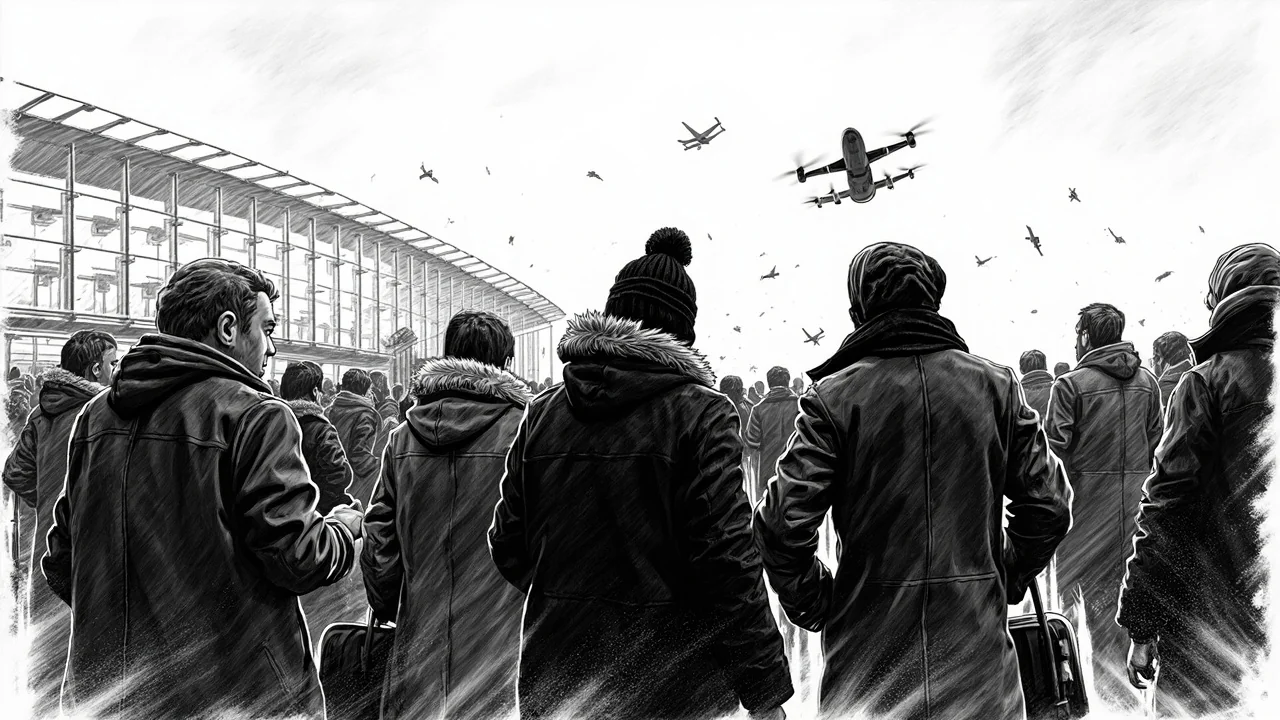
Norway's main aviation hub, Oslo Airport Gardermoen, faced a sudden closure of its eastern runway on Friday following a confirmed drone sighting. The incident, which police are now investigating as a potential criminal act, caused immediate delays and rerouted air traffic for several hours during a busy afternoon period. Airport operator Avinor detected the unmanned aircraft within the restricted airspace at approximately 14:00 local time, triggering a standard safety protocol. All inbound and outbound flights were immediately directed to the airport's western runway, creating a bottleneck in operations. "It has been a period of high traffic, and the drone will likely lead to minor delays for some flights," said Avinor press officer Karoline Pedersen in a statement. Authorities confirmed they are actively searching for the drone's operator, with police operations leader Rune Isaksen logging the case as a priority investigation. This marks at least the third major drone disruption at Norwegian critical infrastructure in the past 18 months, reviving serious concerns over national aviation and energy security.
A Recurring Threat to Airspace
Drone intrusions at Gardermoen are not isolated events. In December 2022, a similar incident caused significant flight cancellations and delays, stranding thousands of passengers. The frequency of these breaches highlights a persistent vulnerability in Norway's air defense perimeter. Oslo Airport operates with two parallel runways; the closure of one effectively halves its capacity. During peak travel times, such as Friday afternoons, this forces air traffic controllers to implement strict flow management. Flights are held at departure gates or placed in holding patterns, creating a cascade of delays across European and domestic networks. The immediate economic cost is measured in tens of thousands of euros per minute in extra fuel burn, crew overtime, and passenger compensation. The longer-term reputational damage to Norway's famously efficient transport infrastructure is harder to quantify.
The Broader Security Implications
For a nation heavily reliant on secure air corridors for its offshore oil and gas industry, sovereign surveillance, and Arctic mobility, drone threats are a strategic concern. Norway's vast geography and long coastline make complete monitoring nearly impossible with traditional radar. The drones involved in these disruptions are often commercially available models, easily modified to fly beyond visual line of sight. Their small size and low altitude allow them to evade conventional detection systems until they are dangerously close to critical assets. "This isn't just about annoying delays for holidaymakers," says Lars Klev, an independent aviation security analyst based in Bodo. "Gardermoen is a dual-use facility, handling both civilian and military logistics. A drone could be a prelude to something more sinister, or simply a reckless act with catastrophic potential. The intent is almost secondary to the consequence of a collision." The Norwegian Civil Aviation Authority has repeatedly tightened regulations, but enforcement against anonymous, single-use pilots remains extremely difficult.
Legal Framework and Enforcement Challenges
Norwegian law explicitly prohibits drone flights near airports, with a general ban on all drone activity within a five-kilometer radius of Gardermoen's perimeter. Violators face severe penalties, including substantial fines and potential imprisonment for endangering public safety. However, identifying and prosecuting offenders is the core challenge. Police must locate the pilot on the ground, often in a moving vehicle or concealed position, before the drone is recovered or flown away. The technology for remote identification of drones, which would broadcast a registration code, is still not universally mandated or implemented. This investigative hurdle turns most drone incidents into frustrating dead-ends for law enforcement, emboldening future violations. The Øst Police District, responsible for the Gardermoen area, has dedicated resources to the case, but the success rate for solving such crimes remains low.
Industry Response and Technological Arms Race
Avinor and the Norwegian Armed Forces are engaged in a continuous technological battle. The airport operator has invested in layered detection systems including specialized radar, radio frequency scanners, and optical sensors. The goal is to identify a drone intrusion at the maximum possible range to allow for a coordinated response. The preferred non-kinetic method is to jam the radio signal between the pilot and the drone, forcing it into an automatic landing or return-to-home procedure. More advanced military-grade counter-drone systems exist but are costly and can cause disruptive interference with legitimate communications. The industry is also pushing for 'geofencing'—software in the drones themselves that prevents them from entering coordinates of restricted zones—though this can be hacked or disabled on some models. Every incident provides new data, but the adaptive nature of the threat means defenses are always playing catch-up.
A Call for Coordinated National Policy
This latest disruption will inevitably lead to renewed calls in the Storting for a comprehensive national counter-drone strategy. The issue straddles the responsibilities of the Ministry of Justice and Public Security, the Ministry of Transport, and the Ministry of Defence. A fragmented approach, critics argue, leaves gaps that determined or negligent pilots can exploit. Proposals have included a national drone registry linked to real-time identification, stricter point-of-sale controls on high-performance drones, and increased funding for police drone investigation units. With Norway's role as a guardian of NATO's northern flank and a global energy supplier, the security of its aerial approaches is of international interest. A drone causing a fatal accident at Gardermoen would not be a national tragedy alone; it would be a geopolitical event.
The runway has reopened, and schedules are slowly normalizing. But the unanswered question lingers in the control tower and the halls of government: Who was at the controls, and when will they strike again? The search for the pilot continues, even as Norway searches for a lasting solution to a threat that is small in size but vast in its potential for disruption.