
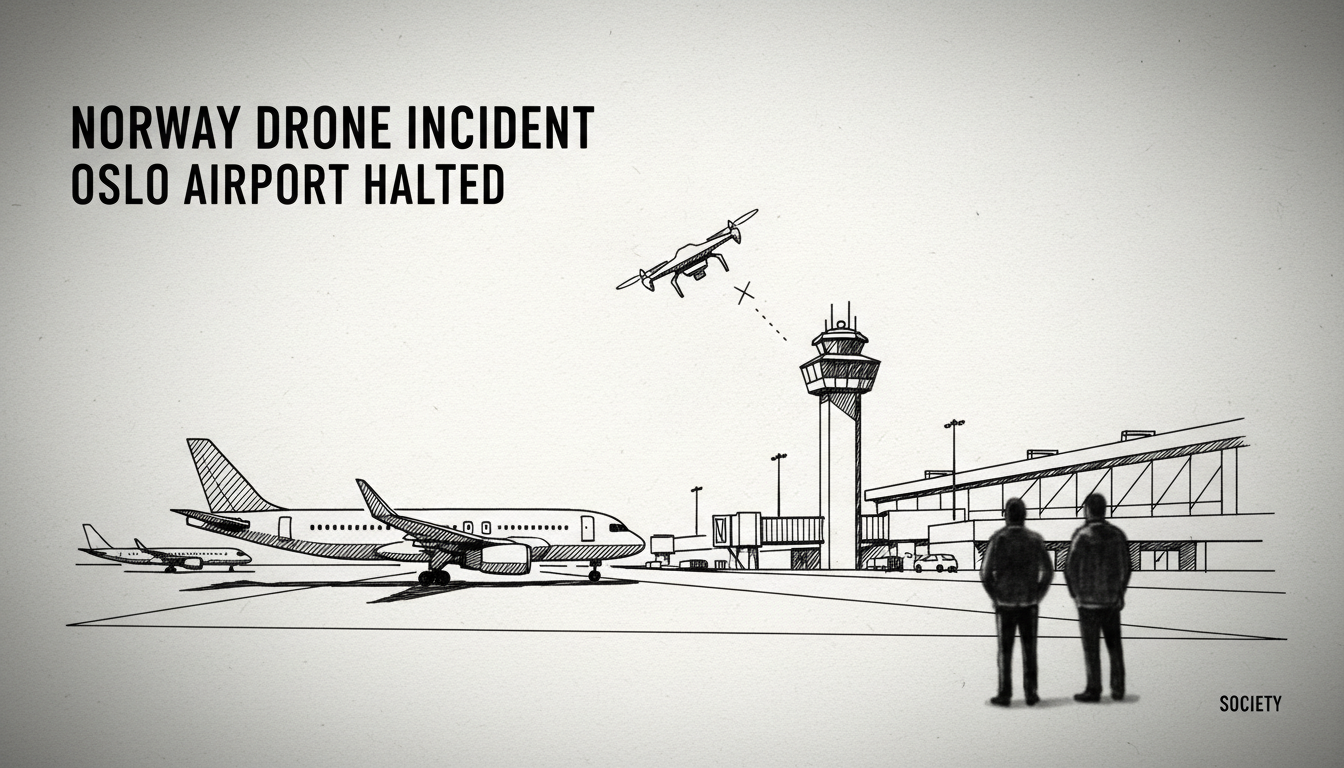
Norway's main international airport faced a critical security breach when an unauthorized drone halted two aircraft. Police are now in contact with a drone pilot near Oslo Airport Gardermoen, according to operations manager Rune Isaksen. The incident, which occurred on Thursday, forced airport authorities to pause arrivals or departures, creating immediate safety concerns and operational delays. This event highlights the persistent vulnerability of major transport hubs to drone incursions, despite strict national regulations.
A Critical Breach at Norway's Aviation Hub
Oslo Airport Gardermoen, located 35 kilometers northeast of the capital, is the nation's primary gateway. It handled approximately 25 million passengers in 2023, making it one of the busiest airports in the Nordic region. Any disruption here sends ripples through both domestic and international travel networks. The halted flights represent more than an inconvenience; they signify a direct threat to aviation safety. A collision between a drone and a commercial aircraft, particularly during takeoff or landing, could have catastrophic consequences.
Norwegian law is unequivocal on this point. The general permissible distance for drone flying from airports is five kilometers. This perimeter is designed to create a buffer zone where no unauthorized unmanned aircraft should operate. Violations can result in significant fines and, in severe cases, imprisonment. The swift police response to identify and contact the pilot underscores the seriousness with which authorities treat such breaches. The incident did not escalate to a full-scale shutdown, but it triggered the airport's security protocols.
The Growing Global Threat of Rogue Drones
This is not an isolated event in Norway or globally. Airports worldwide have grappled with the challenge of detecting and mitigating unauthorized drone activity. The problem stems from the accessibility of drone technology. Consumer-grade drones are inexpensive, readily available, and capable of flying into restricted airspace with relative ease. While most pilots operate responsibly, a single negligent or malicious actor can endanger hundreds of lives and disrupt travel for thousands.
Aviation safety experts consistently warn that public awareness has not kept pace with technological proliferation. Many drone owners may not fully comprehend the regulations or the profound risk their hobby poses near flight paths. "The airspace around an airport is a meticulously managed environment," said a senior aviation security analyst, who requested anonymity due to their ongoing work with authorities. "An unauthorized drone is an uncontrolled variable. It's like a pedestrian wandering onto a Formula 1 track. The potential for disaster is immense, even if the intent was harmless."
The economic impact is also substantial. Halting flights causes immediate financial losses for airlines through wasted fuel, disrupted crew schedules, and missed connections. It creates cascading delays across networks and erodes passenger confidence. For an airport like Gardermoen, which functions as a critical node for travel to Northern Norway and the Arctic, such disruptions can isolate remote communities reliant on air links.
Norway's Regulatory Framework and Enforcement Challenges
Norway has positioned itself as having robust drone regulations. The Norwegian Civil Aviation Authority clearly delineates no-fly zones, which include areas around all airports, prisons, and major public events. Pilots must use official apps to check flight restrictions before operating. Drones over a certain weight must be registered. The rules are clear, but enforcement remains a complex, real-time challenge.
Police and airport security cannot monitor every kilometer of airspace visually. Detection systems are deployed, but they are expensive and not infallible. The incident at Gardermoen suggests the drone was detected, likely by pilot reports or airport radar systems, prompting the swift intervention. The fact that police made contact with the pilot indicates they were able to locate the operator, which is not always possible if a drone is flown beyond visual line of sight.
This gap between regulation and real-world enforcement is the central dilemma. The consequences for violators, while legally significant, are primarily punitive after the fact. The priority during an incident is ending the threat, not assigning blame. This creates a deterrent that some irresponsible operators may discount until it is too late.
Technological Arms Race and Future Solutions
The response to drone incursions is evolving into a technological arms race. Airports and security forces are investing in advanced systems to detect, track, and neutralize rogue drones. These can include radio frequency scanners to identify drone controller signals, sophisticated radar, and even counter-drone technology that can jam signals or capture intruding drones with nets. However, deploying such systems in a way that does not interfere with legitimate airport communications and navigation equipment is a significant technical hurdle.
A multi-pronged approach is emerging as the most viable path forward. It combines stricter point-of-sale education, mandatory geofencing software in drones that physically prevents them from entering restricted zones, and continued investment in detection infrastructure. Public awareness campaigns are crucial. Many citizens may not realize that flying a drone near an airport is not just a minor infraction but a grave threat to public safety.
For Norway, with its vast geography and numerous regional airports, the challenge is magnified. Securing Gardermoen is one task; protecting smaller airfields across the country is another. The principles, however, remain the same: clear regulations, effective enforcement, and continuous public education.
A Wake-Up Call for Responsible Innovation
The Gardermoen incident serves as another wake-up call. As drone technology advances, finding applications in logistics, photography, and infrastructure inspection, the potential for conflict in shared airspace grows. The industry must prioritize safety-by-design. Manufacturers bear a responsibility to build safeguards into their products that prevent reckless use near critical infrastructure.
Norway's government and aviation authorities will likely review this event. Questions will be asked about whether detection systems performed optimally and if response protocols were followed effectively. Each incident provides data to strengthen defenses. The goal is not to stifle the beneficial use of drones but to ensure their integration into society does not come at the cost of aviation safety.
The two flights that were halted have likely continued on their journeys. The passengers may never know how close they came to potential danger. That is the nature of successful risk mitigation—it is invisible. The true measure of success will be a future where such security breaches become vanishingly rare, not just at Gardermoen, but at every airport where the hum of jet engines must never be interrupted by the buzz of a rogue drone.