
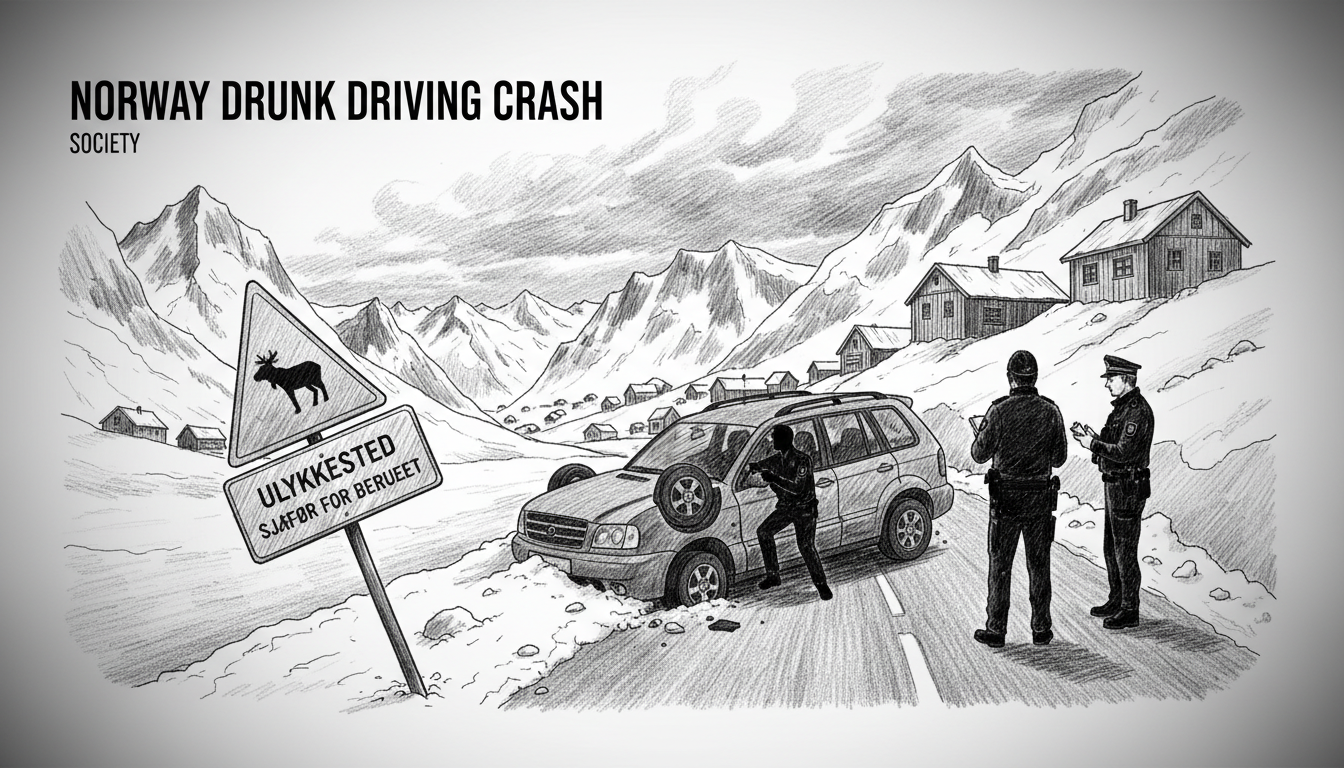
Norway's strict drunk driving laws faced a stark real-world test early Thursday when a high-speed single-vehicle crash on the E6 highway sent four intoxicated individuals to hospital. The driver was reported to be too impaired by alcohol for police questioning following the accident in Steinkjer, which left the car severely damaged and two lampposts demolished. This incident underscores the persistent challenge of impaired driving even in a nation with some of Europe's toughest penalties and a legal blood alcohol limit of just 0.02%.
A Crash in the Early Hours
Police were called to the E6 in Steinkjer in Trøndelag county during the night. The force of the collision indicated the vehicle had been traveling at significant speed, according to operations leader Marie Fossen. "There is major material damage to the car and two lampposts have been knocked down. It is assumed the car had quite high speed prior to the accident," Fossen said in a statement. All four occupants of the car showed clear signs of intoxication at the scene. The driver's impairment was so severe that authorities could not conduct an immediate interview. Two people were transported to the emergency clinic in Steinkjer, while two others required further treatment at Levanger Hospital.
The Strictest Regime in Europe
This crash occurs within a legal framework designed to deter such behavior aggressively. Norway's permissible blood alcohol concentration (BAC) of 0.02% is among the lowest in the world, effectively meaning a single drink can put a driver over the limit. Penalties escalate sharply: a BAC between 0.02% and 0.05% typically brings a hefty fine and a minimum one-year license suspension. For levels above 0.05%, imprisonment becomes a likely outcome, especially if aggravated circumstances like high speed or an accident are present. In this Steinkjer case, with an accident causing injury, the driver faces serious criminal charges. Police have already seized the driver's license and initiated a criminal case.
"The system is built on zero tolerance, both in law and in societal attitude," says a legal expert familiar with Norwegian traffic law. "The immediate license seizure is standard. The inability to question the driver due to intoxication is not uncommon in severe cases, but it highlights a profound level of impairment that jeopardized everyone in that vehicle." The expert noted that the courts will ultimately determine the penalty, but with injured parties and property damage, a custodial sentence is a distinct possibility.
A Persistent Problem Despite Progress
Statistics reveal the nuanced reality of drunk driving in Norway. While overall traffic fatalities have declined dramatically over decades, alcohol remains a stubborn factor. In 2022, it was a contributing element in roughly 10% of all fatal road accidents. This figure, while lower than many countries, represents an absolute failure of judgment that Norwegian authorities continue to combat through enforcement and public campaigns. The Norwegian Road Administration runs regular awareness initiatives, emphasizing the devastating consequences beyond legal penalties—the loss of life, lifelong injury, and profound personal guilt.
The E6, where this crash occurred, is Norway's main arterial road, running from the Swedish border in the south to Kirkenes in the far north. It traverses long, often dark, and sometimes challenging stretches through regions like Trøndelag. Driving demands full attention and sobriety. Accidents involving impairment on such a critical route risk causing multi-vehicle pile-ups and major disruptions, magnifying the potential danger posed by one driver's decision.
Societal Cost and Personal Responsibility
Beyond the legal process, crashes like this impose a significant burden on public services. The emergency response from police, fire, and medical personnel represents a substantial allocation of resources. The hospitalizations at two different medical facilities indicate the strain on the regional health system. The material damage to public infrastructure—the lampposts—will be repaired at public expense, though these costs are often later claimed from the responsible driver.
Norwegian society generally exhibits low tolerance for drunk driving, viewing it as a severe breach of social contract. The cultural shift over the past 40 years has been significant, moving from relative acceptance to near-universal condemnation. Peer pressure often works against getting behind the wheel after drinking, with designated drivers and taxis being standard practice. This makes incidents where four adults are all in an intoxicated state in a single vehicle particularly notable and concerning for road safety advocates.
Beyond the Breathalyzer: Technology and Enforcement
Looking forward, the debate in Norway, as in many nations, is turning toward technology as a final barrier. Some analysts advocate for the wider use of alcohol interlock devices, especially for repeat offenders or as part of rehabilitation programs. These devices require a sober breath sample before the vehicle will start. Others point to the need for continued random checkpoint enforcement, which serves as both a detection method and a visible deterrent.
The Steinkjer case will proceed through the judicial system in the coming months. The driver, once sober and legally represented, will provide a statement. The police investigation will reconstruct the crash, likely obtaining blood test results to confirm the exact level of intoxication. The injured passengers will recover, physically at least. Yet the incident leaves behind a clear, damaging mark: a reminder that laws, however strict, cannot control the initial decision to drive impaired. That choice remains a human one, with consequences that ripple far beyond a wrecked car on the E6.
As Norway continues its vision zero quest to eliminate road fatalities, individual accountability remains the most critical, and most fragile, component. The question for authorities is whether the current draconian penalties are the ultimate solution, or if further preventative social and technological measures are needed to stop drivers before they ever turn the key.