
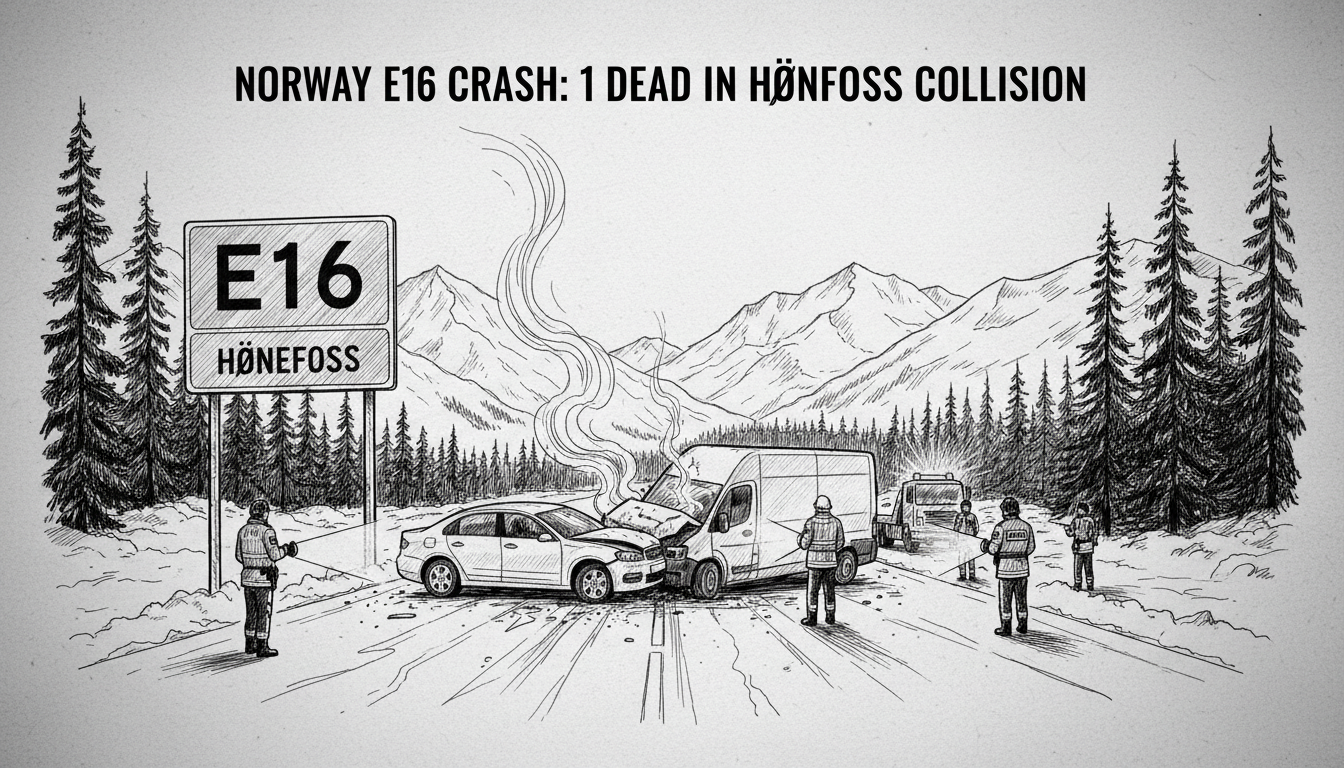
Norway's E16 highway was the scene of a fatal collision Thursday morning, claiming the life of a local man in his thirties. The crash occurred just south of Hønefoss center in Ringerike, where a passenger car and a heavy goods vehicle collided head-on. Emergency services responded to the scene, but the driver of the car, a man from the Ringerike municipality, was pronounced dead. The truck driver emerged physically unharmed.
Police have closed a section of the vital E16 route, a major artery connecting Oslo to Bergen, for a prolonged investigation. Initial reports from the police indicate the passenger car crossed into the oncoming lane. "It looks like the passenger car has come over into the oncoming lane," said police operations leader Tom Richard Jansen. The accident happened in an 80 km/h zone, and authorities reported the road surface was not generally icy at the time.
A Community in Mourning
The death marks a tragic loss for the Ringerike community, a municipality northwest of Oslo known for its mix of industry, agriculture, and natural beauty along the Tyrifjorden lake. While the victim's identity has not been publicly released pending notification of family, the confirmation that he was a local man in his 30s has sent ripples through the area. Such incidents starkly remind residents of the inherent risks on roads they travel daily, transforming a routine morning commute into a site of profound tragedy. The psychological impact on the truck driver, first responders, and witnesses is also a significant, though less visible, consequence of the crash.
The Investigation Begins
Determining the precise cause will be a meticulous process led by specialized teams. Accident investigators from the Norwegian Public Roads Administration (Statens vegvesen) and police forensic technicians are conducting a detailed scene examination. "It is too early to say anything about the cause. We are working with technical examinations on site and are in the initial phase of the investigation. We can therefore not conclude anything," Operations Leader Jansen stated. Their work will involve analyzing skid marks, vehicle positions, and debris patterns. They will also scrutinize the mechanical condition of both vehicles, including braking systems and tires.
A critical part of the investigation will be to understand why the car entered the opposite lane. Investigators will consider multiple factors: driver fatigue, a possible medical episode, distraction, or an evasive maneuver to avoid something on the road. The absence of reported ice does not eliminate other weather or visibility factors. The final report, which can take weeks or months, will aim to provide a definitive sequence of events.
Traffic Chaos on a Critical Corridor
The immediate practical impact of the crash was severe traffic disruption during the morning rush hour. The E16 is a backbone for regional and long-distance travel, and its closure created significant bottlenecks. Although detours were signposted, the alternative routes through Hønefoss and surrounding areas were quickly overwhelmed. "The queue is increasing now as people are heading to work," said traffic operator Fabian Vesteng at the Road Traffic Center. The closure, expected to last much of the day, affected commercial freight, public transport, and hundreds of commuters, underscoring the economic and logistical dependency on this single transport route.
Local businesses reliant on timely deliveries faced delays, and the incident highlights the vulnerability of Norway's transport network, where key highways like the E16 often have limited parallel alternatives, especially in more rural sections. The police's decision to keep the road closed for a "good while" reflects the priority given to a thorough investigation over traffic flow, a balance authorities must constantly manage.
Norway's Road Safety in Context
This fatal accident occurs against the backdrop of Norway's generally strong road safety record. The country has consistently been one of the safest in the world for road users, thanks to decades of investment in infrastructure, strict enforcement of traffic laws, and high vehicle safety standards. Preliminary figures for 2022 recorded 116 traffic fatalities in Norway, a historically low number for a country of its size and challenging geography. In the same year, 544 people were seriously injured in road traffic accidents.
However, statistics offer little solace in the face of individual loss. Each fatality represents a policy failure on the path toward "Vision Zero," the ethical principle that no loss of life on the roads is acceptable. While single-vehicle accidents and incidents at intersections are common, head-on collisions on high-speed roads like the E16 are particularly deadly due to the combined force of impact. They often prompt urgent reviews of specific road segments.
The Path Forward: From Investigation to Prevention
The work of the Statens vegvesen investigators extends beyond determining blame. Their analysis is fundamentally about prevention. The findings from this crash on E16 near Hønefoss will feed into a continuous safety assessment of Norway's road network. Experts will examine if any engineering improvements could reduce the risk of similar events. This could include evaluating the need for a median barrier—a concrete or wire-rope system that physically prevents vehicles from crossing into oncoming traffic—on this section of road.
Other potential measures include enhanced signage, rumble strips to alert drifting drivers, or adjustments to speed limits based on a revised risk assessment. The investigation may also influence broader national campaigns focused on driver awareness, fatigue management, or the dangers of distraction. The ultimate goal is to translate tragic events into actionable data that saves future lives.
A Harsh Reminder on a Routine Morning
The collision on E16 is a stark interruption to the ordinary rhythm of life in Ringerike. It transforms a familiar stretch of asphalt into a place of memory and sorrow. For the family and friends of the deceased man, the journey ahead is one of grief. For authorities, the task is one of meticulous reconstruction and analysis. For the community and regular users of the E16, it is a sobering reminder of the thin margin between a normal journey and catastrophe.
As the investigation continues quietly behind police tape, the broader questions linger: Could this have been prevented? What systemic lessons can be learned? The answers, when they come, will be critical for honoring the life lost and for ensuring Norway's roads move closer to the ultimate goal of zero fatalities. The true test of the system is not just in responding to tragedy, but in effectively learning from it.